 हिंदी खबर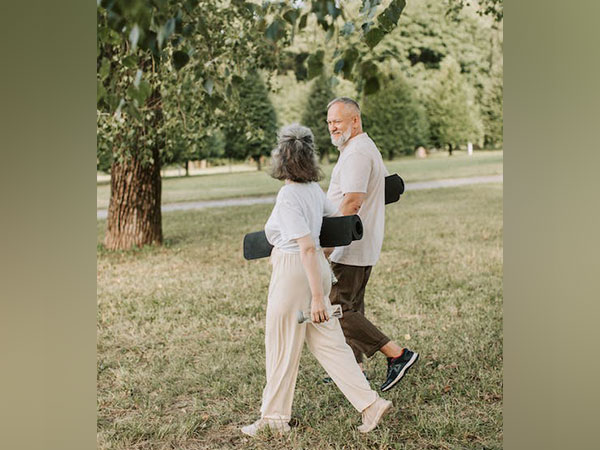

Washington [US], October 1 (ANI): According to a recent study, boosting daily exercise by 3,000 steps may significantly decrease elderly people's high blood pressure.
Pescatello collaborated with Elizabeth Lefferts, the lead author of the study, and other members of Duck-Chun Lee's lab at Iowa State University.
The Journal of Cardiovascular Development and Disease reported the findings.
“We’ll all get high blood pressure if we live long enough, at least in this country,” Pescatello said. “That’s how prevalent it is.”
Pescatello is an expert on hypertension (the clinical term for high blood pressure) and exercise. Her previous research has demonstrated that exercise can have a significant immediate and long-lasting impact on lowering blood pressure in hypertensive adults.
This study sought to determine if older adults with hypertension could receive these benefits by moderately increasing their daily walking, which is one of the easiest and most popular forms of physical activity for this population.
“It’s easy to do, they don’t need any equipment, they can do it anywhere at almost any time,” Lee said.
The study focused on a group of sedentary older adults between ages 68 and 78 who walked an average of about 4,000 steps per day before the study.
After consulting existing studies, Lee determined that 3,000 steps would be a reasonable goal. This would also put most participants at 7,000 daily steps, in line with the American College of Sports Medicine’s recommendation.
“3,000 steps is large enough but not too challenging to achieve for health benefits,” Lee said.
The team conducted the study during the height of the COVID-19 pandemic, which meant they had to do everything remotely.
The researchers sent participants a kit with pedometers, blood pressure monitors, and step diaries for participants to log how much they were walking each day.
On average, participants’ systolic and diastolic blood pressure decreased by an average of seven and four points, respectively, after the intervention.
“It’s exciting that a simple lifestyle intervention can be just as effective as structured exercise and some medications,” Lefferts said.
The findings suggest that the 7,000-step regimen the participants in the study achieved is on-par with reductions seen with anti-hypertensive medications. Eight of the 21 participants were already on anti-hypertensive medications. Those participants still saw improvements in systolic blood pressure from increasing their daily activity.
“In a previous study, we found that when exercise is combined with medication, exercise bolsters the effects of blood pressure medication alone,” Pescatello said. “It just speaks to the value of exercise as anti-hypertensive therapy. It’s not to negate the effects of medication at all, but it’s part of the treatment arsenal.”
The researchers found that walking speed and walking in continuous bouts did not matter as much as simply increasing total steps.
“We saw that the volume of physical activity is what’s really important here, not the intensity,” Pescatello said.
“Using the volume as a target, whatever fits in and whatever works convey health benefits.” (ANI)




