Study shows that six-feet social distancing may not be enough
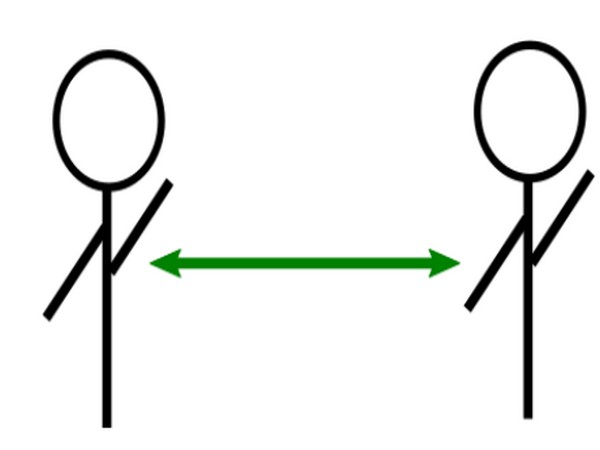
Washington D.C. [USA], May 23 (ANI): The current social distancing guideline of 6 feet maybe insufficient according to a recent study as saliva droplets can travel 18 feet in five seconds at low wind speeds.
ANI
May 23, 2020 15:18 IST

Washington D.C. [USA], May 23 (ANI): The current social distancing guideline of 6 feet maybe insufficient according to a recent study as saliva droplets can travel 18 feet in five seconds at low wind speeds.
Airborne transmission of viruses, like the virus causing COVID-19, is not well understood, but a good baseline for the study is a deeper understanding of how particles travel through the air when people cough.
In a paper published in Physics of Fluids, from AIP Publishing, Talib Dbouk and Dimitris Drikakis discovered that a mild cough occurring in low wind speeds of 4-15 kph can propel saliva droplets 18 feet.
"The droplet cloud will affect both adults and children of different heights. Shorter adults and children could be at higher risk if they are located within the trajectory of the travelling saliva droplets." Drikakis said.
Saliva is a complex fluid, and it travels suspended in the bulk of surrounding air released by a cough. Many factors affect how saliva droplets travel, including the size and number of droplets, how they interact with one another and the surrounding air as they disperse and evaporate, how heat and mass are transferred, and the humidity and temperature of the surrounding air.
To study how saliva moves through the air, Dbouk and Drikakis created a computational fluid dynamics simulation that examines the state of every saliva droplet moving through the air in front of a coughing person. Their simulation considered the effects of humidity, dispersion forces, interactions of molecules of saliva and air, and how the droplets change from liquid to vapour and evaporate.
The computational domain in the simulation is a grid representing the space in front of a coughing person. The analysis involved running partial differential equations on 1,008 saliva droplets and solving approximately 3.7 million equations in total.
"Each cell holds information about variables like pressure, fluid velocity, temperature, droplet mass, droplet position, etc.," Dbouk said.
"The purpose of the mathematical modelling and simulation is to take into account all the real coupling or interaction mechanisms that may take place between the main bulk fluid flow and the saliva droplets, and between the saliva droplets themselves," Dbouk added.
Further studies are needed to determine the effect of ground surface temperature on the behaviour of saliva in air and to examine indoor environments, where air conditioning significantly affects the particle movement through the air.
"This work is vital, because it concerns health and safety distance guidelines, advances the understanding of spreading and transmission of airborne diseases, and helps form precautionary measures based on scientific results," said Drikakis. (ANI)
Get the App