 हिंदी खबर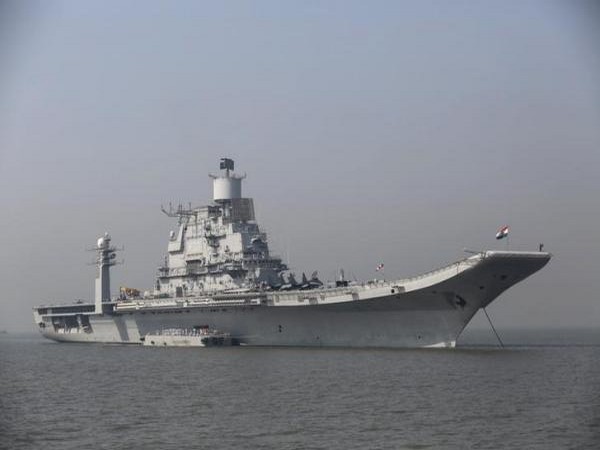

Washington [US], February 28 (ANI): At present, India has two aircraft carriers - INS Vikramaditya and INS Viraat, while it is planning to develop the third - INS Vishaal by 2030. The question arises why is India developing a fleet of aircraft carriers?
Robert Farley, writing for The National Interest - American bimonthly international affairs magazine, wrote that the rationale behind India's carrier force development has three reasons.
The first is the support of a conventional war against Pakistan, which would involve strikes against Pakistani naval assets and land bases.
Second, the carriers make the Indian Navy the preeminent force in the Indian Ocean, better able to command the area than any foreign competitor.
The third prong involves geopolitical competition with China.
Regarding Pakistan, Vikrant and Vikramaditya would struggle in strike operations because of limitations on aircraft weight, although they certainly would attract Pakistani attention. Meanwhile, the Indian Navy being the preeminent force in the Indian Ocean, Indian carriers will always have better access to bases and support facilities in the Indian Ocean than China, the United Kingdom, or even the United States, and the presence of the carriers facilitates the projection of Indian power and the management of trade protection.
The third and main reason, competition with China - Beijing has managed to leapfrog Indian naval aviation development in a relatively short period of time. Although China lacks India's experience with carriers, it boasts a remarkably efficient shipbuilding industry and an increasingly sophisticated aviation sector, making it less dependent on foreign technology. Although India may struggle to keep up with Chinese construction, it can leverage geography (proximity to bases) to its advantage in the most likely areas of any conflict, reported The National Interest.
Despite considerable economic challenges, India took carrier aviation very seriously in the years after independence. Unlike China (or even the Soviet Union), India focused on carriers instead of submarines.
INS Vikrant, a Majestic-class light carrier, served from 1961 until 1997, fighting effectively in the 1971 war. INS Viraat, formerly the Centaur-class carrier HMS Hermes, joined the Indian Navy in 1987 and served until 2016.
The operational INS Vikramaditya, former Kiev-class warship Admiral Gorshkov, was inducted into service in 2014. The 45,000-ton INS Vikramaditya could operate around twenty MiG-29K fighters, along with utility helicopters.
The ship offered the Indian Navy the chance to redevelop its aviation muscles after years of operating only VSTOL (vertical and/or short take-off and landing) aircraft from Viraat.
Vikramaditya was only the first step towards recapitalizing the aviation wing of the Indian Navy. The second step was the new INS Vikrant, a 40,000-ton ski-jump carrier built in India's Cochin Shipyard. Laid down in 2009, Vikrant is expected to finally enter service around 2020, with an air wing similar to that of Vikramaditya, reported The National Interest.
For the time being, India has decided to stick with the MiG-29K as its primary naval combat aircraft, rather than the Su-33, the F/A-18, or the Dassault Rafale. Both Boeing and Dassault remain at least somewhat hopeful of exporting carrier-borne fighters to India. Even Saab expressed an interest in converting the Gripen for naval service. The Indian Navy also contemplated developing a navalised version of the HAL Tejas, but (for now) has wisely rejected the complicated effort to convert the troubled fighter, wrote Robert Farley.
With one large carrier in service and another on the way, India has become one of the world's pre-eminent naval aviation powers.
India has committed to carrier aviation and has the resources and experience to develop a successful force.
The next step in India's naval aviation project will be INS Vishaal, a 65,000-ton conventionally propelled, domestically produced CATOBAR (Catapult Assisted Take-Off But Arrested Recovery) carrier. With experience gleaned from the experience with Vikrant, the design and construction of the carrier will hopefully go more smoothly.
It appears as if India will have unprecedented access to US technology for the construction of Vishaal, including the EMALS electromagnetic catapult system used on the Gerald R Ford class. Unlike Vikrant or Vikramaditya, Vishaal will be able to launch and recover heavy strike aircraft, as well as early warning planes such as the E-2 Hawkeye. Vishaal is supposed to enter service by 2030, although that timeline may be optimistic, said Robert Farley. (ANI)




