

ADD ANI AS A TRUSTED SOURCE
googleads
Menu
Science

South African, US astronomers use MeerKAT to solve mystery of 'X-Galaxies'

Washington D.C. [USA], May 7 (ANI): A team of astronomers from South Africa and the US has used the MeerKAT telescope to solve a longstanding puzzle in 'X'-shaped radio galaxies.

ANI May 07, 2020 23:00 IST googleads

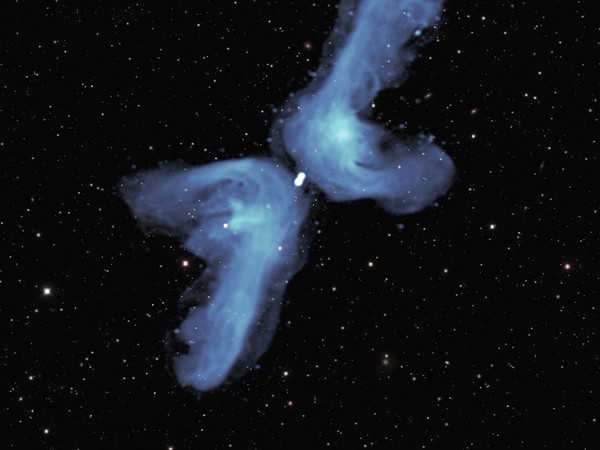
A team of astronomers from South Africa and the US has used the MeerKAT telescope to solve a longstanding puzzle in 'X'-shaped radio galaxies (Image courtesy: NRAO/AUI/NSF; SARAO; DES)

Washington D.C. [USA], May 7 (ANI): A team of astronomers from South Africa and the US has used the MeerKAT telescope to solve a longstanding puzzle in 'X'-shaped radio galaxies.
Many galaxies far more active than the Milky Way have enormous twin jets of radio waves extending far into intergalactic space.
Normally these go in opposite directions, coming from a massive black hole at the center of the galaxy. However, a few are more complicated and appear to have four jets forming an 'X' on the sky.
Several possible explanations have been proposed to understand this phenomenon. These include changes in the direction of spin of the black hole at the center of the galaxy, and associated jets, over millions of years; two black holes each associated with a pair of jets; and material falling back into the galaxy being deflected into different directions forming the other two arms of the 'X'.
Exquisite new MeerKAT observations of one such galaxy, PKS 2014-55, strongly favour the latter explanation as they show material "turning the corner" as it flows back towards the host galaxy; the results have just been accepted for publication in the journal Monthly Notices of the Royal Astronomical Society.
This work was carried out by a team from the South African Radio Astronomy Observatory (SARAO), the (US) National Radio Astronomy Observatory (NRAO), the University of Pretoria, and Rhodes University.
Previous studies of these unusual galaxies lacked the high-quality imaging provided by the recently completed MeerKAT telescope.
This telescope array consists of 64 radio dishes located in the Karoo semi-desert in the Northern Cape province of South Africa.
Computers combined the data from these antennas into a telescope 8 km in diameter and provided images in the radio band of unprecedented quality for PKS 2014-55 which enabled solving the mystery of its shape.
Bernie Fanaroff, former director of the SKA South Africa project that built MeerKAT, and a co-author of the study, noted that "MeerKAT was designed to be the best of its kind in the world. It's wonderful to see how its unique capabilities are contributing to resolving longstanding questions related to the evolution of galaxies."
Lead author William Cotton of the NRAO said that "MeerKAT is one of a new generation of instruments whose power solves old puzzles even as it finds new ones -- this galaxy shows features never are seen before in this detail which are not fully understood." Further research into these open questions is already underway. (ANI)


Get the App

What to Read Next

Science

Large, small galaxies may grow in ways more similar

 Large, small galaxies may grow in ways more similar

A team of astronomers led by University of Arizona researcher Catherine Fielder captured the most precise photographs of a small galaxy and its surroundings, revealing features typically found in much larger galaxies.

Read More
Science

Fossil study finds how sea level changes shaped early life

Fossil study finds how sea level changes shaped early life

A newly developed timeline of early animal fossils suggests a relationship between sea level fluctuations, variations in marine oxygen, and the appearance of the earliest ancestors of present-day animals.

Read More
Science

Researchers finds hidden threats with advanced x-ray imaging

 Researchers finds hidden threats with advanced x-ray imaging

To produce multi-contrast images that may be utilized in thousands of complex scenarios to identify potentially threatening materials like explosives, researchers have integrated multiple x-ray imaging methods. Security screening and applications in the biological and physical sciences may benefit from the new method, which also makes use of easily accessible machine learning processes for materials classification.

Read More
Science

ISRO successfully tests fuel cell on PSLV-C58's orbital platform

ISRO successfully tests fuel cell on PSLV-C58's orbital platform

ISRO took to the social media platform X and posted, "POEM-3 on PSLV-C58: VSSC/ISRO successfully tests a 100 W class Polymer Electrolyte Membrane Fuel Cell on PSLV-C58's orbital platform, POEM3. https://isro.gov.in/FuelCellFlightTestedPSLVC58.html... Powering missions with efficiency and emitting only water, these fuel cells are the future for power production in space habitats".

Read More
Science

Researchers give more insight into development of lupus in female

Researchers give more insight into development of lupus in female

For many years, healthcare professionals have known that lupus, an autoimmune disease, affects women nine times more than males. Some of the variables that contribute to the disease's high incidence in women have remained unknown, but Johns Hopkins Medicine researchers have found answers in a new study exploring immune system mechanisms in lupus and the X chromosome.

Read More
Home About Us Our Products Advertise Contact Us Terms & Condition Privacy Policy

Copyright © aninews.in | All Rights Reserved.
