

ADD ANI AS A TRUSTED SOURCE
googleads
ANI Logo
Menu
Science

Researchers finds hidden threats with advanced x-ray imaging

To produce multi-contrast images that may be utilized in thousands of complex scenarios to identify potentially threatening materials like explosives, researchers have integrated multiple x-ray imaging methods. Security screening and applications in the biological and physical sciences may benefit from the new method, which also makes use of easily accessible machine learning processes for materials classification.

ANI May 23, 2024 23:20 IST googleads

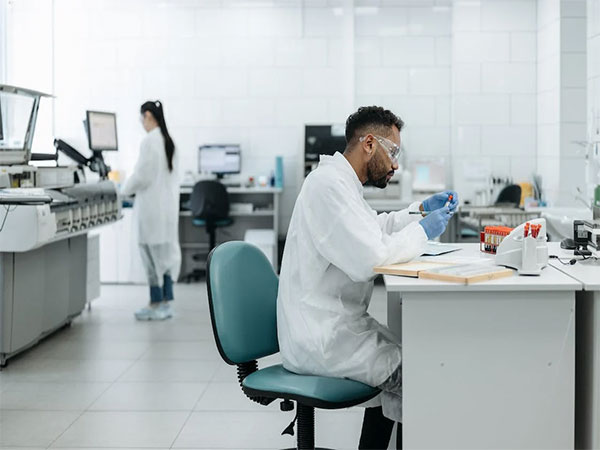
Representative Image

Washington [US], May 23 (ANI): To produce multi-contrast images that may be utilized in thousands of complex scenarios to identify potentially threatening materials like explosives, researchers have integrated multiple x-ray imaging methods. Security screening and applications in the biological and physical sciences may benefit from the new method, which also makes use of easily accessible machine learning processes for materials classification.
"This method is particularly well suited to discriminating objects with very similar elemental composition," said research team leader Thomas Partridge from University College London in the UK. "It could be used in airport security or any inline scanning operation to examine materials flagged as suspicious by an initial fast scan such as a traditional x-ray system."
In Optica, Optica Publishing Group's journal for high-impact research, the researchers show that the new approach was highly effective in accurately detecting and identifying explosives in almost 4,000 scans of threatening and non-threatening materials hidden inside bags or obscured by various types of objects. They achieved a near-perfect recall rate of 99.68%, with just one false negative, from the threat-bearing cases.
"Although more work is needed, this approach could also prove useful for medical imaging," said Partridge. "While traditional x-ray imaging struggles to separate healthy from diseased tissue, other studies have suggested that phase contrast imaging might be able to capture textures that could be used to distinguish healthy and benign tissues."
The x-ray machines found in airports or medical facilities are based on x-ray attenuation, which images the reduction in intensity in x-rays after they pass through a material. The new technique creates multi-contrast images by combining conventional x-ray attenuation data at various x-ray energies with x-ray phase information, which consists of refraction and dark-field channels.
"Many explosives and common everyday items are composed of primarily carbon, hydrogen, nitrogen and oxygen, a similarity that makes them difficult to separate with x-ray attenuation alone," said Partridge. "The additional channels offer significantly better enhancement of edges as well as textures and grains of materials, allowing the discrimination of objects with very similar elemental compositions."
This work builds on previous efforts by the researchers to use multi-contrast x-ray phase enhanced imaging with machine learning approaches for threat detection with a smaller number of explosives and benign objects.
In the new experiment, they significantly scaled up the number of materials investigated and the number of imaging scenarios to better mimic real world situations. They also created a more effective scanning system with a resolution that could be changed by modifying the scanning speed and applied edge illumination phase contrast. Edge illumination involves placing masks before and after the sample to create the sub-pixel x-ray 'beamlets' needed to make the system sensitive to phase signals. One key advantage of this illumination approach is that it works with incoherent x-ray sources, widening its applicability.
Since the increased complexity of the imaging scenarios required more sophisticated protocols, the researchers applied machine learning with a hierarchical architecture that separated the cluttering objects before distinguishing material types. This made it possible to rapidly discern subtle differences in shapes and textures to distinguish materials based on key identifying features.
To test the new technique, they used 19 threat materials and 56 non-threat materials, all at three thicknesses and obscured by a range of cluttering objects such as brushes, facewipes, socks and other items passengers would have in a carry-on bag. By using all the acquired contrast channels, the researchers demonstrated not just material discrimination but identification in some cases. Using deep learning to analyze the signals from the combination of x-ray contrasts provided very promising results, with just a single miss out of 313 threat cases.
The researchers said that translating this approach to a commercial setting would require improving the scanning speed through further optimization of the system. The robustness of material discrimination also needs to be tested on a larger set of data. One area of active study for the team is combining the method with 3D computed tomography scanning, which is being explored for security purposes because of its ability to provide detailed, three-dimensional images of objects. (ANI)


Get the App

What to Read Next

Science

New method guides magnetism without magnets

New method guides magnetism without magnets

Researchers at Paul Scherrer Institute PSI have demonstrated an innovative method to control magnetism in materials using an energy-efficient electric field.

Read More
Science

New insights into how cancer evades the immune system: Study

New insights into how cancer evades the immune system: Study

Immunotherapy research primarily focuses on better recognition of cancer cells by the body's own immune system. Researchers at Amsterdam UMC and Moffitt Cancer Center have taken a different approach.

Read More
Science

Scientists use AI to better understand nanoparticles: Study

Scientists use AI to better understand nanoparticles: Study

A group of scientists has created a way to illuminate the dynamic behavior of nanoparticles, which are essential components in the production of pharmaceuticals, electronics, and industrial and energy-conversion materials.

Read More
Science

Strand Life Sciences launches portal for rare disease diagnosis

Strand Life Sciences launches portal for rare disease diagnosis

Marking Rare Disease Day, Strand Life Sciences, a subsidiary of Reliance Industries and a leading genomics research company, has launched the StrandOmics Portal, an innovative digital platform designed to assist doctors in diagnosing rare diseases more efficiently.

Read More
Science

New technology enhances gravitational-wave detection: Study

New technology enhances gravitational-wave detection: Study

A team of physicists led by Jonathan Richardson of the University of California, Riverside, demonstrated how new optical technology can extend the detection range of gravitational-wave observatories such as the Laser Interferometer Gravitational-Wave Observatory, or LIGO, and pave the way for future observatories.

Read More
Science

Discovery of unexpected collagen structure to influence research

Discovery of unexpected collagen structure to influence research

Collagen, the body's most abundant protein, has long been considered a predictable structural component of tissues.

Read More
Science

Shubhanshu Shukla: IAF officer becomes first Indian astronaut for

Shubhanshu Shukla: IAF officer becomes first Indian astronaut for

Shubhanshu Shukla, Indian Air Force (IAF) officer and one of four astronauts for Indian Space Research Organisation's (ISRO) Gaganyaan mission, has been sele Shubhanshu Shukla, Indian Air Force (IAF) officer and one of four astronauts for Indian Space Research Organisation's (ISRO) Gaganyaan mission, has been selected as the pilot for Axiom Mission 4, scheduled for Spring 2025.cted as the pilot for Axiom Mission 4, scheduled for Spring 2025.

Read More
Science

Weather change linked to heightened risk of Salmonella outbreaks

Weather change linked to heightened risk of Salmonella outbreaks

According to new research from the University of Surrey, climate change has an impact on Salmonella spread. This study builds on prior work by the researchers, which discovered that weather change is contributing to the spread of deadly diarrhoeal illnesses.

Read More
Science

Astronomers find the smallest main-belt asteroids ever detected:

Astronomers find the smallest main-belt asteroids ever detected:

The majority of known asteroids orbit inside the main asteroid belt, which is positioned between Mars and Jupiter at an average distance of around 250 million km from Earth. Since the discovery of the first asteroid in 1801, about 750.000 asteroids have been identified, primarily in the last decade thanks to several optical surveys that examine the sky on clear nights.

Read More
Science

Study finds connection between quantum theory, information theory

Study finds connection between quantum theory, information theory

"Our results have no clear or direct application right now. It's basic research that lays the foundation for future technologies in quantum information and quantum computers. There's enormous potential for complete discoveries in many different research fields," said Guilherme B Xavier, a researcher in quantum communication at Linkoping University, Sweden.

Read More
Home About Us Our Products Advertise Contact Us Terms & Condition Privacy Policy

Copyright © aninews.in | All Rights Reserved.


