

ADD ANI AS A TRUSTED SOURCE
googleads
ANI Logo
Menu
Science

Bees can connect symbols to numbers, finds study

Washington DC [USA], June 6 (ANI): After learning that bees can understand zero and do basic math, researchers have now discovered that these tiny insects may be capable of connecting symbols to numbers as well.

ANI Jun 06, 2019 19:21 IST googleads

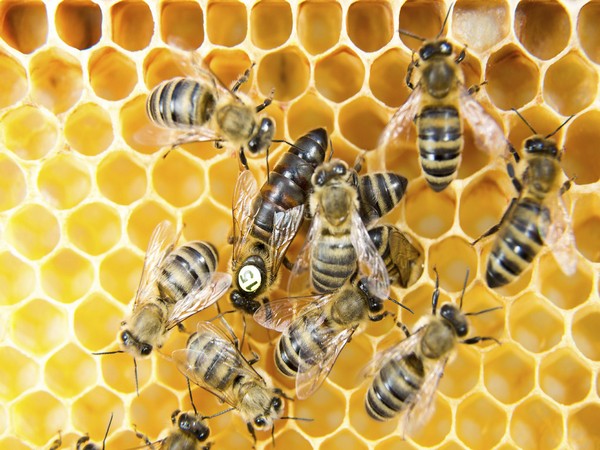
Representative Image

Washington DC [USA], June 6 (ANI): After learning that bees can understand zero and do basic math, researchers have now discovered that these tiny insects may be capable of connecting symbols to numbers as well.
Researchers have trained honeybees to match a character to a specific quantity, revealing they are able to learn that a symbol represents a numerical amount. It's a finding that sheds new light on how numerical abilities may have evolved over millennia and even opens new possibilities for communication between humans and other species.
The discovery also points to new approaches for bio-inspired computing that can replicate the brain's highly efficient approach to processing.
Associate Professor Adrian Dyer said that while humans were the only species to have developed systems to represent numbers, like the Arabic numerals we use each day, the research showed the concept can be grasped by brains far smaller than ours.
"We take it for granted once we've learned our numbers as children, but being able to recognise what '4' represents actually requires a sophisticated level of cognitive ability," Dyer said.
"Studies have shown primates and birds can also learn to link symbols with numbers, but this is the first time we've seen this in insects. Humans have over 86 billion neurons in our brains, bees have less than a million, and we're separated by over 600 million years of evolution. But if bees have the capacity to learn something as complex as a human-made symbolic language, this opens up exciting new pathways for future communication across species," he added.
According to the study published in the Journal of Biological Sciences, a number of non-human animals have been able to learn that symbols can represent numbers, including pigeons, parrots, chimpanzees and monkeys.
In a Y-shaped maze, individual bees were trained to correctly match a character with a number of elements.
They were then tested on whether they could apply their new knowledge to match the character to various elements of the same quantity.
A second group was trained in the opposite approach, matching a number of elements with a character.
While both could grasp their specific training, the different groups were unable to reverse the association and work out what to do when tested with the opposite (character-to-number or number-to-character).
"This suggests that number processing and understanding of symbols happens in different regions in bee brains, similar to the way separate processing happens in the human brain. Our results show honeybees are not at the same level as the animals that have been able to learn symbols like numbers and perform complex tasks. But the results have implications for what we know about learning, reversing tasks, and how the brain creates connections and associations between concepts. Discovering how such complex numerical skills can be grasped by miniature brains will help us understand how mathematical and cultural thinking evolved in humans, and possibly, other animals," said lead researcher, Dr Scarlett Howard. (ANI)

Get the App

What to Read Next

Science

Study finds new T cells, genes related to immune disorder

Study finds new T cells, genes related to immune disorder

A team of researchers has identified a number of uncommon helper T cell subtypes that are linked to immune conditions like asthma, rheumatoid arthritis, and multiple sclerosis.

Read More
Science

New weight loss medication helps lower BP in adults with obesity

New weight loss medication helps lower BP in adults with obesity

According to new research, nearly 500 adults with obesity who took the new weight loss medication tirzepatide for about eight months saw a significant reduction in their systolic blood pressure--the top number in a blood pressure reading.

Read More
Science

Genetics affect need for surgery in patients with osteoarthritis

Genetics affect need for surgery in patients with osteoarthritis

Rhizarthrosis, also known as trapeziometacarpal osteoarthritis, is a kind of osteoarthritis that affects the thumb. Treatment options include splints and surgery. Researchers discovered a number of genetic differences between those with rhizarthrosis who have surgery and those who choose nonsurgical therapies.

Read More
Science

Research shows how obesity dismantles our mitochondria

Research shows how obesity dismantles our mitochondria

Since 1975, the number of obese people has nearly tripled, creating a global epidemic. While lifestyle variables such as nutrition and exercise contribute to the development and progression of obesity, scientists have shown that obesity is also linked to intrinsic metabolic abnormalities.

Read More
Science

Study finds paxlovid treatment does not lower risk of long Covid

Study finds paxlovid treatment does not lower risk of long Covid

Paxlovid (Nirmatrelvir-ritonavir) did not decrease the chance of developing long COVID in vaccinated, non-hospitalized patients during their initial COVID-19 infection, according to a team of UC San Francisco researchers. They also discovered a larger number of people with acute symptoms rebounding and testing positive than previously reported.

Read More
Science

Lowering inequality is essential in dealing with climate crisis

Lowering inequality is essential in dealing with climate crisis

Researchers argue in a new analysis published in the journal Nature Climate Change that reducing inequality is critical in getting the world towards Net-Zero because inequality limits who can afford to adopt low-carbon habits.

Read More
Science

Hotter weather due to climate change could lead to more mosquitos

Hotter weather due to climate change could lead to more mosquitos

A recent study conducted by Virginia Commonwealth University scientists found that a warmer environment may result in more mosquitos as predators struggle to maintain their number.

Read More
Science

Adjuvants, pesticides disrupt honey bee's sense of smell: Study

Adjuvants, pesticides disrupt honey bee's sense of smell: Study

Pesticide sprays have long been recognised as a threat to honey bees. In a new study, researchers uncovered the influence of such sprays on bees' sense of smell, which could disrupt their social signalling.

Read More
Science

Pesticides, adjuvants disrupt honey bee’s sense of smell: Study

Pesticides, adjuvants disrupt honey bee’s sense of smell: Study

Pesticide sprays have long been known to be hazardous to honey bees. Researchers discovered the effect of such sprays on bees' sense of smell in a new study, which could disrupt their social signals.

Read More
Science

Study sheds light on advances in gene therapy for rare diseases

Study sheds light on advances in gene therapy for rare diseases

A recent review article Therapy summarises major milestones in the development of gene therapy medical products that have aided in the treatment of a large number of uncommon disorders. The essay also discusses the obstacles to the advancement of gene therapy for rare disorders.

Read More
Home About Us Our Products Advertise Contact Us Terms & Condition Privacy Policy

Copyright © aninews.in | All Rights Reserved.




