

ADD ANI AS A TRUSTED SOURCE
googleads
ANI Logo
Menu
Science

Astronomers discover rare double nucleus feature in a 'Cocoon Galaxy'

Washington D.C. [USA], Feb 6 (ANI): Astronomers have revealed in a new study that the so-called 'Cocoon Galaxy' has a unique double-nucleus structural feature and shape.

ANI Feb 06, 2020 15:14 IST googleads

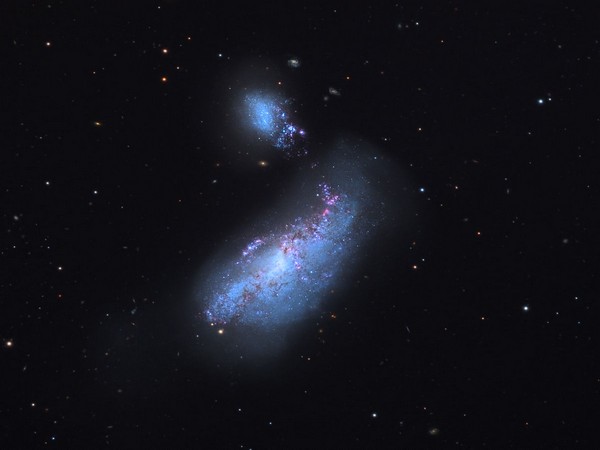
Image of NGC 4490 and NGC 4485

Washington D.C. [USA], Feb 6 (ANI): Astronomers have revealed in a new study that the so-called 'Cocoon Galaxy' has a unique double-nucleus structural feature and shape.
After studying data from optical and radio telescopes based on the ground and in space, a team of astronomers determined that a galaxy known as NGC 4490 (and nicknamed the "Cocoon Galaxy" because of its shape) has "a clear double nucleus structure," according to their paper.
One nucleus can be seen in optical wavelengths. The other is hidden in dust and can only be seen in infrared and radio wavelengths.
The paper reporting the discovery is now online and has been accepted for publication in the Astrophysical Journal.
The first author is Allen Lawrence, who earned a master's degree in astronomy from Iowa State University in 2018 and continues to work with Iowa State astronomers.
Co-authors are Iowa State's Charles Kerton, an associate professor of physics and astronomy; and Curtis Struck, a professor of physics and astronomy; as well as East Tennessee State University's Beverly Smith, a professor of physics and astronomy.
Lawrence started the study in 2013 while taking astronomy classes at the University of Wisconsin-Madison. He had the chance to study one of two galaxy systems and picked NGC 4490, which is interacting with a smaller galaxy, NGC 4485. The system is about 20% the size of the Milky Way, located in the Northern Hemisphere and about 30 million light-years from Earth.
"I saw the double nucleus about seven years ago," Lawrence said, adding, "It had never been observed - or nobody had ever done anything with it before."
Some astronomers may have seen one nucleus with their optical telescopes. And others may have seen the other with their radio telescopes. But he said the two groups never compared notes to observe and describe the double nucleus.
The new paper says both nuclei are similar in size, mass and luminosity. It says both are similar in mass and luminosity to the nuclei observed in other interacting galaxy pairs. And, it says the double nucleus structure could also explain why the galaxy system is surrounded by an enormous plume of hydrogen.
"The most straightforward interpretation of the observations is that NGC 4490 is itself a late-stage merger remnant" of a much-earlier collision of two galaxies, the authors wrote. A merger could drive and extend the high level of star formation necessary to create such a large hydrogen plume. (ANI)

Get the App

What to Read Next

Science

New technology enhances gravitational-wave detection: Study

New technology enhances gravitational-wave detection: Study

A team of physicists led by Jonathan Richardson of the University of California, Riverside, demonstrated how new optical technology can extend the detection range of gravitational-wave observatories such as the Laser Interferometer Gravitational-Wave Observatory, or LIGO, and pave the way for future observatories.

Read More
Science

Large, small galaxies may grow in ways more similar

 Large, small galaxies may grow in ways more similar

A team of astronomers led by University of Arizona researcher Catherine Fielder captured the most precise photographs of a small galaxy and its surroundings, revealing features typically found in much larger galaxies.

Read More
Science

Astronomers find the smallest main-belt asteroids ever detected:

Astronomers find the smallest main-belt asteroids ever detected:

The majority of known asteroids orbit inside the main asteroid belt, which is positioned between Mars and Jupiter at an average distance of around 250 million km from Earth. Since the discovery of the first asteroid in 1801, about 750.000 asteroids have been identified, primarily in the last decade thanks to several optical surveys that examine the sky on clear nights.

Read More
Science

Researchers finds hidden threats with advanced x-ray imaging

 Researchers finds hidden threats with advanced x-ray imaging

To produce multi-contrast images that may be utilized in thousands of complex scenarios to identify potentially threatening materials like explosives, researchers have integrated multiple x-ray imaging methods. Security screening and applications in the biological and physical sciences may benefit from the new method, which also makes use of easily accessible machine learning processes for materials classification.

Read More
Science

Males, females have different risk factors for hearing loss

Males, females have different risk factors for hearing loss

Certain factors associated with developing age-related hearing loss differ by gender, including weight, and hormone exposure, according to a study published in the open-access journal PLOS ONE by Dong Woo Nam of Chungbuk National University Hospital in South Korea and colleagues.

Read More
Science

Air pollution related to higher hospitalisations

Air pollution related to higher hospitalisations

Short and long-term exposure to fine particulate matter (PM2.5) air pollution is linked to an increased risk of hospitalisation for serious heart and lung problems, according to two major US studies published in The British Medical Journal.

Read More
Science

Research reveals brain processes speech, its echo separately

Research reveals brain processes speech, its echo separately

Echoes can make speech difficult to understand, and getting rid of echoes in an audio recording is a very difficult engineering task. According to a study published in the open-access journal PLOS Biology by Jiaxin Gao of Zhejiang University in China and colleagues, the human brain appears to successfully handle the challenge by splitting sound into direct speech and its echo.

Read More
Science

Bacterial meningitis affects one out of every three children

Bacterial meningitis affects one out of every three children

One out of every three children who suffer bacterial meningitis has irreversible neurological impairments as a result of the infection. This is according to a recent epidemiological study done by Karolinska Institutet and published in the top medical journal JAMA Network Open.

Read More
Science

Study finds immune system can influence behaviour

Study finds immune system can influence behaviour

According to a Yale-led study published in the journal Nature, the immune system plays a critical role in modifying our behaviour.

Read More
Science

Early nerve intervention lowers complications post amputation

Early nerve intervention lowers complications post amputation

A study published in the issue of Plastic and Reconstructive Surgery, the official medical journal of the American Society of Plastic Surgeons (ASPS), suggests that performing targeted muscle reinnervation (TMR) at the time of amputation can reduce pain scores and prevent complications related to abnormal nerve regrowth.

Read More
Home About Us Our Products Advertise Contact Us Terms & Condition Privacy Policy

Copyright © aninews.in | All Rights Reserved.




