Search For "primate"
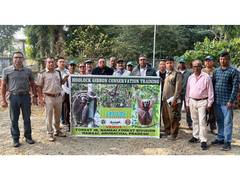
Forest staff trained to protect India's only ape in Arunachal's Namsai
Updated : 17 hours, 42 min ago IST
The training aimed to familiarise forest personnel with the Western Hoolock Gibbon (Hoolock hoolock), India's only ape, and to strengthen their motivation and capacity for its conservation.
Read More
Assam: International Primate Day celebrated at Kaziranga National Park
Updated : 5 months, 2 weeks ago IST
International Primate Day is observed annually on September 1 to raise awareness and encourage action for the protection and conservation of the world's primate species.
Read More
Assam: Aaranyak conducts Hoolock Gibbon conservation training for forest d
Updated : 1 year, 5 months ago IST
The week-long and residential training was conducted in collaboration with Jorhat Forest Division with support from the Habitats Trust, and IUCN Primate Specialists Group for the 4th batch of forest staff from September 16 to 22.
Read More
AI benchmark test Geekbench AI launched to evaluate device performance in
Updated : 5 months, 2 weeks ago IST
Primate Labs, the creators behind the popular Geekbench benchmarking suite, have introduced a cutting-edge tool to assess machine learning capabilities: Geekbench AI.
Read More
Study finds use of habitat for agricultural purposes puts primate in dange
Updated : 2 years, 2 months ago IST
According to a study published in Current Biology, frequent trips to oil palm farms are significantly increasing mortality rates among baby southern pig-tailed macaques (Macaca nemestrina) in the wild.
Read More
Colorful primates don’t have better color vision: Study
Updated : 2 years, 5 months ago IST
Researchers found that red skin and/or red-orange fur may be advantageous for use in social communication even in primate species with poor colour vision.
Read More
Biodiversity organisation Aaranyak, stakeholders celebrate International P
Updated : 2 years, 6 months ago IST
Biodiversity conservation organisation Aaranyak with the objective to highlight the importance of primate species in our ecology, facilitated several collaborative awareness programmes in Assam and Arunachal Pradesh on the occasion of International Primates Day on Friday.
Read More
Researchers use monkey poop to learn reproductive patterns of endangered s
Updated : 2 years, 7 months ago IST
Researchers used muriquis poop to gain insight into how the primates choose their mates in order to better understand what goes on in their mating lives.
Read More
Study finds potential solution for bacterial infection
Updated : 2 years, 8 months ago IST
According to a new study, a vaccine originally developed to prevent bacteria-caused diarrhoea has now been found to help infant nonhuman primates grow faster and will treat bacterial infections.
Read More
Socially adept monkeys have superior impulse control: Study
Updated : 2 years, 9 months ago IST
Non-human primates have been used by researchers to test one of the theories put up to explain how humanity developed to become smarter. A team from the University of Portsmouth led a study that discovered a strong link between monkeys' social organisation and their cognitive abilities.
Read More
Global primate genome study reveals their evolution and applications for h
Updated : 2 years, 9 months ago IST
Two new investigations carried out by global scientists combine genome sequencing of over 800 individuals from 233 primate species, covering nearly half of all existing primate species on Earth, with the study of fossil remains and multiplying by four-fold the number of primate genomes avail
Read More
Research suggests cultural heritage may influence capuchin monkeys' tool c
Updated : 3 years, 3 months ago IST
Capuchin monkeys (Sapajus spp.) are among only a few primates that use tools in day-to-day activities. In the Cerrado and Caatinga, they use stones as hammers and anvils to crack open cashew nuts, seed pods of Hymenaea courbaril (West Indian locust; jatoba in Brazil) and other hard foods.
Read More