 हिंदी खबर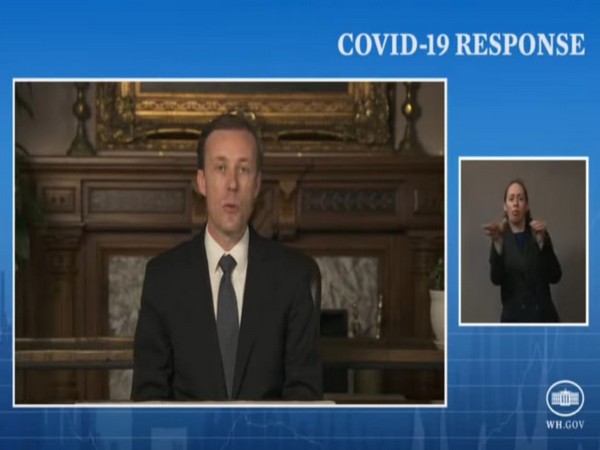

Washington [US], June 4 (ANI): US National Security Advisor Jake Sullivan on Thursday (local time) discussed the sharing of 25 million COVID-19 vaccines with the world and said that the US will not use it to secure favours from other countries in lieu of the pandemic assistance.
"We are announcing our plan for sharing the first 25 million US vaccines with the world. I'm going to briefly outline why we are sharing them, how we plan to share them, and where we will share them," said Sullivan in a White House COVID-19 response press briefing.
Sullivan reiterated that the goal in sharing vaccines is in service of ending the pandemic globally adding, "Our overarching aim is to get as many safe and effective vaccines to as many people as fast as possible. It's as simple as that. We want to save lives and thwart variants that place all of us at risk. But perhaps most important: This is just the right thing to do."
Thanking the ingenuity of American scientists and the resilience and commitment of the American people, he said, "we're in a position to help others, so we will help others. And as the President has said, the United States will not use its vaccines to secure favours from other countries."
US has received requests from all over the world regarding vaccines. The allocation of 25 million vaccines were determined on various factors. These factors included achieving global coverage, responding to surges and other specific urgent situations and public health needs, and helping as many countries as possible who requested vaccines, informed Sullivan.
The US decided to share at least 75 per cent of these vaccines through COVAX and 25 per cent in a flexible way.
"This will maximize the number of vaccines available equitably for all countries and will facilitate sharing with those most at risk. And we decided to share up to 25 percent of these vaccines for immediate needs and to help with surges around the world," said Sullivan.
US will be sharing these 25 million doses with a wide range of countries within Latin America and the Caribbean; South and Southeast Asia; and across Africa, in coordination with the African Union.
"This includes prioritizing our neighbours here in our hemisphere, including countries like Guatemala and Colombia, Peru and Ecuador, and many others. It respects existing regional networks for vaccine sharing, like the platform of the African Union and African Centres for Disease Control and Prevention, and the regional public health agency in the Caribbean -- CARPHA," added Sullivan.
These networks will help decide where to allocate needed doses in regions with low vaccination rates and to those most at risk, including healthcare workers who haven't yet gotten their shots.
US will also prioritize South and Southeast Asia, including countries like India, Nepal, the Philippines, and others that are undergoing surges right now.
"It recognizes our closest neighbours, Canada and Mexico, which received our first shared vaccines; and friends like the Republic of Korea, where our military shares a command. And it prioritizes other partners around the world, including countries with low vaccination rates or dealing with urgent present crises, like the West Bank and Gaza, Ukraine, Kosovo, Iraq, Haiti, and others," said Sullivan.
In the days ahead, the US will coordinate closely with COVAX and with countries that will receive the vaccines. US President Joe Biden has earlier committed to sharing doses on an ongoing basis, starting with 80 million by the end of June.
"We will continue to donate from our excess supply as that supply is delivered to us. We will work with our international partners to get ahead of the virus, to follow the science, and to help countries in crisis," added Sullivan.
He also said that sharing 25 million doses won't be enough to end or reduce the lifespan of the pandemic. "We're working with allies and partners to expand the production of vaccines and raw materials, including here at home by building capacity around the world."
"We're also working with our G7 partners on a larger effort to help end the pandemic so that the world's democracies deliver for people everywhere. And we will have more to say about this next week when the G7 leaders meet in the UK," added Sullivan.
As per Sullivan, the US approach is focused on stopping the spread of COVID-19 by increasing vaccination, detecting outbreaks and variants, responding rapidly to flares, and critically recovering economically.
He focussed upon strengthening global public health institutions and ability to come together as an international community to defeat not just this pandemic, but the next one and the one after that. (ANI)
US will not use it to secure favours from other countries: Jack Sullivan on sharing 25 million COVID vaccines
ANI | Updated: Jun 04, 2021 06:13 IST




