 हिंदी खबर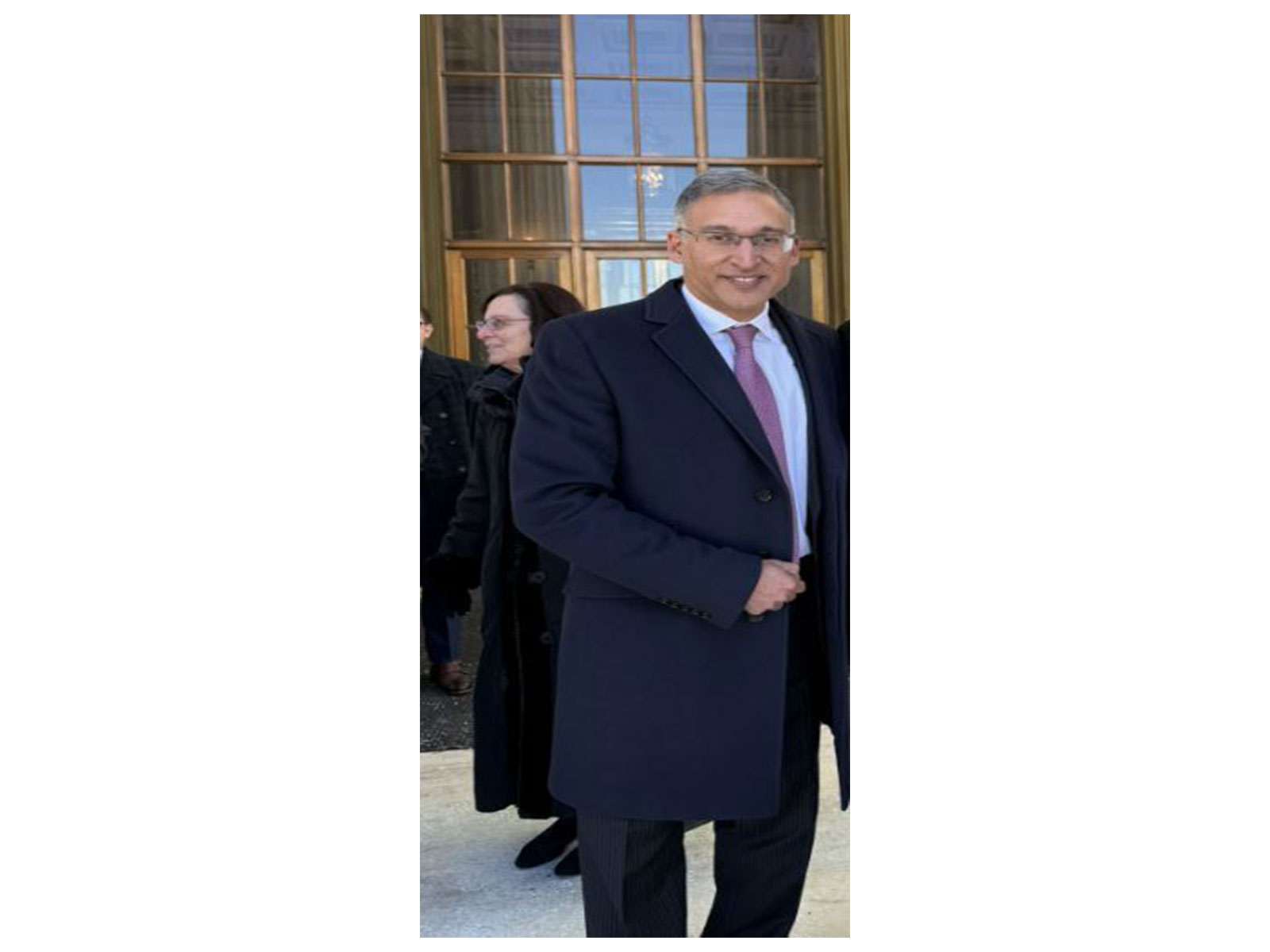

Washington, DC [US], February 22 (ANI): Prominent Indian-American litigator Neal Katyal has raised significant legal questions regarding President Donald Trump's decision to impose a 15 per cent global tariff, pointing to a direct contradiction with previous arguments made by the Department of Justice (DOJ).
In a post on X, Katyal, who recently led a successful legal challenge against the administration's earlier trade policies at the Supreme Court, suggested that the President's reliance on Section 122 of the Trade Act of 1974 may be legally flawed.
He highlighted that the administration's own legal team had previously distanced itself from that statute.
Katyal quoted the DOJ's earlier statement to the Court, "Nor does [122] have any obvious application here, where the concerns the President identified in declaring an emergency arise from trade deficits, which are conceptually distinct from balance-of-payments deficits."
Seems hard for the President to rely on the 15 percent statute (sec 122) when his DOJ in our case told the Court the opposite: “Nor does [122] have any obvious application here, where the concerns the President identified in declaring an emergency arise from trade deficits, which…
— Neal Katyal (@neal_katyal) February 21, 2026
This earlier position, he argued, makes it difficult for the President to now invoke Section 122 for the current tariffs.
This scrutiny arises in the immediate aftermath of a landmark Supreme Court ruling that struck down most of Trump's previous sweeping tariff measures.
The Court ruled 6-3 that the administration exceeded its authority by using the International Emergency Economic Powers Act (IEEPA) of 1977 to impose broad-based import tariffs, affirming that the power to levy taxes resides primarily with Congress.
Following the ruling, Trump announced a new 10 per cent global tariff on all countries under Section 122 of the Trade Act of 1974, describing it as a temporary import surcharge (up to 15%) allowed for 150 days to address balance-of-payments deficits.
He later raised it further to the "fully allowed, and legally tested, 15% level," effective immediately.
In a Truth Social post, Trump stated that this adjustment responds to the Supreme Court's "ridiculous, poorly written, and extraordinarily anti-American decision," while his administration would determine new, legally permissible tariffs in the coming months to continue "Making America Great Again."
Katyal emphasised that if the President seeks sweeping tariffs, he should follow the constitutional process by seeking legislative approval from Congress rather than relying on executive statutes.
He argued that if the tariffs are a good idea, persuading Congress should not be difficult, as that is what the Constitution requires.
The core legal dispute centres on whether trade deficits can be equated with balance-of-payments deficits to justify Section 122.
Katyal's analysis underscores that these are conceptually distinct issues, aligning with the DOJ's prior stance.
Adding weight to this critique, former IMF First Deputy Managing Director and prominent economist Gita Gopinath endorsed Katyal's perspective in a social media interaction on X.
Sharing his post, she remarked that he was "speaking International Economics 101" by questioning the administration's reliance on Section 122, as the legal arguments appear to clash with basic economic distinctions between trade deficits and balance-of-payments deficits.
.@neal_katyal speaking International Economics 101:“Nor does [122] have any obvious application here, where the concerns the President identified in declaring an emergency arise from trade deficits, which are conceptually distinct from balance-of-payments deficits." https://t.co/lQyeKGJ4Hi
— Gita Gopinath (@GitaGopinath) February 21, 2026
Trump's latest move follows closely after the administration signed an executive order for the initial 10% global tariff, with a White House official confirming that countries like India would be subject to it until another authority is invoked, and urging trade partners to abide by existing deals.
This comes amid ongoing US-India trade developments, On February 7, the two countries announced a framework for an Interim Agreement on reciprocal and mutually beneficial trade, reaffirming commitment to broader Bilateral Trade Agreement negotiations.
The Interim Agreement includes India eliminating or reducing tariffs on various US industrial goods, food, and agricultural products, while the US applies a reciprocal 18 per cent tariff on certain Indian-origin goods under an existing executive order, with provisions for removals upon successful conclusion of the agreement.
In response to the Supreme Court judgment and Trump's subsequent announcements, India's Commerce and Industry Ministry stated that it is studying the implications of these developments for their potential impact. (ANI)


