Group Captain Shuka works on uncovering how microgravity contributes to muscle loss at ISS on flight day 6 of Axiom 4 mission
Group Captain Shukla conducted detailed operations inside the Life Sciences Glovebox (LSG) as part of the myogenesis study, which aims to identify the molecular pathways that lead to skeletal muscle dysfunction in space.
ANI
Jul 01, 2025 17:17 IST

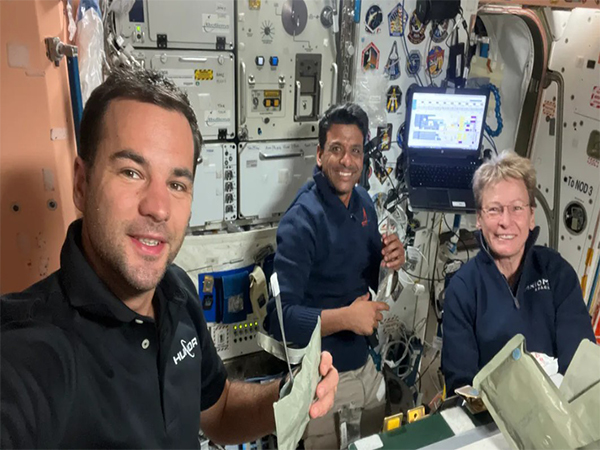
Florida [US], July 1 (ANI): Group Captain Shubhanshu Shukla, the first Indian astronaut at the International Space Station (ISS), conducted a critical biomedical experiment aboard the ISS on flight day 6 of the Axiom 4 Mission, focusing on how microgravity contributes to muscle loss.
Group Captain Shukla conducted detailed operations inside the Life Sciences Glovebox (LSG) as part of the myogenesis study, which aims to identify the molecular pathways that lead to skeletal muscle dysfunction in space.
As per a blog by Axiom Space on the mission, the findings from this study could play a vital role in developing targeted therapies to prevent muscle atrophy during long-duration missions and may also lead to new treatments for muscle-wasting diseases on Earth, including those linked to ageing and immobility.
"Shux performed operations in the Life Sciences Glovebox (LSG) for the myogenesis study, which could uncover how microgravity contributes to muscle loss. By identifying the molecular pathways behind skeletal muscle dysfunction, the research could lead to targeted therapies to prevent atrophy during long-duration spaceflight. These insights may also translate to improved treatments for muscle-wasting conditions on Earth, including those linked to ageing and immobility," the blog stated.
Alongside Group Captain Shukla, the Ax-4 crew, Commander Peggy Whitson, and Mission Specialists Slawosz Uznanski-Wisniewski and Tibor Kapu had also continued with their schedule of scientific research aboard the ISS.
Commander Whitson of the US, advanced work on the Cancer in Lymphoma Epidemiology of Outcomes (LEO) study, capturing images of tumour organoids in microgravity to understand how cancer behaves in space.
As per the blog, the research in partnership with the Sanford Stem Cell Institute is helping to push forward the development of Rebecsinib, a promising cancer drug that has shown strong efficacy in space trials and is now entering clinical trials under FDA's Investigational New Drug (IND) status.
"Peggy continued working on the Cancer in LEO study by capturing tumour organoid images in microgravity, helping researchers understand how cancer behaves in space. In partnership with the Sanford Stem Cell Institute and Axiom Space, this work is supporting the development of Rebecsinib -- a drug that has outperformed existing treatments in space-based tests. Now under FDA-approved Investigational New Drug (IND) status, Rebecsinib is moving into clinical trials, marking a major step toward new therapies for aggressive cancers on Earth," the blog stated.
Meanwhile, Hungary's Kapu monitored radiation levels aboard the station through the Rad Nano Dosimeter, which supports better crew protection strategies for future space exploration and advances Earth-based radiation detection technologies. Additionally, working on the VITAPRIC experiment, examining how selenium levels affect the nutrient content of microgreens grown in microgravity.
The team also continued work on the Telemetric Health AI study, which uses biometric data and ultrasound scans to monitor cardiovascular and balance system responses in microgravity. This AI-driven approach could revolutionise both space medicine and remote health care access on Earth.
As per the blog, a standout innovation was seen in the PhotonGrav brain-computer interface project, in which astronauts used specialised headsets to measure blood flow and indirectly track neural signals. This experiment explores how thought-based control systems could be used for spacecraft operations and may also benefit neurorehabilitation technologies for individuals with mobility or speech impairments.
Earlier, on flight data 5 of the mission, Group Captain Shukla focused on the space microalgae experiment, deploying sample bags and capturing images of the algae strains. These experiments with these tiny organisms could play a big role in the future of space exploration, offering a sustainable, nutrient-rich food source for long-duration missions.
On June 26, Group Captain Shukla became the first Indian to board the ISS and the second Indian in space.
The Ax-4 crew includes former NASA astronaut Peggy Whitson, ISRO astronaut Shubhanshu Shukla, and ESA astronauts Slawosz Uznanski-Wisniewski of Poland and Tibor Kapu of Hungary. The mission is expected to last up to 14 days.
Axiom Mission 4 was launched at noon IST on June 25 aboard a SpaceX Falcon 9 rocket from Launch Complex 39A at NASA's Kennedy Space Centre in Florida.
The Dragon spacecraft successfully docked with the ISS on June 26 at 4:05 pm IST, ahead of schedule, connecting to the space-facing port of the station's Harmony module. (ANI)
Tags:
Get the App