 हिंदी खबर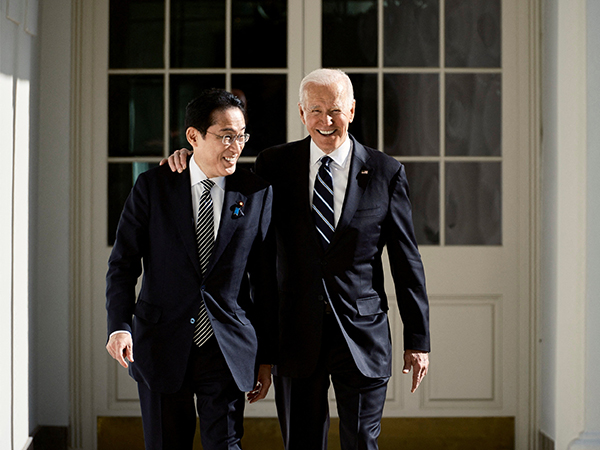

Washington DC [US], March 29 (ANI): China has been raising objections to the US-Japan plans to upgrade their security alliance, saying it does not want to be a 'target' of the defence plans, Voice of America (VOA) reported.
The defence plans that are expected to be announced at a summit in April are being considered the biggest upgrade to the security alliance between Washington and Tokyo in decades.
"China always believes that military cooperation between states should be conducive to regional peace and stability, instead of targeting any third party or harming the interests of a third party," Liu Pengyu, a spokesperson for the Chinese Embassy in Washington, said.
A US State Department spokesperson pushed back against Beijing's concerns, emphasising the importance of the US-Japan alliance in the Indo-Pacific region.
"The US-Japan alliance has served as the cornerstone of peace, security and prosperity in the Indo-Pacific and across the world for over seven decades and has never been stronger," the spokesperson said.
On Tuesday, White House National Security Advisor Jake Sullivan met his Japanese counterpart, Akiba Takeo, at the White House to discuss "next steps to finalise key deliverables" that President Joe Biden and Japanese Prime Minister Fumio Kishida will announce during their April 10 meeting in Washington.
Japanese Chief Cabinet Secretary Yoshimasa Hayashi said on Monday that Tokyo was in discussion with Washington about strengthening the command and control of their militaries to enhance readiness.
Meanwhile, this discussion comes as Indo-Pacific Command chief Admiral John Aquilino told the US House Armed Services Committee that the Chinese People's Liberation Army is preparing to invade Taiwan by 2027, VOA reported.
"The time is long overdue to upgrade the command structure in Japan so that the US and Japanese militaries can operate together more seamlessly" in the region, Ralph Cossa, president emeritus and WSD-Handa chair in peace studies at the Pacific Forum, said.
James Schoff, senior director of the US-Japan NEXT Alliance Initiative at the Sasakawa Peace Foundation USA, said, "This is probably the single most important step that the allies can take to enhance deterrence against regional threats and respond to any sort of major crisis."
"This is especially true at this moment as Japan prepares to stand up its first joint operational command and introduces longer-range counterstrike capabilities," he added.
Notably, Japan plans to set up a joint operations command by March 2025 to improve coordination among its air, ground and maritime Self-Defense Forces (JSDF). The updated command structure within US Forces Japan (USFJ) is expected to complement Japan's establishment of its joint operations command, VOA reported.
Ryo Hinata-Yamaguchi, senior non-resident fellow at the Atlantic Council's Indo-Pacific Security Initiative in the Scowcroft Centre for Strategy and Security, said, "Although the details are yet to be determined, the plan is to enhance the USFJ's authority within INDOPACOM [US Indo-Pacific Command]."
He added that the revised US military command "will also have greater institutional ability to communicate and coordinate with the JSDF."
Currently, US Forces Japan has limited authority to conduct joint operations with Japan. The commander of USFJ needs to coordinate its operation with US Indo-Pacific Command, located in Hawaii, as reported by VOA.
Earlier on Tuesday, President Biden nominated Air Force Major General Stephen Jost as the new commander of USFJ and promoted him to Lieutenant General.
Schoff said that "the existing parallel chain of command would remain" in the US and Japanese militaries rather than "a single allied chain of command for both US and Japanese forces."
However, the US Forces Japan will be unlike the South Korean-US Combined Forces Command led by a US general during wartime, according to VOA.
James Przystup, senior fellow at the Hudson Institute and its Japan chair specialising in alliance management in the Indo-Pacific, said the upgrades in US military command in Japan "would serve to enhance US-Japan defence cooperation and deterrence in Northeast Asia, both with respect to North Korea and China."
"As for what this might look like in practice, the US-ROK Combined Forces Command could be one model, but not necessarily the one [into which it] eventually evolves," he added. (ANI)




