 हिंदी खबर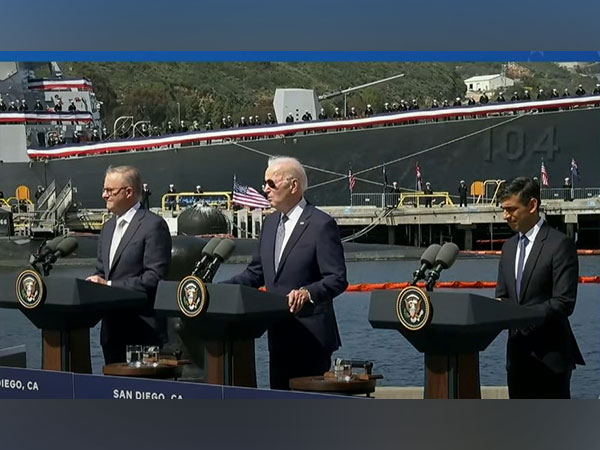

San Diego [United States], March 14 (ANI): United States President Joe Biden along with Australian Prime Minister Anthony Albanese and United Kingdom Prime Minister Rishi Sunak on Monday announced that Australia will purchase nuclear-powered attack submarines from the US to modernise its fleet. The agreement is aimed at countering China's influence in the Indo-Pacific region.
Addressing a joint statement after holding in person bilateral talks on a US naval base in San Diego, California, the three leaders underscored their shared commitment to the 18-month-old trilateral security partnership given the acronym AUKUS -- for Australia, the United Kingdom and the United States.
"Today, we're announcing the steps to carry out our first project under AUKUS and developing Australia's conventionally armed nuclear-powered submarine capacity. The submarines are nuclear-powered and not nuclear-armed," said US President Joe Biden at the Naval Base Point Loma in San Diego.
Biden, flanked by Albanese and Sunak, also highlighted that the agreement's purpose was solely not only to sell submarines to Australia but also to develop something new together.
Biden said, "United Nations will sell three submarines to Australia with the potential to sell two more if needed. The ultimate goal is not just selling submarines to Australia, it is developing something new together, we are calling it the SSN-AUKUS."
US National Security Advisor Jake Sullivan addressing a press gaggle on board Air Force One ahead of the San Diego meeting said that partnership will lay out a multi-phase process that begins over the next few years and begins immediately with the training of Australian sailors, engineers, technicians, and other personnel to be able to take on the responsibility and stewardship of nuclear propulsion.
"And a few years down the line in the 2020s, you'll start to see the regular rotational deployment of US and UK subs in Australia," Sullivan was cited as saying by the White House.
The US official said that by the early 2030s, US will deliver three conventionally armed nuclear powered Virginia-class submarines to Australia over the course of the 2030s, "with the possibility of going up to five if that is needed."
Prime Minister of Australia, Anthony Albanese underlined the important features of the AUKUS agreement such as building a future in Australia while investing in skills, jobs and infrastructure.
Albanese said, "AUKUS agreement represents the biggest single investment in Australia's defence capability in all of our history, strengthening Australia's national security and stability; building a future made in Australia with record investments in skills, jobs and infrastructure."
Albanese said that it was the first time in 65 years, and only the second time in history, that the United States has shared its nuclear propulsion technology.
"We are also proud to partner with the United Kingdom to construct the next-generation submarine, to be called SSN-AUKUS. A new, conventionally-armed, nuclear-powered submarine, based on a British design and incorporating cutting edge Australian, UK and US technologies. This will be an Australian sovereign capability, built by Australians, commanded by the Royal Australian Navy and sustained by Australians in Australian shipyards, with construction to begin this decade," Albanese said.
Prime Minister of the United Kingdom, Rishi Sunak cited growing challenges such as "Russia's illegal invasion of Ukraine, China's growing assertiveness, and the destabilising behaviour of Iran and North Korea all threaten to create a world defined by danger, disorder and division."
Sunak said that under the partnership UK will provide "the world leading design and build the first of these new boats, creating thousands of good, well-paid jobs" and will share its knowledge and experience with Australian engineers, so they can build their own fleet.
"Our partnership is significant because not just are we building these submarines together, they'll also be truly interoperable," Sunak said.
The UK Prime Minister said that the Royal Navy will operate the same submarines as the Australian Navy and both will share components and parts with the US Navy.
Submarine crews of the three countries will train together, patrol together, and maintain their boats together and will communicate using the same terminology and the same equipment.
Terming it as a powerful partnership, sunak said that through AUKUS they will raise the standards of nuclear non-proliferation.
"For the first time ever, it will mean three fleets of submarines working together across both the Atlantic and Pacific, keeping our oceans free, open, and prosperous for decades to come," Sunak said.
In September 2021, Australia, the United Kingdom and the United States announced AUKUS - a new security partnership aimed at promoting a free and open Indo-Pacific that is secure and stable.
AUKUS is a plan to outfit Australia with nuclear-powered submarines in an unprecedented three-way defence partnership that seeks to counter China's attempts to achieve naval dominance in the Pacific, reported Japan Times.
The key element of AUKUS was a US agreement to export to Australia its prized technology of nuclear-powered submarines, previously shared only with Britain when it designed its undersea fleet in the 1960s, reported Japan Times. Ahead of the announcement for British-built submarines with US parts, China warned that AUKUS risked setting off an arms race and accused the three countries of setting back nuclear non-proliferation efforts.
"We urge the US, the UK and Australia to abandon the Cold War mentality and zero-sum games, honour international obligations in good faith and do more things that are conducive to regional peace and stability," Chinese Foreign Ministry spokeswoman Mao Ning had told reporters in Beijing.
Australia has committed to a "proportional" investment in US and British industrial capacity, and over the next several decades will be spending more than USD 100 billion to buy the submarines and build up its own industrial capacity, as well as shore up America's and Britain's shipbuilding capability.
Nuclear-powered submarines would allow Australia in the coming decades to maintain an underwater presence for months on end, offering an advantage as China's military expands its reach, reported Japan Times.
China in recent months reached a controversial security pact with the Solomon Islands and has not ruled out the use of force to take Taiwan, a self-governing democracy that is claimed by Beijing and effectively blocks it from projecting military power deeper into the Pacific. (ANI)


