 हिंदी खबर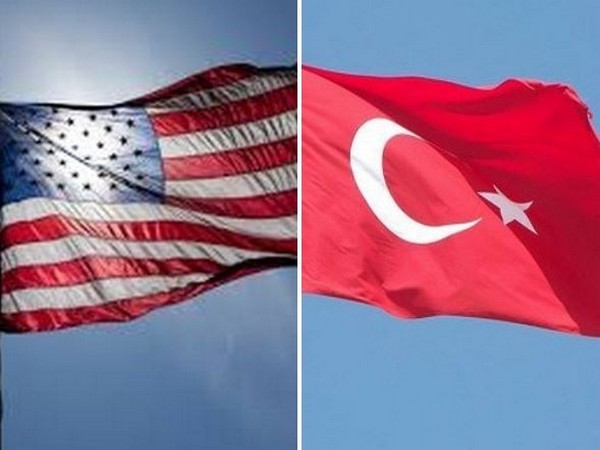

By John Solomou
Nicosia [Cyprus], March 8 (ANI): The United States and Turkey, two countries which for many years used to share the same views on geopolitics and common threats - mainly the Soviet Union and extremism- now view each other with great suspicion and take a different stand on many international issues.
It is now doubtful if the two countries, which have the two largest armies in North Atlantic Treaty Organisation (NATO), continue to be real allies, or are allies in anything more than a name.
Indicative of the change in the dysfunctional relationship between them is a recent survey carried out by the German Marshall Fund (GMF) and the Bilgi University in Istanbul, which showed that 48 per cent of Turks consider the US to be the biggest threat to Turkey, compared to only 3.9 per cent of Turks who see it as an ally. According to other surveys, Turks see Russia and not the US as their main ally.
There is a long list of different views between Turkey and the US on international issues-such cooperation with Russia and China- but the relations between the two "allies" have been tested by four main crises: Erdogan's purchase of the Russian S-400 missile defence system which are said to endanger NATO aircraft, and the US sanctions imposed on Turkey's defence industry, the issue of Syrian Kurds, Turkey's belligerent movements in the Eastern Mediterranean and the court case in the US against Turkey's state-own Halk Bank, which is accused of helping Iran break the US sanctions.
A serious point of friction is the continuous repression of human rights in Turkey, about which the new US Administration has said it will not turn a blind eye. Former President Donald Trump systematically ignored the question of blatant human rights' violations in Turkey and admired Erdogan "a world-class chess player". In sharp contrast, President Biden described Erdogan as an "autocrat who should pay a price for his repression", while Secretary of State Antony Blinken referred to Turkey as our "so-called strategic partner", in response to a question on Turkey's purchase of the S-400 systems.
Indicative of how testy the relations between US and Turkey have become is Erdogan's angry reaction with regard to a US statement about the botched attempt to free 13 police officers who had been abducted by the outlawed Kurdistan Workers' Party (PKK) and held hostage in a cave in northern Iraq. Turkey accused the PKK of killing the hostages, but the PKK says they were killed by Turkish bombs dropped during the rescue operation.
A US statement on the incident issued on February 14 was cautious on culpability. It said "if the reports of the death of Turkish civilians at the hands of the PKK, a designated terrorist organization, are confirmed ..." This infuriated Erdogan. 'Hey West!' Erdogan angrily said "This is ridiculous...If you want to continue our alliance globally and within NATO, then you must stop siding with terrorists."
Undoubtedly, the most contentious dispute between Ankara and Washington is Erdogan's insistence on acquiring the advanced S-400 missile air-defence system from Russia, despite repeated US and NATO warnings that it would endanger the West most sophisticated aircraft. The US countered by barring Turkey from manufacturing or purchasing advanced F-35 warplanes.
Turkey's state-owned Defense Industry Technologies (SSTEK) has recently signed a contract worth USD 750,000 with one of Washington's most prestigious law firms in an attempt to remain in the F-35 stealth jet fighter program. Earlier in February the Pentagon said that the Biden administration would not lift the ban on Turkey buying F-35 fighter jets.
Obviously, a mutually acceptable formula on the S-400 systems is unlikely to be found anytime soon, and this issue is set to become a long-lasting irritant in the relationship between the two countries.
During the Presidency of Tayyip Erdogan, Turkey has not been acting as a true NATO ally. However, it should be pointed out but no matter what it does in the various parts of the world where it is involved, the fact remains that Turkey cannot be expelled from NATO. The alliance of twenty-nine nations has no mechanism to oust members.
While in the past, the officers of the Turkish Armed Forces were in their vast majority fervent supporters of NATO, with the extensive purges of officers made by Erdogan of suspected supporters of his former ally Fetulah Gulen, the situation now has changed dramatically.
As Gonul Tol, Director of Turkish studies at the Middle East Institute in Washington says: "It's very difficult to promote closer US-Turkey ties or nato-Turkey ties." Tens of thousands have been purged from the military. "If you are seen as pro-nato now, it could kill your career."
The majority of experts who follow closely the relations between Washington and Ankara agree that neither party wants a complete breakdown of relations, as each has very good reasons to avoid it. In fact lately, Erdogan indicated that he wants to improve Turkey's relations with the US. For his part, US President Joe Biden does not want to push Turkey into the arms of Moscow. In all probability, they both prefer to continue to be allies, even in name only.
Galip Dalay, of the Brookings Doha Centre, points out: "In the current political climate, the U.S. and Turkey are unlikely to be able to resolve any of their major files of contention. This in return means that they should invest time and energy in crisis management rather than crisis solution in order to avoid a rupture in the relationship." (ANI)


