 हिंदी खबर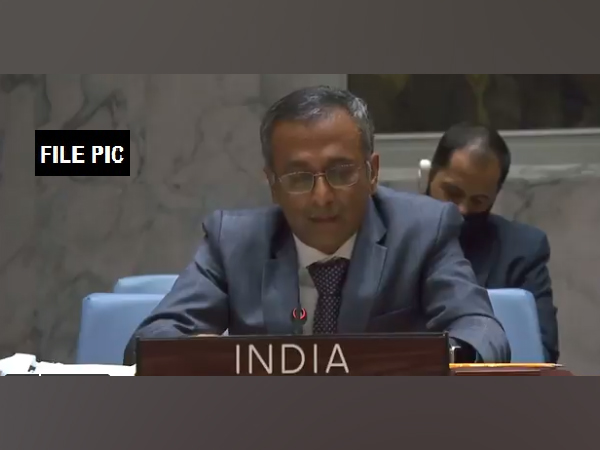

New York [US], February 15 (ANI): India on Monday (local time) said that 21st-century peacekeeping must be anchored in a strong ecosystem of technology and innovation.
Speaking at the United Nations Security Council (UNSC) meeting on 'Special Committee on Peacekeeping Operations', India's Deputy Permanent Representative to the UN, R Ravindra said, "This is also in line with the Strategy for Digital Transformation of UN Peacekeeping which seeks to advance the use of technology across the Action for Peacekeeping (A4P) themes, including performance, safety and security, politics, protection and peacebuilding. India, during the presidency of the Security Council in August last year, piloted the Presidential Statement on 'Technology for Peacekeeping', the first such UN Security Council document on this topic."
He said that India has been a pioneer in UN Peacekeeping, deploying more than a quarter of a million troops over the years in as many as 49 UN Peacekeeping Missions.
"Serving under the blue flag, 174 gallant Indian soldiers have made the supreme sacrifice over the years, the largest number among troop-contributing countries. In keeping with this tradition, we have today more than 5000 personnel deployed across nine missions," said Ravindra.
He also offered tribute to, all the Men and Women, who continued to defend peace, through their professionalism, dedication, and courage in UN peacekeeping operations and those who have lost their lives in serving the cause of peace.
The Indian envoy said that an effective mandate is critical for mission success and for the credibility of UN peacekeeping.
"A practical, deliverable mandate can only be crafted in consultation with TCCs and other stakeholders involved in the execution of actions on the ground. Their mandate should not be changed arbitrarily so that they are not equipped for when deployed initially. National ownership in peacekeeping and peacebuilding activities is critical for the success of our field missions," he said.
"Moreover, peacekeeping missions are meant to be transitional measures and not operate in perpetuity. There is an urgent need for time-bound exit strategies to ensure that peacekeeping missions do not become instruments for furthering political interests. We also need to exercise caution in the new doctrinal approaches to peacekeeping. The new doctrinal approaches need to reflect ground realities and be objective," he added.
UN peacekeeping operations have evolved to complex multidimensional missions operating in the volatile security environment, particularly in Africa.
Today, peacekeeping operations are increasingly called upon to not only maintain peace and security but also to facilitate the political processes, protect civilians, disarm combatants, support elections, protect and promote human rights and restore the rule of law.
"Multi-dimensional missions have complex mandates not just protection of civilians. Such missions have multiple components working together and all components need to perform in sync for the mission to succeed. Performance criteria for all components need to be identified and implemented and not just for the military component; only then will we genuinely improve Mission's performance. A tendency to assess the performance of only uniformed components must be avoided," said Ravindra.
He said that in recent years, peacekeepers have experienced a greater level of asymmetric threats, ranging from landmines to IEDs.
"We must ensure that peacekeepers carry weapons and tools which enhance their mobility, performance, endurance, range, and load-carrying capabilities while guaranteeing their safety and security. This also includes strengthening of communication within missions and enhancing overall capacity to make informed decisions at the tactical or operational level," said the Indian representative at UN.
He also talked about 'Protecting the Protectors' - COVID-19 vaccinations to UN peacekeeping forces. India provided 2,00,000 doses of COVID-19 vaccines for UN Peacekeeping personnel worldwide last year.
Talking about resolution 2589 on 'Accountability of Crimes against UN Peacekeepers' during India's presidency of the Security Council last year, he said, "We believe the implementation of the resolution will help deter impunity and crimes against peacekeepers."
Supporting his voice for the adoption of "No National Caveats Policy" at UN peacekeeping deployments, the Indian envoy said, "The caveats compromise the success of the mission, besides jeopardizing safety and security of peacekeepers and equipment. A comprehensive policy on Caveats is long overdue." (ANI)
21st-century peacekeeping must be anchored in strong ecosystem of technology, innovation: India at UN
ANI | Updated: Feb 15, 2022 05:22 IST




