 हिंदी खबर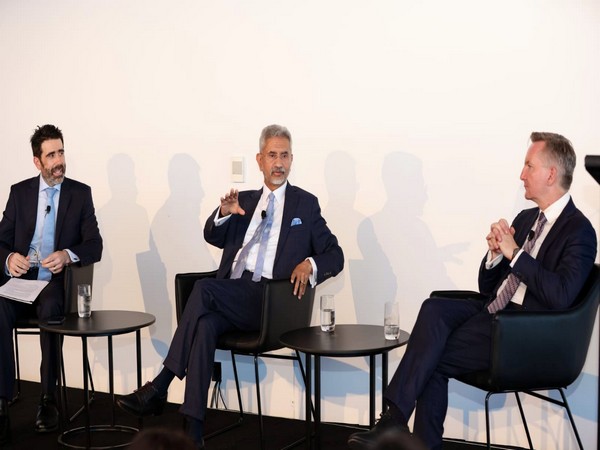

Sydney [Australia], February 18 (ANI): Speaking at the inaugural Australian Strategic Policy Institute (ASPI) and India's Observer Research Foundation (ORF) Raisina @ Sydney event, External Affairs Minister S Jaishankar on Saturday highlighted the need for derisking the global economy and ensuring trust and transparency in the digital domain.
He said that there is an urgent collective task to derisk the global economy, adding, "Over-dependence on manufacturing, over-dependence on energy, over-dependence on services. So how do we create more reliable and resilient supply chains? In a more digital world, how do we ensure at least minimal trust and transparency? Because the fact is that we cannot be agnostic about data in the manner in which we were mistakenly agnostic about products, you know. Where my data resides? Who processes it? What do they do with it? How do they extrapolate it? It matters deeply to me. So for us to pretend that all nations are the same, and it's none of our business, what happens inside, I think that era is now behind us, and we must not just accept it, we must actually be aware of it, and make plans to deal with this."
Underscoring "great uncertainty, a lot of unpredictability, new players, new behaviour," he said, "if we put together really the cumulative impact of three years of COVID, the damage that it has done to the global socio-economic fabric, the year of the Ukraine conflict, the knock-on effects, the fuel, food, fertiliser, trade disruptions, the shortages it has created, the uncertainties it has enhanced, and then take some of the perennial challenges which pre-existed."
On climate change, Jaishankar said, "climate was a growing concern. I think in the last few years, what we thought the future portended has actually happened to us. So we are witnessing climate events on an increasingly larger, more catastrophic scale. And in fact, today in any global risk assessment, I would say, building in a climate calculation is very much a part of that."
"This applies as well to green technologies. We should not end up in a world where our desire to be greener leads us to be more dependent on a few and therefore more insecure. So how do we decentralize, how do we collaborate, how do we diversify, and in a sense how do we democratize the world? Democratize it technologically, democratize it economically," added Jaishankar.
He also raised concerns over terrorism, maritime security and financial sustainability.
"There are the other concerns - concerns about terrorism, concerns about maritime security. There are also growing concerns about financial sustainability. I think there are more than 70 countries that have or are engaging the IMF, in terms of stabilizing their national finances. And unlike in the near past, many of these are not low-income countries, some of them are middle-income countries. So, I think even an optimistic view of the world would be reasonably pessimistic at this point," said Jaishankar.
Talking about globalization, Jaishankar said that it is a double-edged sword.
"Because globalization has worked, it's had its problems, it's had its downsides. But it's had actually an enormous impact, both the pluses and minuses on global society. Globalization actually has helped to create a rebalancing," he added.
The EAM said that the G20 itself is proof of that rebalancing, that, till 2008, the global leadership such as it was, was seen as G7. And the fact was that the events of 2008, 2009 demonstrated that G7 was too narrow.
"So I use G20, but I would not stop at G20. I use that as a metaphor to underline the point that if you look today, at the production and consumption centers of the world, they are vastly different, certainly from what they were in 1945. But I would say almost every decade, it's very useful to actually see a decadal chart of who's up and who's down and how the balances are shifting then," added Jaishankar.
He further added that rebalancing is creating an emerging multipolarity. He gave the example of the US and said that it is aware of its limitations and has changed its mindset as it is now ready to work with like-minded allies.
"The US is actually getting into a mindset where it is aware of that limitation and is open to working with like-minded partners and addressing it," Jaishankar said.
He said that democracy is perceived as a global aspiration because India chose to be a democracy at the time of her independence.
The foreign minister pointed out that as the world transformed and rebalanced from the era of a very "Euro Atlantic" view there was a need for a debate and a conversation on practices and beliefs and cultures which are relevant to how democracy is actually executed and improved.
Jaishankar said that the members of the G20 have a huge responsibility since the countries of the world expect them to address and solve their concerns.
On the G20 presidency, Jaishankar said that it is an extraordinary opportunity and a great honour.
"It is a time when you have a certain convening power, agenda-shaping opportunity but it is also a particular juncture of world politics," he added.
"Our hope is to stir the G20 in the direction to undertake the responsibilities, and remit with which it was originally tasked, which was economic growth and global development. And we are doing this not as a feeling or vibes from the rest of the world, we did it as a practical empirical exercise in January," he added.
He said that India consulted with Prime Ministers and Cabinet ministers of 123 countries. He said that India has a good sense today by literally asking the world.
"With the incomings and the outgoings associated with a particular chair, we have some visibility, some role as well, he added.
He clarified that at a strategic level, the most notable is Indo-Pacific and at the mechanism level, is the Quad.
"The Quad is an enterprise laden with a lot of significance. If you look at the Indo-Pacific space, the four countries are not geographically contiguous, with an enormous amount of sea and land space between them. They have overcome their past outlook to forge something common in response to a perceived and regional lead," he added.
Regarding the role of the chair in the G20, he lauded the predecessor Indonesia and said that the last year was a real struggle, the Ukraine conflict had polarized the G20. "We worked very hard to find common ground on that issue and succeeded at the Bali summit. An enormous amount of credit is due to Indonesia's patience and creativity.
Jaishankar also met Australian Deputy Prime Minister and Defence Minister Richard Marles and discussed challenges that India and Australia confront.
"Great to meet DPM and Defence Minister @RichardMarlesMP this evening. An Insightful conversation on defence and security challenges that India and Australia confront. Our shared values and strategic convergence underpin growing cooperation," he tweeted. (ANI)


