 हिंदी खबर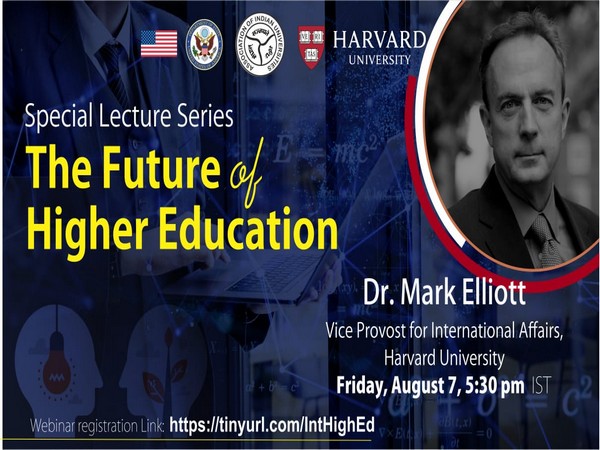

By Aveek Banerjee
New Delhi [India], Aug 7 (ANI): The restrictions on international travel due to the COVID-19 pandemic have disrupted the aspirations of students who wished to continue their higher education in acclaimed international universities.
In these unprecedented circumstances, there has been debate about the future of higher education in Indian and foreign institutions. To contribute to this discussion, the Association of Indian Universities and the US Embassy in New Delhi collaborated to present a special lecture series titled "The Future of Higher Education" on Friday.
The webinar series, moderated by Karl Adam, First Secretary, Education and Culture, US Embassy, New Delhi, and Dr Pankaj Mittal, Former Additional Secretary of University Grants Commission, seeks to answer a key question: How does internationalisation of higher education look like in a post-COVID world?
The main speaker of the event, Dr Mark Elliott, the Vice Provost for International Affairs, Harvard University, began the series by saying: "In the short term, it is clear that the pandemic has indeed effected massive changes in the patterns we have come to observe in international higher education."
Dr Elliott remarked that people across the world had adapted to the pandemic much more quickly than expected, through online tools of communication.
Speaking on the future of internationalisation of higher education, Dr Elliot said: "The enormous experiment in online education will leave us all permanently changed. We would be far more willing to participate in long-distance educational ventures. The work we have been doing in this area for the last few years would be seen as preparatory to a more widespread turn to online teaching, and education, and knowledge transfer. Universities will become more involved in this domain than before."
Dr Elliott said that a possible increase in number of partnerships between universities could be seen, stating that after COVID-19, more people in administrative positions can see the value of cultivating relationships at an institutional level.
Speaking about the recently introduced National Educational Policy (NEP) 2020, he stated that the policies promise a new beginning in education at all levels in India, and lay the foundation of a brighter future for all Indians regardless of birth, religion or socioeconomic situations.
While responding to a question by Dr Mittal on how India can attract international students, Dr Elliott said: "Indian students are among the most talented in the world, and Harvard and other American universities would be much stronger with the addition of really talented, smart, creative and hardworking scholars and scientists from India. I know from my visits to many campuses that efforts have been underway in some universities. I hope that the NEP will provide more room for these universities to grow, and to have the kind of autonomy and independence that is vital for success for all institutions of higher education."
"There is a big market for education in India, and some combination of foreign universities setting up campuses in India, or joint programmes with Indian institutions is on the cards," he said.
On being asked on how India can become a brand for higher education, Dr Elliot emphasised on government investment on infrastructure, laboratories and other facilities in universities.
"It needs a firm hand of the government, and then letting the faculty handle it. Institutions like JNU and IIT have demonstrated that this can be done. India also has a huge advantage as English is widely spoken here, as compared to other East Asian countries," he said. (ANI)


