 हिंदी खबर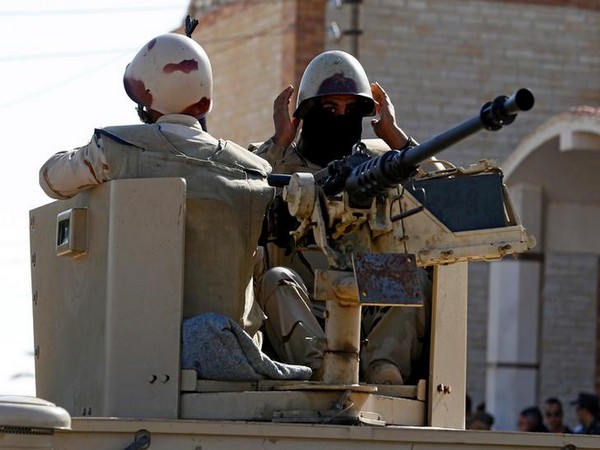

By John Solomou
Nicosia [Cyprus], August 16 (ANI): Since 2013, the Egyptian government has been trying hard to stem a deadly insurgency in the Sinai Peninsula with scores of insurgents and Egyptian soldiers dead every month.
The insurgency, which is spearheaded by a local Islamic State (ISIS) affiliate called Wilayat Sinai (Sinai Province), remains largely hidden from the public eye, as the Government of President Abdel Fattah al-Sisi does not allow journalists and outside observers to visit the sparsely populated North Sinai. The conflict has also been kept at a distance from the popular tourist resorts at the southern end of the peninsula, like Sharm El Sheikh, Dalab and Taba.
Hardly a month passes by without a terse statement issued that IS insurgents killed several soldiers, usually by improvised explosive devices (IEDs) or in gun battles, or that soldiers killed a number of insurgents.
As journalists are not allowed to visit the area, these statements do not give many details about the continuous conflict in North Sinai, which has caused the displacement of about 100,000 residents and has left over 400,000 in need of humanitarian aid.
Last Thursday, a roadside bomb exploded in New Rafah, in the northern part of the Sinai Peninsula, on the border with the Gaza Strip, killing eight members of Egypt's security forces, including an officer and wounding six soldiers.
On August 1, an army spokesman said that security forces have killed 89 suspected insurgents in several operations in North Sinai, without specifying when the operations took place. The army also destroyed 404 IEDs, four explosive belts and 13 tunnels used by militants to infiltrate Egyptian territory. The spokesman added that the army had suffered eight casualties.
In October 2015, Sinai Province insurgents claimed responsibility for the bombing of a Russian Airliner that killed all 224 people on board. Russian officials at the time complained that security procedures at Egyptian airports were insufficient and banned flights to Egyptian Red Sea Resorts.
Flights from Russia to Sinai were resumed last Monday after almost 6 years.
Sinai Province insurgents in 2017, launched modern Egypt's deadliest attack when 311 worshippers were killed by armed men carrying flags like those of the ISIS in a gun and bomb assault at the mosque in Bir al-Abd during Friday prayers.
Egypt has been battling armed groups in northern Sinai for years. The vast rugged peninsula has always been a hotbed of illicit activities, like the smuggling of arms, drugs and supplies to the Gaza Strip, breaking the blockades imposed by Israel and Egypt.
Recently the Egyptian government stated that in northern Sinai, the army has created a buffer zone and destroyed tunnels which, as it claims, were used by smugglers to send weapons and fighters between Egypt and Hamas-run Gaza.
Violence in Sinai escalated after the 2013 military coup that removed Islamist President Mohamed Morsi, of the Muslim Brotherhood, amid nationwide protests against his brief rule. Insurgents are mainly targeting Egyptian Security forces, minority Christians and people accused of collaborating with the police and the military.
It should be noted that even before the insurgency, the region's mainly Bedouin tribes have been politically and economically disenfranchised and treated as second class citizens by the central government in Cairo, which prohibits Bedouins to serve in the army or in government positions. Sinai residents often are deprived of education, health care or clean water. This may be because Bedouins are accused by Egyptians of collaborating with Israel during the occupation of Sinai in the wake of the 1967 Arab-Israeli war. For most of the time since 2013 North Sinai has been under a state of emergency.
The scorched earth policy and heavy-handed counterinsurgency tactics followed by the Egyptian army increase the frustration and desperation felt by Bedouins and makes some of them join the WSinsurgents. There are reports that the soldiers employ collective and indiscriminate punishment by targeting and arresting members of the family of suspected insurgents.
Human Rights Watch reported in May 2019, that based on interviews with scores of Sinai residents, throughout the operations in Sinai the "Egyptian military and police have carried out systematic and widespread arbitrary arrests--including of children--enforced disappearances, torture, and extrajudicial killings, collective punishment, and forced evictions."
In March 2021, Human Rights Watch accused the Egyptian armed forces of violating international human rights law and committing war crimes by demolishing more than 12,300 residential and commercial buildings and destroying 6,000 hectares of farmland in North Sinai between 2013 and 2020.
Although in recent months, the frequency of attacks and clashes between security forces and insurgents has decreased, this does not mean that the "hidden war" in North Sinai is over. As Alison McManus, senior fellow at the Centre for Global Policy says: "Certainly militant capacity has been degraded, but not to the point of securing the province for the safety of its residents or of economic development."
The Egyptian government should make serious efforts to win over the Bedouin tribes by stopping discrimination against them and start improving the region's infrastructure and the provision of essential services.
David Thaler and Yousef Addelfatah, researchers at Rand Corporation, in an article in Small Wars Journal point out: "To make headway against WS and other militant groups on the peninsula, the Egyptian government could focus on providing services to its citizens there and repairing its relationship with them. Better aligning the tribes with Cairo and having them serve as the government's eyes and ears in the region could provide the Egyptian military with a significant advantage--one they are unlikely to succeed without." (ANI)




