Erdogan's belligerent policies leave Turkey more isolated than ever
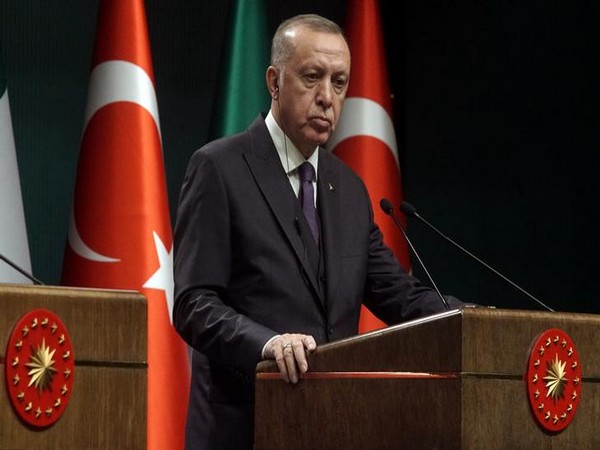
Nicosia (Cyprus), November 02 (ANI): In the past few years Turkish President Tayyip Erdogan has reversed the policy of his country from "zero problems with neighbours" and from a model of Muslim democracy and ally, into a country with almost zero friends and allies, while Ankara is currently locked in several conflicts and is engaged in the destabilization of several countries in the Middle East, North Africa and now the Nagorno-Karabach region.
ANI
Nov 02, 2020 12:45 IST

By John Solomou
Nicosia (Cyprus), November 02 (ANI): In the past few years Turkish President Tayyip Erdogan has reversed the policy of his country from "zero problems with neighbours" and from a model of Muslim democracy and ally, into a country with almost zero friends and allies, while Ankara is currently locked in several conflicts and is engaged in the destabilization of several countries in the Middle East, North Africa and now the Nagorno-Karabach region.
All this is taking place at a time when the Turkish currency has breached the psychological barrier of 8 Turkish Lira to the US dollar and the Turkish economy is heading for a repeat of the disastrous 2001 financial crisis.
Ten years ago Turkey's Foreign Minister Ahmet Davutoglu was proclaiming a policy of "zero problems with neighbours" and US President Barack Obama was saying that Turkey is a model for Muslim democracy.
All this started to change in 2015 when the ruling AKP party (Justice and Development Party) lost its parliamentary majority and Erdogan formed an alliance with the far-right nationalist MHP party (Nationalist Movement Party) and neo-nationalists on the left, who supported a militaristic foreign policy and reliance on hard power.
Gonul Tol, Director of the Centre for Turkish Studies at the Middle East Institute, says: "The new foreign policy doctrine views Turkey as a country surrounded by hostile actors and abandoned by its western allies. Therefore, it urges Turkey to pursue a proactive foreign policy that rests on the use of military power outside its borders."
So far Ankara has made three military incursions into Syria, allegedly to stop Kurdish militias operating near its borders, occupies large swathes on the north of the country, and carries out bombings of Kurdish communities in Iraq.
It became involved in the civil war in Libya, where it sends proxy mercenaries and arms supplies to the government of Prime Minister Fayez al-Sarraj, and signed an agreement with it, which redraws the maritime boundaries in the Eastern Mediterranean to the advantage of Ankara and severely restricting the rights of Greece and Cyprus.
It has sent drilling ships in the Aegean Sea, escorted by warships, violating the Law of the Sea and Cyprus' rights to its Exclusive Economic Zone. The tension between Greece and Turkey, two supposedly NATO allies, is escalating every week and nobody can rule out the possibility of an accident that would lead to war.
Last July, when fighting broke out between Armenian and Azerbaijani forces in Nagorno-Karabakh, (an area inhabited by ethnic Armenians) Turkey pledged to provide "unconditional support" to Azerbaijan. It has sold a lot of arms to the oil and gas-rich country, including Turkish made Bayraktar drones- which are manufactured by Erdogan's son in law- and sends numerous Syrian mercenaries to fight together with Azeri forces. While Russia called upon the warring parties to show restraint, Erdogan expressed support with Baku and said that Azerbaijan and Turkey are "one nation in two states."
Undoubtedly, Turkey is a strategically important country with a strong army, but there is no country she can ask for real support, except Qatar, which can only give it money. Erdogan has angered the West by seeking closer ties with Moscow and is probably facing US sanctions for the purchase of the Russian S-400 missile system. Although Russian President Vladimir Putin reportedly has good relations with Erdogan, the fact remains that in a number of conflicts, and specifically in Syrian, Libya and now Nagorno-Karabakh they are on opposite sides.
Some observers view the Russian airstrike on the Faylaq Al-Asham rebel training camp in the Syrian province of Idlib on October 26 as Moscow's "warning shot" to Turkey over its support for groups viewed by Moscow as extremist. OrwaAjjoub, affiliated researcher at the Centre for Middle Eastern Studies at Lund University in Sweden has said that the airstrike on the Turkish-backed rebels should be seen as part of a wider conflict between the two nations.
"Turkey's involvement in the conflict between Azerbaijan and Armenia in Nagorno-Karabakh and the escalation of the war with a possible occupation of the city of Stepanakert would probably violate Russia's red line and Moscow may feel compel to activate its defence pact with Armenia."
Erdogan's arrogant attitude succeeded in offending just about everybody in Europe and the US. He called the present leaders of Europe "links in the chain of the Nazis", said that he will give US President Donald Trump "a lethal Ottoman Slap", insists that some Aegean Islands should belong to Turkey and not to Greece, frequently attacks Israel, pretending to be the defender of Palestinians, and threatens to flood Europe with refugees.
His most recent clash is with French President Emanuel Macron who, following the beheading of a French school teacher vowed to combat what he described as" Islamist separatism" in France. Erdogan called for a boycott of French products and said that "Macron needs mental treatment." France recalled its Ambassador to Turkey, while a French presidential official said: "We demand that Erdogan change the course of his policy because it is dangerous in every respect."
David Romano, Professor of Middle East Politics at Missouri State University says: "In a short amount of time, Turkey may find itself very much over-extended and isolated. At some time after that happens, the Turkish public will either blame Erdogan for what happened or Turkey will see itself become a much weaker pariah state, or both." (ANI)
Tags:
Get the App