UAE-held International Roundtable on Humanitarian Prediction and Consequent Action concludes
Titled Humanitarian 'Aid Predictive Landscape Roundtable', the event saw the participation of leading global experts on humanitarianism and Artificial Intelligence, representing several international organisations.
ANI
Jun 19, 2026 14:12 IST


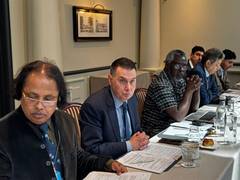
Abu Dhabi [UAE], June 19 (ANI): An international roundtable held by the Office of Development Affairs, the Presidential Court, under the patronage of Theyab bin Mohamed bin Zayed Al Nahyan, Deputy Chairman of the Presidential Court for Development and Fallen Heroes' Affairs, on Tuesday, June 16, 2026, at Zayed National Museum, Abu Dhabi, on how to close the gap between predicting humanitarian crises and acting to provide urgent relief has concluded with a rich set of ideas and proposals thrown in.
Titled Humanitarian 'Aid Predictive Landscape Roundtable', the event saw the participation of leading global experts on humanitarianism and Artificial Intelligence, representing several international organisations.
In his opening remarks, Omar Sultan Al Olama, Minister of State for Artificial Intelligence, Digital Economy, and Remote Work Applications, highlighted that artificial intelligence is opening new horizons for the humanitarian sector, strengthening its ability to anticipate and respond to crises more effectively. He noted that the advanced analytical and predictive power of today's technologies allows humanitarian organisations to better understand challenges before they emerge and to anticipate future needs.
Al Olama added that the coming phase will witness a shift in how humanitarian priorities are defined and how international efforts are coordinated, driven by advanced technologies that enable more effective ways of working to support communities and enhance resilience.
He stressed that the future of artificial intelligence depends on broader collaboration between governments, international organizations, the private sector, and technology institutions to ensure these tools are used in service of humanity, emphasizing that the true success of AI lies in its positive impact on the society.
Speaking on the roundtable and its significance, Jan Rielaender, Head of Resilient and Sustainable Development Strategies at the OECD Development Centre, said: "AI must be guided by clear principles -- transparency, fairness, accountability -- so that it serves rather than undermines the public good.
At the roundtable, we discussed several aspects of the link between prediction and action, including its operational and institutional dimensions. In my opinion, one area that deserves urgent attention is climate resilience planning -- building a clear picture of how climate risk is shifting, right down to the local level, wherever people live."
Greg Puley, Chief of Climate and Innovation at the UN Office for the Coordination of Humanitarian Affairs, said that so many humanitarian disasters are predictable. "We have powerful new tools to improve the way in which we can anticipate disasters, yet too often we in the humanitarian system respond after the crisis hits.
We need to take steps to close this gap between prediction and anticipatory action. We need to seize the full potential of artificial intelligence to help us know what we must know far in advance. If we are able to ensure that the benefits of early action are enjoyed equally by all, this has the potential to improve our humanitarian response in ways unimaginable in the past," he concluded.
The participants discussed the most prominent challenges to expanding the use of artificial intelligence within the humanitarian system, which are represented in laying the right foundation for data, overcoming financial challenges and various obstacles, and the importance of establishing a forecasting mechanism to ensure four essential pillars to support the humanitarian system, which are: helping to expand the scope of success stories and practices, addressing the necessary challenges and providing vital capabilities, and providing space to test artificial intelligence applications. (ANI/WAM)
Tags:
Get the App