 हिंदी खबर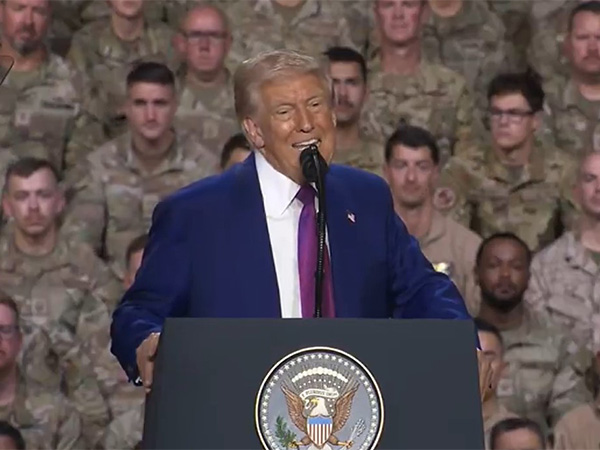

Doha [Qatar], May 15 (ANI): US President Donald Trump on Thursday said to have played a role in settling the escalating tensions between India and Pakistan.
According to Trump, the situation was getting "more and more hostile" but somehow managed to get it "settled."
Speaking to American troops at a base in Doha, Qatar, Trump mentioned that both countries were happy with the trade discussion, suggesting that focusing on trade instead of conflict could be a way forward.
"I don't want to say I did, but I sure as hell helped settle the problem between Pakistan and India last week, which was getting more and more hostile, and all of a sudden, you'll start seeing missiles of a different type, and we got it settled," Trump said.
Tensions between India and Pakistan heightened after a deadly attack in Kashmir's Pahalgam, which killed 26 people. India accused Pakistan of supporting the attack, leading to a series of diplomatic and military actions, including the suspension of the Indus Waters Treaty and Operation Sindoor.
The US President mentioned that the situation was "escalating out of control" but seemed confident that his efforts had contributed to a resolution.
"I hope I don't walk out of here and two days later find out that it's not settled, but I think it is settled, and we talked to them about trade. Let's do trade instead of, and Pakistan was very happy with that, and India was very happy with that, and I think they're on the way..."
He also commented on the historical nature of the dispute. "They have been fighting for about a 1000 years in all fairness. So I said, you know. I could settle that up. I could settle; let me settle it up, and let's get them all together. How long have you been fighting for about 1000 years? Oh, that's a lot. I'm not sure about that. I'm not sure about settling. That's a tough one. They've been fighting for a long time... It was really going to be escalating out of control."
Notably, Pakistan was created on August 14, 1947, as a result of the Partition of India, which was driven by the demand for a separate Muslim state. The partition was officially sanctioned by the Indian Independence Act of 1947, leading to the formation of both Pakistan and India as independent dominions.
The All-India Muslim League, under the leadership of Muhammad Ali Jinnah, played a key role in advocating for the creation of Pakistan.
Earlier today, foreign affairs expert KP Fabian asserted that India's decision to engage with Pakistan was not a result of US mediation post Operation Sindoor.
He said that the US played a subtle yet significant role in pushing Pakistan towards the ceasefire talks.
Speaking to ANI, Fabian clarified that the US did not facilitate direct mediation between India and Pakistan. Instead, the Americans seem to have nudged Pakistan in the right direction, encouraging them to talk with India directly.
"America did not mediate; they might have pushed Pakistan at some point for the ceasefire. It was not the US telling us, 'You should talk about it, India will do this, Pakistan will do that,' - that would be termed mediation. However, pushing Pakistan towards the ceasefire talks is not mediation but is still good. We are grateful to them for that much. We should thank President Trump for this, but the thanks is in context, not for the mediation; I clarify that there was no mediation. America just pushed Pakistan in the right direction, and we thank them for it," he said.
After the intense cross-border hostilities between India and Pakistan, a ceasefire was brokered on May 10, the US played a subtle yet significant role in pushing Pakistan towards the ceasefire talks.
The US administration's behind-the-scenes efforts, particularly those of Vice President JD Vance and Secretary of State Marco Rubio, involved extensive communication with Indian and Pakistani officials. Vance reportedly called Prime Minister Narendra Modi, urging him to consider de-escalation options, while Rubio spoke with India's External Affairs Minister, S Jaishankar, and Pakistan's Army Chief, General Asim Munir.
These diplomatic efforts ultimately led to Pakistan's Director General of Military Operations reaching out to India's DGMO to discuss a possible ceasefire.
While the US attempted to take credit for the ceasefire, Fabian suggested that their role was more nuanced.
According to Fabian, when US President Trump announced that he had spoken to both parties and secured a ceasefire agreement, the Indian government was "quite upset" with the claim.
India took decisive action, leaving Pakistan uncertain about its next steps. Pakistan faced a dilemma: escalate the situation or seek a ceasefire.The US stepped in, urging Pakistan to request a ceasefire. The US then informed India of Pakistan's request, but India insisted on direct communication from Pakistan.
"When President Trump said before the announcement that he had spoken to both parties throughout the night and that we had agreed to the ceasefire, our people were quite upset with that. America did not mediate. We were stern with our actions, and Pakistan did not know what to do next. Should they escalate, or do they ask India to discuss a ceasefire? They were in a dilemma," Fabian said, reflecting on the tense period of engagement.
Pakistan's Director General of Military Operations (DGMO) eventually contacted their Indian counterpart, and the two DGMOs agreed to talks, paving the way for a ceasefire.
Fabian highlighted India's firm stance, ultimately leading to Pakistan seeking a ceasefire. The diplomatic efforts culminated in a fragile peace between the two nations.
He detailed how the situation unfolded diplomatically. "During that time, America asked Pakistan to ask for a ceasefire. The US then told us that Pakistan is asking for a ceasefire, and we said fine, good enough, but we would want to hear that straight from Pakistan. Pakistan should tell us directly that they want a ceasefire. The Pakistani DGMO called after that, and after a while, our respective DGMOs agreed on the talk."
Operation Sindoor was launched by the Indian Armed Forces in the early hours of May 7, targeting nine terror sites in Pakistan and Pakistan-occupied Jammu and Kashmir (PoJK). The operation was a retaliatory response to the May 5 terrorist attack in Jammu and Kashmir's Pahalgam, which killed 26 civilians, including one Nepali national, and injured several others.
In response, Pakistan carried out cross-border shelling across the Line of Control and attempted drone attacks along the border regions.
India retaliated with a coordinated strike, damaging radar infrastructure, communication centres, and airfields across Pakistani airbases. (ANI)
"I sure as hell helped settle problem between India-Pak last week," says Trump
ANI | Updated: May 15, 2025 22:51 IST




