 हिंदी खबर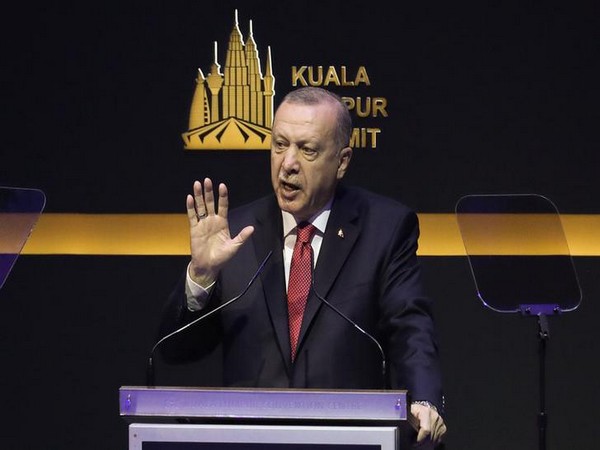

By John Solomou
Nicosia [Cyprus] February 28 (ANI): Russia's invasion of Ukraine has put Turkey's President Recep Tayyip Erdogan in a very difficult position, as he must strike a very delicate balance in Turkey's relationship with NATO - and the West in general- and Russia, with which Ankara has very important economic relations.
While supporting Ukraine and realizing that he must stand on the side of NATO in this conflict or else risk the wrath of the West, Erdogan also feels compelled to do his utmost to minimize the risks of retaliation by Russian President Vladimir Putin.
Erdogan has been offering to mediate between Kyiv and Moscow and says Turkey wanted to keep good relations with both countries. However, it would be extremely difficult to maintain real neutrality. In the end, inevitably one of the two countries would consider that Turkey has taken the side of its enemy.
Although Turkey has condemned Russia's invasion of Ukraine, it tries to maintain neutrality and so far, it has not participated in the sanctions imposed by Western governments against Russia. It has also, reportedly, rejected the call by Ukrainian President Volodimir Zelensky to close the Black Sea to Russian warships.
It should be pointed out that, under the Montreux Treaty of 1936, Turkey cannot stop Russia - a country that has shores to the Black Sea- from sending more ships to the Black Sea if those ships are going to their homeport. It can only prevent Russia from sending ships into the Mediterranean.
President Erdogan, speaking ahead of a NATO conference on 25 February said that NATO should have taken more "determined steps" against Russia's military incursion into Ukraine and pointedly added: "Right now, the European Union is giving plenty of advice to Ukraine. The EU has not taken a determined stance.
Speaking to reporters after the meeting, NATO's Secretary-General Jens Stoltenberg stressed that the world would hold Russia and Belarus accountable for their actions and added:
"The US, Canada and European Allies have deployed thousands of more troops to the eastern part of the Alliance. We have over 100 jets at high alert operating in over 30 different locations. And over 120 ships from the High North to the Mediterranean, including three strike carrier groups. There must be no space for miscalculation or misunderstanding. We will do what it takes to protect and defend every Ally and every inch of NATO territory."
It is not known yet if Turkey undertook any commitments in the NATO meeting and whether it will provide any military assistance to Ukraine since Ankara's financial and defence ties with Moscow have limited considerably Turkey's credibility as a staunch supporter of the Alliance.
In a shift from Ankara's attitude in the past few years, Turkish officials at the NATO meeting promised increased coordination with NATO allies, but what this means in practice remains to be seen.
The Turkish government a few years ago had supplied Ukraine with Bayraktar TB-2 drones, which last October were used against pro-Russian forces in Donbas.
At that time Russian President Vladimir Putin warned Erdogan that Ankara was involved "in a provocative and destructive activity."
Turkey finds itself in a quandary because it has defence industry relations both with Ukraine and Russia.
It has supplied drones to Kyiv, while last November Turkey's drone magnate Baykar signed a contract with one of the leading engine companies in Ukraine for the procurement of engines for Baykar's Combat Unmanned Aircraft System (MIUS) project.
Ankara purchased from Moscow Russian S-400 missiles, which led to the escalation of tension in the Turkish-American relations and resulted in the US ousting of Turkey from the F-35 jets program.
Furthermore, state-owned Russian companies are constructing Turkey's first nuclear power plant in Akkuyu in the Mersin Province at a cost of more than USD 20 billion.
There is no doubt that Turkey will be one of the countries the economy of which will be most affected by the Russian invasion of Ukraine. The sectors of trade, energy, tourism, agriculture and construction in Turkey will be adversely affected.
According to official statistics, Turkey's annual trade volume is USD 34.7 billion with Russia and USD 7.4 billion with Ukraine. Russia is one of Turkey's largest partners in exports and imports.
Turkey depends heavily on Russia for its energy supplies and covers one-third of its needs with Russian natural gas. Even if there is no disruption of Russian gas supplies, Turkey's faltering economy has already been hit hard by the steep rises in energy prices.
The sector of tourism, which last year contributed more than 24.5 billion dollars in desperately needed foreign exchange, depends to a large extent on Russian and Ukrainian tourists.
Last year, approximately 4.65 million Russians and 2.55 million Ukrainian tourists visited Turkey and now, with the war in Ukraine, it would be next to impossible to see such high numbers.
In 2021, Turkey imported 64.6 per cent of its wheat from Russia and 13.4 per cent from Ukraine. Ankara would desperately need to find enough wheat to cover its needs this year.
Even if it succeeds it, will have to pay a much higher price, something that will severely affect most Turks, who cannot afford to buy bread from bakeries and rely on government-subsidized bread.
Turkish construction companies were last year very active in Russia, where they accounted for about 38 per cent of the business volume and earned more than 11 billion US dollars.
Additionally, the Turkish economy will also feel the immediate global implications of the crisis which will certainly be higher inflation and lower growth.
So, Turkey must do its utmost to strike a very delicate balance in its relationship with NATO and Russia and avoid at the same time a devastating blow in its faltering economy. (ANI)


