 हिंदी खबर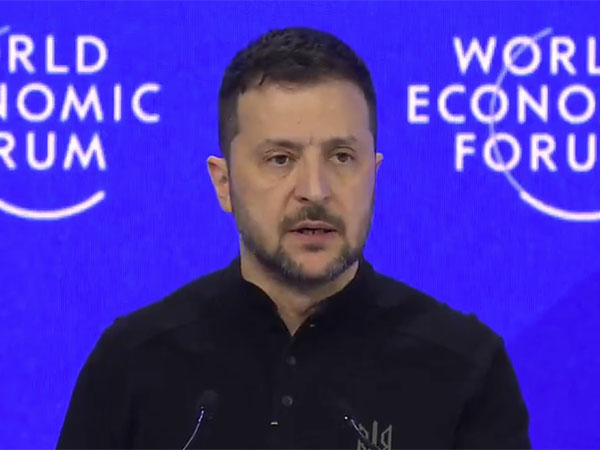

Davos [Switzerland], January 22 (ANI): The 55th Annual Meeting of the World Economic Forum (WEF) officially began on January 21, 2025, with leaders from around the globe emphasising the urgent need for collaboration in an increasingly uncertain geopolitical and geo-economic landscape.
Klaus Schwab, the founder of the World Economic Forum, set the tone for the event by focusing on the theme of "Collaboration for the Intelligent Age," stressing the importance of global partnerships to address the complexities and opportunities arising from the rapid transition from the Industrial to the Intelligent Age.
"This transition from the Industrial to the Intelligent Age is occurring at an exponential pace, carrying unprecedented risks for humanity as we strive to prepare and adapt for its complexities. Yet, it also offers significant opportunities to transcend our current challenges and spark a new renaissance - one defined by advancements in knowledge, health, culture and societal welfare," Schwab said. He urged stakeholders from all sectors - government, business, civil society, and academia - to embrace "constructive optimism" and work together to craft solutions that can shape a future where every human being can reach their full potential.
Borge Brende, President and CEO of the World Economic Forum, highlighted the critical juncture the world finds itself at, stressing that 2025 would be a year of monumental importance. He pointed out that the traditional international order, which had shaped the global landscape for the past three decades, is in decline, urging leaders to seek more effective ways of working together. Brende underlined that collaboration is the only viable path forward to overcome challenges and secure future progress.
Echoing these sentiments, Karin Keller-Sutter, the President of the Swiss Confederation for 2025, reinforced the need for stable governance to ensure prosperity. She emphasised that democratic and liberal values provide a framework for stability and progress, with open markets, fair rules, and fiscal discipline as the cornerstones of sustainable prosperity. "Only a state with stable institutions can create a sound environment where everyone can realise their potential, and a state must protect this freedom with rules," Keller-Sutter said.
Europe's role in navigating the shifting global dynamics was also addressed, with Ursula von der Leyen, President of the European Commission, laying out a strategy to adapt to an era of "harsh geostrategic competition." She called for increased competitiveness within Europe, the strengthening of global partnerships, and a continued commitment to sustainable development. "To sustain our growth in the next quarter of the century, Europe must shift gears," von der Leyen asserted. "We should not take anything for granted. We must look for new opportunities wherever they arise. This is the moment to engage beyond blocs and taboos. And Europe is ready for change."
German Chancellor Olaf Scholz spoke about the pressing need for renewed commitments to both security and prosperity in the face of global challenges. He underscored that partnerships are key drivers of successful economic development and announced plans to reform Germany's public debt regulations to boost domestic growth. Scholz also highlighted the need for Europe to strengthen its defense capabilities and industrial base, acknowledging the uncertainty surrounding the new administration in Washington, DC, but remaining optimistic about emerging technologies.
Ukraine's President Volodymyr Zelenskyy, now in the third year of the war with Russia, emphasised the importance of Europe uniting to solidify its role as a global leader. Zelenskyy urged European nations to prioritise technological advancements and military cooperation to ensure their continued strength on the world stage. "Europe needs to compete for the top spot in priorities, alliances, and technological development," Zelenskyy said, urging European countries to allocate sufficient resources for security and defense.
China's Vice-Premier, Ding Xuexiang, used the platform to address growing concerns over the fragmentation of the global economic system and the rise of protectionism. He warned that a "trade war has no winners," advocating instead for a process of globalisation that benefits all nations equally. Ding reaffirmed China's commitment to multilateralism, emphasising the importance of a UN-centered global order and stressing that nations must work together on issues like climate change and economic inequality. He also highlighted China's progress in green energy and ongoing economic reforms. "China's door of opening up will not be closed and will only open even wider, and our business environment will only get better," Ding stated.
Pham Minh Chinh, the Prime Minister of Viet Nam, spoke of the country's dedication to leveraging artificial intelligence (AI) for its economic development. He noted that Viet Nam aims to become a hub for high-tech manufacturing and development in the region, prioritising the establishment of research and development centers, especially in AI and other advanced technologies. "These efforts will not only advance technological innovation, but also position Viet Nam as a hub for high-tech manufacturing and development in the region," Chinh said.
Cyril Ramaphosa, President of South Africa, outlined the priorities for the country's G20 Presidency, which will focus on solidarity, equality, and sustainable development. Ramaphosa emphasised the need for global cooperation to tackle the pressing challenges of the 21st century, including climate change, pandemics, poverty, and terrorism. "We are again called upon to harness that most powerful, and that most enduring, of human attributes: mutually beneficial cooperation and collaboration," he said, as South Africa prepares to host the first G20 Summit in Africa later this year.
Isaac Herzog, President of Israel, touched upon the regional instability in the Middle East, welcoming the recent ceasefire and the release of hostages but cautioning against premature optimism. "I want to be lucid and cautious...there are opportunities, but still risks. We must ensure this never happens again," Herzog said, emphasising the need for continued vigilance and collaboration in the region. (ANI)




