 हिंदी खबर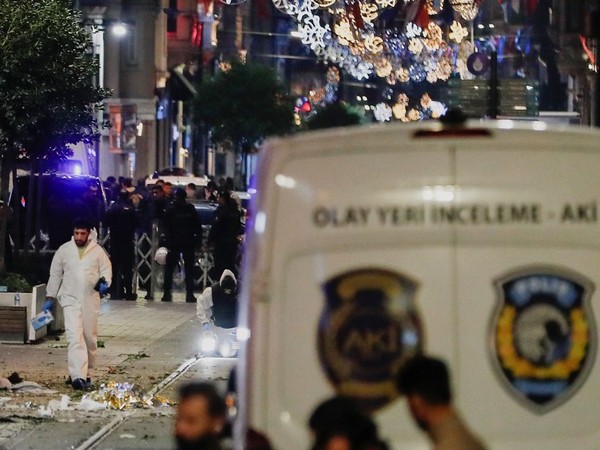

By John Solomou
Nicosia [Cyprus], November 21 (ANI): The deadly explosion on Istanbul's bustling Istiklal Street at 4.20 pm on November 13 was immediately blamed by the Turkish government on the outlawed Kurdistan Workers' Party (PKK) and the People's Defense Units (YPG). However, there are strong suspicions that it could be another false flag operation, aiming at serving President Recep Tayyip Erdogan's aims.
The PKK and the YPG have denied any involvement in the attack and claimed the government was using it as a pretext to move against Kurdish forces in Syria.
The blast in Istiklal street- one of the most popular destinations with tourists and residents in Istanbul with large chain stores and shopping malls- killed six people, including two girls aged 9 and 15, and wounded another 80.
It is remarkable that the Turkish authorities in less than 24 hours arrested the alleged perpetrator of the attack, a Syrian woman named Ahlam Albashir and accused the PKK of being behind the bombing.
Justice Minister Bekir Bozdag told Turkish media that an Arab woman (later identified as Ahlam Albashir) was seen on security camera footage as planting a suspicious package that was in fact the bomb. She had sat on a bench in the area for more than 40 minutes, leaving just minutes before the blast took place.
The police claim that Albashir admitted that she was trained as a special intelligence agent by the PKK/PYD/YPG and received instructions from Ayn al-Arab in northern Syria, where the group has its Syrian headquarters.
However, there are several things that contradict the official narrative. For example, it is highly unlikely for a trained terrorist to wait 40 minutes with a bomb in a location monitored by hundreds of CCTV cameras. Furthermore, if Albashir is an Arab, as the Police claim, it is highly unlikely that she was recruited by one of the Kurdish armed organisations, which up to now use only Kurds in their operations against the Turkish state.
Just one day after the deadly incident, Interior Minister Suleyman Soylu insisted that it was the work that outlawed PKK and its Syrian branch, the People's Defense Units (YPG).
He also put forward the allegation that if the security forces had failed to arrest the alleged perpetrator, she would have fled to Greece. Turkey keeps accusing its neighbour Greece of harbouring PKK terrorists and tension between the two countries keeps escalating.
Furthermore, Soylu once again accused Washington of supporting "terrorist organizations," saying the attack was perpetrated by the PKK, and that the PKK is supported by the US. Continuing, he flatly rejected a message of condolences from the US Embassy in Turkey concerning the Istiklal bombing. He added: "accepting condolences from the US is like a murderer being first to arrive at the scene of the crime.
However, not everybody believes the Turkish government's version of the events. A senior Turkish official told Reuters that Turkish authorities are not ruling out that the attacker has ties to the Islamic State in Iraq and the Levant (ISIL).
Journalists and politicians reminded the public of the series of bombing attacks in 2015 and 2016 that killed 862 people, which occurred at a time of parliamentary elections and which Erdogan and his Justice and Development (AKP) party exploited to their benefit in order to regain a majority.
They point out that the failed July 15, 2016, coup gave Erdogan the opportunity to purge all his opponents from key government institutions and send to jail tens of thousands of people seen as opponents of the AKP and his rule.
Turkish Minute Journalist Turkmen Terzi points out that Turkish authorities are not ruling out that the bomber has ties with the ISIL and adds: "However, this deadly blast, which targeted civilians, was more likely Turkish President Recep Tayyip Erdogan's new false flag operation prior to the G-20 summit, which convened in Indonesia earlier this week, to convince world leaders of the need for Turkey to conduct a military operation in northern Syria."
The false flag is defined as the intentional misrepresentation of an attack or hostile action that obscures the identity of the participants carrying out the action while implicating another group or nation as the perpetrator.
Sina Ciddi, a senior fellow of the Foundation for Defense of Democracies (FDD) shares Terzi's view and says: "With a government that is bent on silencing the media, placing limits on the ability of individuals and journalists to ask legitimate questions, and peddling false accusations, an equally plausible explanation is the argument that this was a false flag operation perpetrated by the Justice and Development Party (AKP), Turkey's ruling party....The Turkish government has signalled its intention to mount a heavy response against the PYD, presumably indicating that a military incursion into northern Syria may take place."
Continuing Ciddi says: "A beleaguered leader who is facing re-election in several months--in the midst of the worst economic downturn in the country's history--could have manufactured the perfect crisis to deflect public attention away from consumer inflation and toward a decisive stance against terrorism."
Berkay Mandiraci, a senior analyst from the International Crisis Group, points out: "Even before the investigation was complete, Turkish officials had made the case for a new military operation in northern Syria."
On Sunday morning, just a week after the Istanbul bombing, Turkey launched a major cross-border "anti-terror" operation in northern Syria "destroying PKK/YPG shelters, caves and warehouses", as Turkey's Defense Minister Hulusi Akar said.
It should be noted that Erdogan since October 2021 has been trying unsuccessfully to get a green light from Russia and the United States for its Syria operation, and the deadly bombing in Istanbul gave him a good excuse to execute the operation and present it as a retaliation for a terrorist bombing. It also gives him an excellent opportunity to swing away public opinion from the negative attention given to Turkey's economic woes and make ordinary Turks rally around the flag and support the government. Erdogan now presents himself as a strong leader who can defend the country against terrorism. The question is if enough Turks believe him and vote for him in next year's elections. (ANI)




