 हिंदी खबर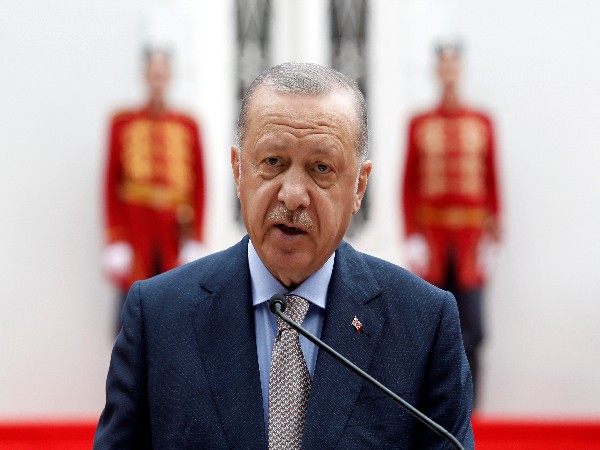

Nicosia [Cyprus] January 3 (ANI): As a result of Turkish President Recep Tayyip Erdogan's unorthodox and misguided economic policies and especially his conviction that high-interest rates raise prices, the Turkish Lira is expected to have lost 44 per cent of its value in 2021, scoring its worst performance in 20 years.
On Friday Erdogan urged Turks to keep their savings in local currency and run their business on Turkish Lira. "A long as we don't take our money as a benchmark, we are doomed to sink. I want all my citizens to keep their savings in our own money, and I recommend this," he said.
Earlier, on December 20, Erdogan announced a new deposit scheme aimed at stopping the frantic efforts made by ordinary Turks to preserve the purchasing power of their savings by exchanging them for dollars or gold.
The Turkish President promised to those who can deposit money in a foreign currency-Lira account in a bank, if the Lira loses value against the foreign currency, the amount of the loss will be charged to the Treasury.
Soon after the announcement, between 1 billion to 1.5 billion US dollars in savings were converted into Turkish Liras and from an all-time low of 18.4 to the US dollar, the Lira strengthened to 11.09, winning about 50 per cent.
This, however, did not last long as a few days later it started losing its value again and last week it sank around 20 per cent. On December 31st, it stood at 13.36 to 1 dollar.
Some economists point out that Erdogan's plan is risky because if the Lira continues to depreciate, it will push inflation up and cause a heavy fiscal burden for the state, amounting to scores of billion Liras, as it will have to cover future losses based on the exchange rate.
The autocratic Turkish leader projects the theory that there is an international conspiracy to stifle Turkey's economic development and prevent Turkey from becoming a great power.
In a bombastic speech, Erdogan said: "We see the games being played on the exchange rate and interest rates. ... With the help of Allah and the support of our nation, we will emerge from this economic war of independence with victory... Turkey may for the first time in its history have the opportunity to follow an economic policy in line with its own needs and realities."
The Turkish President is a firm believer in the crackpot theory that high-interest rates cause inflation, while orthodox economists believe that higher interest rates are needed to lower inflation.
Erdogan has been exercising great pressure on Turkey's Central Bank to keep lowering the interest rates. If the Governor of the Bank refuses or delays to act according to the President's wishes, he replaces him. In just two years he changed three Central Bank Governors. Every time this happened the Turkish Lira took a dive.
In November, inflation in Turkey was 21.31 per cent from 19.98 the previous month. As the Central Bank on December 16 cut interest rates by 100 basis points to 14 per cent, this means that in real terms the interest rates are a negative 7 per cent, essentially turning away foreign investments.
The devaluation of the Lira has made Turkey's exports cheaper but has not substantially helped the country's manufacturers or producers, who must pay much more for energy and necessary imported materials, spare parts, fertilizers etc. Furthermore, the Lira crisis eroded the savings and earnings of people and businesses and has overturned their budgets and plans.
Surely, the plunge of the Lira has made life difficult for average Turks who see the price of foodstuffs and all necessary things sharply increasing every week, and their standard of living going down.
The deposit scheme, as well as the recently announced 50 per cent increase in the minimum wage, require huge amounts of Liras to be printed, while nothing is done to curb inflation. In this way, Turkey will be flooded with money, although the purchasing power of this money will be substantially reduced due to the galloping inflation.
Political observers expressed the view that the ruling alliance of Erdogan's AKP party with the ultra-nationalists of MHP will try to take advantage of the relative relief to be created in the money-flooded market and thus Erdogan will be able to call snap elections.
One of them Ozer Sencar, MetroPoll president, believes that Erdogan's new policy, with short-term gains and potential longer-term pain, signals that Erdogan may intend to hold an election within months, ahead of elections in mid-2023. "I expect a snap election. What has been done in the economy so far is an election strategy," he said.
Economy writer Ugur Gurses says that what lies behind these risky steps of Erdogan can be a calculation "if we win the election, it (the consequences) will be worth the price to pay; if we lose, let the burden be on the shoulders of the winner." (ANI)
Under Erdogan's misguided policies, Turkey's Lira has its worst performance in two decades
By John Solomou | Updated: Jan 03, 2022 09:30 IST




