Recognize 1971 Bangladesh genocide, fix responsibility on Pakistan: Expert urges international community
Brussels [Belgium], March 30 (ANI): Remembering Bangladesh victims of 'Operation Searchlight', Paulo Casaca, founder and Executive Director of South Asia Democratic Forum (SADF) urged the international community to recognize the 1971 genocide of Bangladeshis by Pakistan and fix responsibility on them.
ANI
Mar 30, 2022 10:56 IST

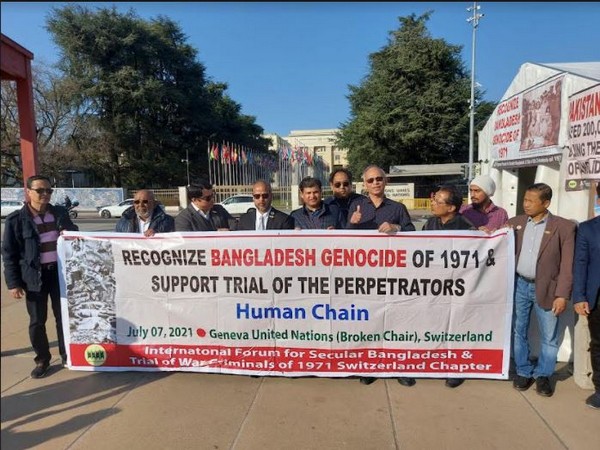
Brussels [Belgium], March 30 (ANI): Remembering Bangladesh victims of 'Operation Searchlight', Paulo Casaca, founder and Executive Director of South Asia Democratic Forum (SADF) urged the international community to recognize the 1971 genocide of Bangladeshis by Pakistan and fix responsibility on them.
"It is so important for all genuine human rights defenders, to get together with Bangladeshis and together with them say: remember the genocide and demand responsibilities from perpetrators!" said Casaca.
Despite the passage of 50 years since the '1971 Genocide' Pakistan has shown no intention to apologize.
Casaca said that he was touched by the Bangladeshi people's struggle for memory, justice, and accountability regarding the Genocide perpetrated against Bangladesh by the Pakistani military authorities.
"This genocide, organised in tandem with Islamic fanatic organisations from both West and East Pakistan, was meant to destroy the Bengali identity by murdering elites, destroying religious diversity, and raping women," he said.
Recalling his visit to the Burn and Plastic Surgery Unit of the Dhaka Medical College Hospital - where countless victims of the Islamist terror actions were being dealt with, Casca said, "At face-value, the issue was related to the supposedly faulty conditions of the coming elections; however, as 'Zead-Al-Malum - public prosecutor of the ICT - explained in a public conference on the 7th (December 2013), 'protests would vanish if the Government was to accept demands to dissolve the Tribunal' (International Crimes Tribunal of Bangladesh-ICT). All the protests regarding the lack of those elections' democratic credentials were nothing but a smokescreen used to hide the fundamental goal by Islamists to obtain impunity for the genocide's culprits."
Casca said that would have certainly not understood what was going on had he not been in Dhaka himself, speaking to doctors, magistrates, academics, or simple citizens as none of these facts were ever available in the Western press.
"Quite the contrary, a meticulously built, fictitious reality wherein this genocide's master minders were presented as 'opposition leaders', 'businessmen' or 'religious entities' - mercilessly persecuted by an authoritarian government - was shamelessly hammered throughout the western press (and most in particular by some NGO such as 'Human Rights Watch)," said Casca.
"Realising to what extent reality was turned upside down, how the very same organisations supposed to 'watch' for the respect of 'human rights' were actually working for providing impunity to genocide perpetrators, was extremely shocking," he added.
In SADF's latest contribution dedicated to the Bangladeshi genocide, Professor Uddin quoted 'The Ten Stages of Genocide' as described by Gregory Stanton in 1996 (classification, symbolization, discrimination, dehumanization, organization, polarization, preparation, persecution, extermination, and denial).
"The last twenty-five years taught us that we must add a completely new stage to that process: reversal. For the denial stage has been transformed into a more complex category of disinformation," said Casca.
Disinformation is not so much about lying (or at the very least, simply, outright lying). It is rather about creating doubts; magnifying distorted, secondary points and denying on this basis a whole narrative; distorting a context and - perhaps the most modern technique - disinforming in the name of 'the fight against disinformation'.
During the 1971 genocide in Bangladesh, the Pakistan military deliberately harmed hundreds of thousands of Bangladeshi citizens.
Rights group says the horrors of 1971 are considered one of the worst mass atrocities in history. The damage they inflicted can be described in the following numbers-- as many as three million people were believed to have been killed, up to 2,00,000 women were violated and over 10 million people were forced to cross the border to India to seek shelter. (ANI)
Tags:
Get the App