 हिंदी खबर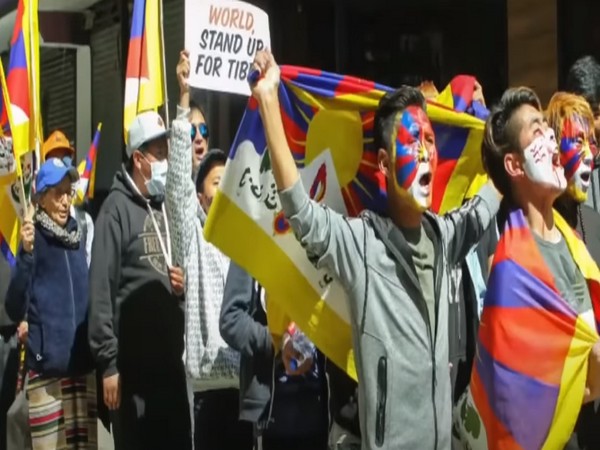

London [UK], April 25 (ANI): The Democracy Forum webinar in London on Monday (local time) highlighted China's policy of forcing state hegemony on Tibetans after 72 years of Chinese colonial rule in Tibet.
A panel of experts spoke about the Tibetan people and their struggle with the oppressive Chinese rule at the webinar.
London-based NGO The Democracy Forum held a virtual debate - titled 'Seventy-two years of Chinese colonial rule in Tibet' - to coincide with a visit to the UK by Penpa Tsering, Sikyong of the Central Tibetan Administration.
The event raised concern on China's policy of forcing a state hegemony on the region's indigenous population, who face denial of religious freedom and a deliberate displacement of their cultural identity, and assessed the impact of China's 'modernisation' of Tibet, as well as considering to what extent Western governments have been indifferent to the plight of Tibetans.
Tsering said the Tibetan movement is still very strong and, while we may not hear so much about Tibet these days due to other oppression such as that of the Uyghurs in Xinjiang, the people of Hong Kong, etc, the perpetrator, China, is always the same, hence the message to the international community is the same.
He spoke of how, 72 years ago, Tibet was forced to sign the Seventeen-Point Agreement under threat of war. The Dalai Lama tried to live under this agreement for almost eight years, but in 1956, China's 'nice' face turned and His Holiness soon came to see how China worked, which he compared unfavourably with India, where he had seen how democracy functioned.
The result of 72 years of Chinese colonialism, said Tsering, is that "our culture is dying a slow death," as is the Tibetan way of life, religion and environment, with the Chinese government employing many forms of AI to surveille the Tibetan people, all aimed at control, and more control.
The Sikyong also highlighted China's desire to be responsible for the reincarnated Dalai Lama, and how many young Tibetans are now self-immolating in protest at their plight, and in the hope that the international community will come to their aid.
While these sacrifices have been in vain so far, the Sikyong believed there was hope, though China's determined Sinicization of the region and people will continue to have serious consequences for Tibetans.
He urged the international community not to keep repeating that Tibet is part of the PRC, as this removes reasons for China to come to the negotiating table with Tibet.
"This is a topic of undeniable international relevance and concern," said TDF President Lord Bruce describing a political system which has evolved over a period of 70 years and continues to exert a level of control over the lives of 6.7 million indigenous Tibetan people, despite being clearly incompatible with the universally accepted language of human and civil rights.
Bruce cited a recent Freedom in the World Report published by Freedom House, which identified Tibet as the least free country on Earth - in a worse ranking than North Korea, and sharing the bottom spot with South Sudan and Syria.
Bruce noted that, for over 60 years, criticism of China's subjugation of Tibet as a colonial project has been aired frequently at the United Nations General Assembly, with resolutions debated and passed to that effect.
Indeed, a UN investigation into the treatment of human rights in Tibet - specifically minority issues, cultural rights, the right to education and the freedom to practise religion - generated a report, published in February as an open letter to the Chinese government, which exposed the cultural alienation of over one million indigenous children, cloistered remotely in residential boarding schools, revealing to the world perhaps the most existential and egregious example of 'a policy of forced assimilation of the Tibetan identity into the dominant Han-Chinese majority, through a series of oppressive actions against Tibetan religious, and linguistic institutions'.
Chris Law MP, Co-Chair of the All-Party Parliamentary Group on Tibet argued that Tibet had been the testing and training ground for future oppression in Xinjiang.
He lamented how families were losing their young children to 'education' boarding camps, with 4-to-6-year-olds taken away to learn Mandarin, Chinese culture and politics, and nothing about their own Tibetan history and culture.
"When they return home, they are withdrawn and show symptoms of PTSD, and the world needs to call China out on this," Law insisted.
Raising the challenges involved in Dharamsala's Middle Way Policy was Dr Martin Mills, Director of the Scottish Centre for Himalayan Research at the University of Aberdeen.
He spoke of how Tibetans' capacity for political agency has clearly diminished, especially in the last 20 years, and wondered what can be done to address this, both by Tibetans in exile and the wider world.
Dibyesh Anand, Head of the School of Social Sciences and Professor of International Relations at the University of Westminster, emphasised why we must see China as a colonial power rather than simply a military aggressor.
He underscored the difference between Chinese colonialism in Tibet and certain previous forms of colonialism, where some citizens could feel a measure of solidarity with the colonial power, in that we are not only dealing with colonial occupation, but colonial occupation by an authoritarian state. (ANI)


