Indian, Australian High Commission to UK co-host Indo-Pacific conference in London, explore strategies for regional strengthening
The Australian and Indian High Commissions to the United Kingdom (UK) co-hosted the inaugural Indo-Pacific Conference in London on Thursday (November 30) to explore practical ideas to strengthen Indo-Pacific resilience.
ANI
Dec 01, 2023 04:27 IST

By Soumik Saha
London [UK], December 1 (ANI): The Australian and Indian High Commissions to the United Kingdom (UK) co-hosted the inaugural Indo-Pacific Conference in London on Thursday (November 30) to explore practical ideas to strengthen Indo-Pacific resilience.
The unique collaboration brought together leading experts from Australia, India, and the United Kingdom to address threats to regional security and enhance strategic stability.
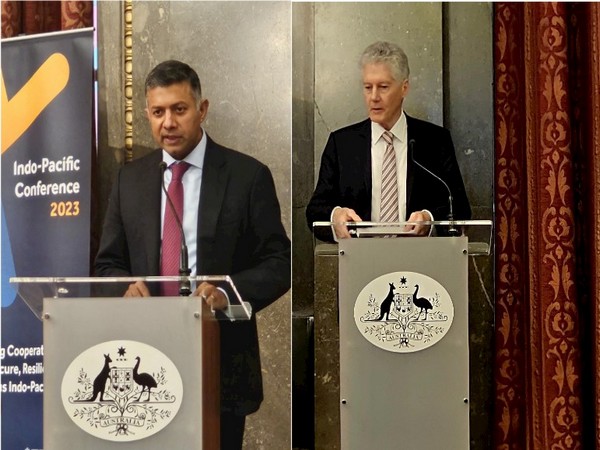
Australian High Commissioner to the UK, Stephen Smith, said, "The Indo-Pacific has never been in greater focus, whether in Australia, India, or here in the UK. This conference is an important opportunity to explore how the regional security and economic dynamics are continuing to shape the strategic environment both in and beyond the Indo-Pacific." 
Acknowledging China's growing influence on the Indo-Pacific region, Stephen Smith added, "Our focus has been with the Pacific, but we're also very strategically conscious of the Indian Ocean. Through IORA, the Indian Ocean Rim Association, we've been working very hard to grow our relationships with Indian Ocean Island states. Whether it's Australia and India meeting in the United Nations General Assembly or meeting in the Commonwealth, there are shared interests which are applicable whichever ocean you're in."
The three "physical neighbours in London" - India House, Australia House, and King's College co-hosted the conference along with the Council on Geostrategy (UK) to further develop the vital conversation on 'deepening cooperation for a more secure, resilient, and prosperous Indo-Pacific'.
Vikram Doraiswami, Indian High Commissioner to the UK stressed that the abiding commitment of India and Australia to promote a vision of a free, open and secure Indo-Pacific is reflected in the strength of our bilateral partnership. 
"Our views are increasingly reflected by other key partners, with whom we work bilaterally and in plurilateral formats, such as the US, Japan, ASEAN, and Korea. We welcome in this regard increased interest in the UK, as part of its Global Britain policy, to work with countries such as India and Australia, in support of this objective," he said.
Replying to ANI on a possible Australian and Indian strategy to get the small islands in the Indo-Pacific out of China's influence, Doraiswami emphasized that the focus is to create opportunities for everybody to partner in an Indo-Pacific approach.
"That addresses each country's sense of what they want to see in a larger and more diverse security space. That isn't just hard security, but it's economic security, environmental security, life and livelihood security, particularly for fishing nations. That's the point that this conference is seeking to bring out, that there are multiple things we can do in this area that is critical to global prosperity and progress," he added.
Jenny Bates, Director General, Indo-Pacific, Foreign, Commonwealth and Development Office (UK), emphasised the importance of the tri-lateral collaboration saying, "The kind of world that the UK wants to have, we cannot do that without partnering more in the Indo-Pacific. This is strategic long-term stuff for us and we are really focussed on where the UK can add value.
She further stressed that it is self-evident that we are not a part of the Indo-Pacific, but we do bring particular assets- capabilities and insights into that region. "We are very focussed on where that value-added must come and we are interested in perspectives and ideas on that."
According to Prof Alessio Patalano, Professor of War and Strategy in East Asia, King's College London, as ties between Australia and India grow strategically stronger, this initiative represents a most timely opportunity to create synergies and enhance the shared capacity to support the development of the international order in three critical domains: maritime, cyber, and technology.
Patalano said, "King's College London has a longstanding intellectual and academic connection with Australia and India, and this event is both a reflection of the depth of these links and an opportunity to chart the direction of our ambition to add an academic layer to the UK Indo-Pacific engagement."
Three sessions encompassing issues of Indo-Pacific connectivity and enhancing regional resilience, strategic stability, and maritime security in the Indo-Pacific, and forging closer cooperation on critical and advanced technologies in the Indo-Pacific, featured an impressive list of high-quality speakers from Australia, India, and the UK from across the academia, civil society, business, government, and the diplomatic community.
James Rogers, Director of Research, Council on Geostrategy, said, "Since our official launch in March 2021, the Council on Geostrategy has argued that the Euro-Atlantic and Indo-Pacific are collapsing into a single geopolitical space- the 'Atlantic-Pacific'."
Rogers also observed, that in an international environment increasingly defined by geopolitical competition, working together, with the allies and partners to secure a free and open Indo-Pacific has never been more important.
Technology and its influence on modern-day geopolitics took centre stage at the conference. Citing examples from the Russia-Ukraine war and the recent Middle East crisis, the panelists discussed the role of technology in modern-day geopolitics and vice versa.
From high-tech warfare to using deep-fake as a weapon, the panels shed light on a wider technological spectrum on which Australia, India, and the UK can collaborate.
Moreover, the speakers at the inaugural Indo-Pacific conference included, Sir Simon Gass, Centre for Grand Strategy at King's College London; Ashok Malik, Partner, The Asia Group; The Hon Lisa Singh, Chief Executive Officer, the Australia India Institute; Professor Harsh V Pant, King's India Institute; Reuben Abraham, CEO, Artha Global; John Lee, Director, East West Futures; Sophia Gaston, Head of Foreign Policy and UK Resilience, Policy Exchange. (ANI)
Tags:
Get the App