 हिंदी खबर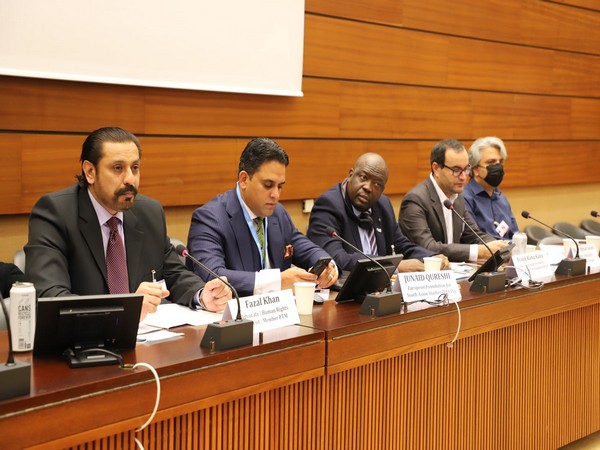

Geneva [Switzerland], September 26 (ANI): Experts and human rights activists discussed the proliferation of terrorist organizations in the region of South Asia during the 51th session of the UN Human Rights Council in Geneva.
The event was organized by the European Foundation for South Asian Studies (EFSAS)
Fazal Khan, a human rights activist and member of the Pashtun Tahafuz Movement (PTM) spoke with a reference to his son, who was killed alongside 146 others during the Peshawar school attack in 2014.
He noted in a statement that "it is natural that such a devastating terrorist attack would have devastating effects of the families involved" and that the attack, perpetrated by the Tehrik-e-Taliban Pakistan (TTP), had been facilitated by Pakistani security agencies.
The evidence of this involvement, however, has been ignored until now. The families affected by the attack have sought justice within Pakistan's judicial system, including through the filing of motions to the Pakistan High Court and the Supreme Court, leading to the Supreme Court ordering the formation of a commission investigating the attack.
Khan stressed that the Pakistani military establishment has been "creating, harbouring, and sponsoring terrorist groups" that have targeted minorities throughout Pakistan and have been supported diplomatically and judicially by State authorities.
"The security apparatus has further sought to equate Pashtuns with terrorists despite terrorist proxies killing up to 60,000 Pashtuns and bodies disappearing and extrajudicially killing Pashtuns", said Khan in the statement.
He called on the international community to "stop the Pakistan Army and its proxies", further noting that the recent negotiations between state authorities and the TTP have been highly controversial in the tribal areas.
Malaiz Daud, formerly Chief of Staff of Afghanistan's former President Ashraf Ghani has stressed that South Asian politics have become increasingly contentious in recent years, producing particularly perilous effects for minority populations in the region.
"The withdrawal of US troops from Afghanistan and the Taliban's return to power have created major ripple effects that have been exacerbated by Imran Khan's removal from office in Pakistan and his subsequent political campaign, the growing clout of the Tehrik-i-Taliban Pakistan (TTP) in Pakistan's tribal areas, and the countermobilization of anti-TTP groups," he said.
He outlined that the growing presence of the Islamic State Khorasan Province (ISKP) in Afghanistan and Pakistan has challenged Pakistan's leverage over the Taliban. Daud additionally described the recent assassination of Al-Qaeda leader Ayman al-Zawahiri in Kabul as a "major turning point in the relationship between the Western world and the Taliban".
The political fractures South Asia witnessed in recent years, Daud suggested, foster opportunities for a variety of social movements, including non-violent movements such as the Pashtun Tahafuz Movement (PTM).
Contemporary challenges for the Pakistani state and the Taliban regime include Imran Khan's reelection campaign, violent and non-violent ethnic movements in Balochistan, the PTM, terrorist organizations targeting Pakistani state interests, female popular resistance in Afghanistan, and the anti-Taliban National Resistance Front (NRF).
Bashir Gwakh, a journalist at Radio Free Europe and an expert on terrorism has extensively focused on the Pakistani tribal areas, specifically regarding questions of human rights and presence of terrorist organizations.
Gwakh argued that the human rights of ethnic minorities in Pakistan are violated by both the military, whose abuses have become more visible over time, and terrorist groups such as the Tehrik-e-Taliban Pakistan (TTP), Jaish-e-Mohammed (JeM), and Lashkar-e-Taiba. The Taliban's return to power in Afghanistan has emboldened Pakistan-based groups and has stoked the belief that other countries and regions could be 'conquered' in the way the Taliban has 'conquered' Afghanistan.
Pakistan, Gwakh averred, has failed to criminalize torture in violation of its agreements under international law.
"The Army's use of torture as a political tool has thus far prevented criminalization providing legal protection to journalists and human rights activists. Pakistan's legal framework has enabled widespread human rights abuses, including the enforced disappearance of 45,000 Baloch. In the Pashtun tribal areas, Islamist terrorists have started to enforce Taliban-inspired social norms, with Taliban control in Afghanistan consolidating the TTP's influence in tribal areas", he said at the event.
The audience and speakers also exchanged views in a debate on dozens of issues including the future of peace in South Asia, the rise of terrorism, need of the strengthening democracy and state effectiveness in countries of South Asia, especially in countries like Pakistan, Afghanistan and Bangladesh, and the role of the Pakistani ISI in perpetrating terrorism as a state policy in the region. (ANI)




