 हिंदी खबर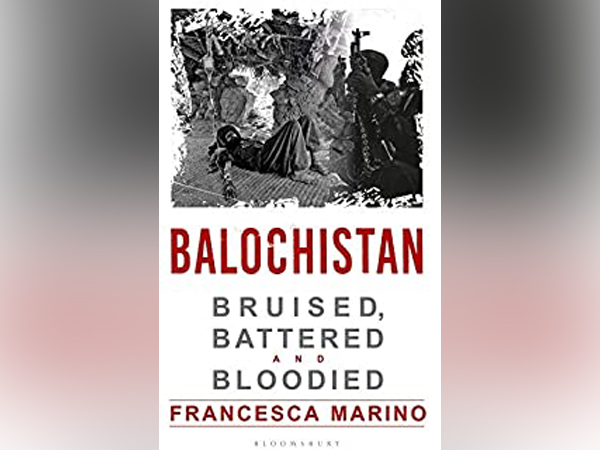

Rome [Italy], November 18 (ANI): The current insurrection in Balochistan is perhaps the most complex and bloody of any in its history since its forced annexation by Pakistan and was born of the "brutal, repressive policies and strategies" of former Pakistan President Pervez Musharraf, says journalist Francesca Marino in her new book.
The book 'Balochistan: Bruised, Battered and Bloodied', will be released on November 28. The foreword of the book has been written by former Pakistan Ambassador to US Husain Haqqani.
The Italian journalist notes in the introduction of her book that the insurrection in Balochistan flared up in 2006 after the murder of Nawab Mohammad Akbar Shahbaz Khan Bugti.
"The killing of Bugti was a turning point in the shaping of regional dynamics, creating an irreparable fracture in relations between the Baloch people and the state. The flames of an independence movement had almost died out as a more restrained quest for autonomy took shape. But now they raged once more, fed further by the policies of the two democratic governments that followed Musharraf," she says.
Francesca Marino says the revolt has already spiralled out of control, even for those who should be guiding it.
"Once respected categories, customs, norms and values are no longer valid. The older groups led by tribal leaders have been joined by new ones that acknowledge no authority, whether tribal or local. A new generation of educated youths from established families has appeared; they are social activists who are concerned with human rights, enraged at the systematic exploitation of local resources and the ferocious repression to which the region has been subjected."
The author says that the number of missing persons is in thousands, and more disappear every day and mass graves filled with unnamed corpses have been found.
"The people of Balochistan still suffer the effects of nuclear tests carried out in the past in their land, amidst widespread indifference at home and abroad," she notes.
She says that CPEC (China-Pakistan Economic Corridor) has exacerbated an already difficult situation.
"This 'new' revolt is now directed not only at the military but has also focused for a while now on the so-called 'settlers' from other regions who have come to live in Balochistan. It is also a revolt against the Chinese presence, considered a 'colonial' invasion carried out in the name of the CPEC...No one can predict with certainty what will happen in the coming years or even the coming months," she says.
The author says that Balochistan is of fundamental strategic and geopolitical importance, not only to Islamabad and to the Chinese CPEC project, but also to the many other players in the region that act as avatars of the powers in the long-running 'Great Game'.
"All of them are staking the lives of the locals. For years now, the world, to its shame, has silently ignored the ethnic and cultural genocide carried out in the region."
She says Baloch people have long been trying to draw international attention to what is happening to them and their homeland and the book is another attempt to do so.
The author notes that the book is not the work of a researcher, an analyst or a scholar but of a journalist, someone who enjoys storytelling.
"It is an attempt to give a voice to those who lack one. As far as possible, I have let the Balochs speak for themselves. It is based on long and detailed conversations with the leading actors in the events I describe," she says.
The author says that foreign journalists for years now have been unable to get near the region, and those who have pointed this out have been expelled from the country, sometimes violently.
"The Pakistani press has been subjected to censorship, often self-imposed, and either declines to cover events or does so incompletely; unless something so significant happens that it cannot be covered up or shrugged off."
The photographs in the book are by Roshaan Khattak. It is being published by Bloomsbury India and has 19 thematic chapters including Forced annexation to Pakistan and Jinnah's betrayal, Nuclear tests, A return to arms, Of old and new militancy, 'Kill and dump' and other atrocities, Missing persons and the Long March, Mass graves and torture, The China-Pakistan Economic Corridor and 'Free Balochistan campaigns and China's hand - Mehran Marri's case. (ANI)
Current insurrection in Balochistan perhaps most complex, bloody, says new book
ANI | Updated: Nov 18, 2020 21:59 IST




