 हिंदी खबर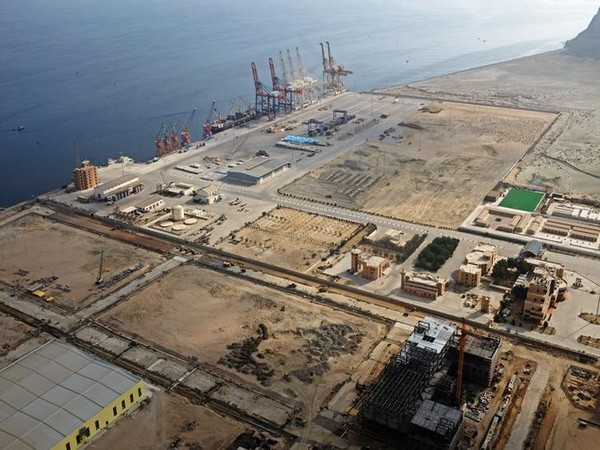

London [United Kingdom], March 9 (ANI): China's Belt and Road Initiative (BRI) that emerged in a specific global and economic context, is now ending, with China going into a period of having less money as it faces several crisis, limiting China on what it can produce economically, said Assistant Prof of Political Science at University of Albany, Christopher Clary.
Clary made the above remarks while addressing a virtual seminar titled 'China in South Asia: Investment or exploitation?' on Wednesday.
As many nations across the world experience China's increased engagement in their economies and societies, London-based not-for-profit The Democracy Forum shone a spotlight on China's role as a primary source of development finance in South Asia, during the virtual seminar.
In highlighting the changing situation impacting China, Clary raised three major points. He said, "Firstly, the BRI emerged in a specific global and economic context, which is now ending, with China going into a period of having less money as it faces a property investment bubble, higher labour costs, an ageing population and imperfect welfare state, with implications for labour participation and consequent limitations on what China can produce economically."
He also said that China's growth, therefore, may not exceed what India, Bangladesh or others can achieve, and a possible long period of accelerated Indian growth means India may have more money to invest abroad, creating an alternative to Chinese investment. Secondly, said Clary, large outside economic, social or political pressure on any society generates antibodies to that pressure, and China will not be immune to problems caused by the lack of integration of its expatriate populations in, for example, Pakistan. And thirdly, he saw real limitations that emerge from Chinese investments overseas, since multipolarity will give troublesome regimes options that they lacked in prior decades.
Clary had no illusions about China's benign intentions, but it is difficult, he said, to both generate economic power and use that power to achieve political ends.
TDF President Lord Bruce said, "China is following a broadly positive programme of investment in public infrastructure to spread the benefits of economic growth or, conversely, if it is pursuing a process which may amount to colonialism by default."
He cited an article in the Economist, which concluded that the world now owes China's eight largest state-owned banks at least $1.6trm - equivalent to 2 per cent of global GDP. Vis-a-vis investment versus exploitation, Lord Bruce highlighted that China is currently pursuing a ratio of loans to grants in the order of 31:1 priced at relatively high interest rates (nearly 6 per cent), although around 36 per cent of all loan programmes started under the Belt and Road Initiative since 2013 have encountered 'implementation problems'.
He also touched on Chinese loans and arms supplies to Bangladesh and the diplomatic leverage Beijing might expect to exert from this relationship, as well as Sri Lanka's accumulated loan obligations to China, which have reached 20 per cent of its total public external debt, and how China is Pakistan's biggest bilateral creditor, holding $30bn of its total debt, with Pakistan additionally hobbled by the contractual obligations it has accumulated under the China-Pakistan Economic Corridor (CPEC).
He also said that China's money 'goes to two kinds of borrowers; those with a good chance of repaying (either because projects are likely to turn a profit or governments are sufficiently rich), or those for which any lost money represents a price worth paying for diplomatic advantage'.
In the case of South Asia, Lord Bruce concluded, it looks as if China's international development criteria will always favour the second category of borrower.
China's involvement in South Asia's security complex is a growing reality, evolving and multi-dimensional, argued Dr Frederic Grare, Senior Policy Fellow at the European Council on Foreign Relations. But it is important not to over-generalise, as not every country in South Asia feels the same way about China's willingness to impose its hegemony over the region, and the very concept of security has evolved.
Grare also spoke of China's 'weaponsiation' of every sector of activity. including influence in connectivity, the environment, all of which could be a potential weapon. This plays out through the dependency question - eg the Maldives, the 99-year lease on Hambantota Port in Sri Lanka - and subsequent repercussions for India and the entire neigbourhood.
Is China pursuing debt-trap diplomacy? asked Grare. Not in the sense that Beijing is deliberately trying to put countries into debt in order to better control them - there are, after all, issues of local responsibility, such as mismanagement of the economy. However, this does not mean China is not trying to play opportunistically on countries' debts - for example, Sri Lanka and Pakistan - and this is where coercion can start.
Addressing the magnitude, as well as the limits, of China's geopolitical, economic and cultural influence on Pakistan was Islamabad-based physicist, writer and activist Pervez Hoodbhoy. He spoke of the 'great expectations' that CPEC would transform Pakistan's economy, with $62.5 billion of Chinese investments in infrastructure and electricity generation, bringing a new era to Pakistan's development. Yet Pakistan is in a state of default, seeking $1.1 bn in IMF bailouts.
Hoodbhoy also highlighted the Chinese 'invisible' presence in Gwadar, and Pakistan army machine guns along CPEC highways. This is a source of resentment for Baloch people, who feel colonised by Punjab. As for the Chinese, they are very sequestered, with little local interaction. "CPEC hasn't delivered on promises," said Hoodbhoy.
Pakistan has a $30bn loan to pay, interest unknown. Looking to the future, Hoodbhoy did not see CPEC fulfilling its promises, nor did he envisage Chinese influence in Pakistan growing to the extent once surmised. China may well be rethinking its relationship with Pakistan; in the wake of attacks on Chinese workers in Pakistan, China feels unsafe. This is unfortunate, Hoodbhoy said, as there is a great deal Pakistan could learn from China, especially in terms of technology and work ethic.
Closing the event, TDF Chair Barry Gardiner said that every country is pursuing its own interests, and China is pursuing both investment and taking advantage of any defaults through exploitation. You can form alliances but don't mistake them for friendship, he warned. Be realistic that every country acts in its own interests, but it should be the public interest, not private interests, as seen in the elites of Sri Lanka and Pakistan. In reference to the youth of Pakistan who wish to leave, Gardiner stressed that it is difficult for them as they have been undereducated in science and technology, but overeducated in religion. (ANI)


