 हिंदी खबर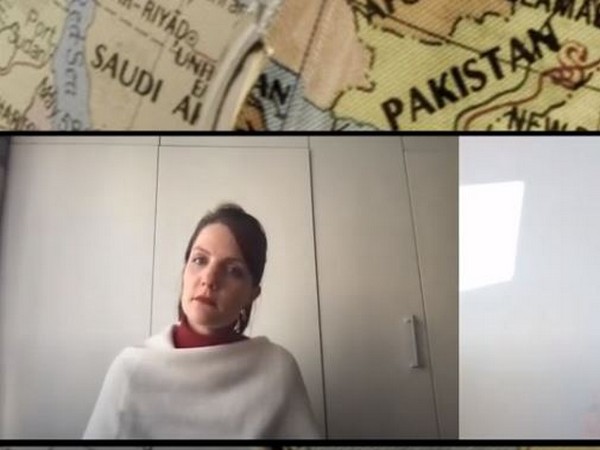

Amsterdam [Netherlands], December 10 (ANI): Dr Dorothee Vandamme, Lecturer at Universite Catholic de Louvain, said that anti-India discourse is what keeps the Pakistan military establishment all-powerful.
In an interview with the European Foundation for South Asian Studies (EFSAS), Dr Vandamme argued that understanding Pakistan foremost means understanding the Pakistani Military. For Dr Vandamme, a particular research interest is how Pakistanis tend to define their identity as non-Indian, and from that starting point, make sense of the country and the world as a whole, noting that there are significant generational divides in these perceptions.
During the interview, issues like Afghanistan, the Taliban, the Pakistani military establishment and relations with India were discussed elaborately.
Dr Vandamme highlighted that the military establishment in Pakistan played a preeminent role in shaping Pakistan's international relations, even during civilian rule.
The influence of the military, she argued, was a result of the privileged role that the army and the bureaucracy held following partition, allowing bureaucrats and military officials to shape Pakistani identity in a way that was consistent with their ideals.
She illustrated how religion in Pakistan is used as a justification to maintain the domestic role of the military and that Pakistan defines its national identity solely in opposition to India and Indians.
She argued that in her numerous encounters with Pakistanis, the population tended to define their identity as non-Indian, instead of drawing upon the numerous qualities and merits that make them Pakistani.
The lecturer said that everything in Pakistan is blamed on India and the whole political discourse is oftentimes about India. "This perpetual anti-India sentiment is what has kept the Military Establishment safely in its saddle while it keeps running the country directly through coups or through hybrid governments, like the current one in Pakistan."
In regard to the recent Taliban takeover of Afghanistan, Dr Vandamme said that this would be seen as a strategic victory of the Pakistani military, as it established, nurtured, armed, trained and provided safe haven to the Taliban for decades.
However, she contended that the Taliban would not be able to maintain long-term control over the country, especially if they cannot secure foreign financial aid.
Dr Vandamme also analysed potential spill-over of jihadist violence in the region, to which she argued that although the core Taliban leadership may not support violence against India, other Taliban operatives might do so, resulting in affiliated Taliban groups sponsoring operations against the country.
"This could translate into regional terrorist groups emboldened by the Pakistani Army and its Taliban associates, to step-up terrorist activities again in the region of Jammu and Kashmir."
When it comes to domestic affairs, Dr Vandamme explained how while some extremist elements, such as the right-wing Tehreek-e-Labbaik Pakistan (TLP) are seen as destabilizing the country from the point of view of the Army, others are deemed useful assets, such as the Lashkar-e-Taiba (LeT), confirming Pakistan's policy of distinguishing between so-called 'good' Terrorists and 'bad' terrorists. She emphasized that the intermittent 'banning' of such groups is mere eyewash.
Despite the international community's view that the Pakistani military's actions and its double game are reaching a tipping point, Dr Vandamme maintained that the same cycles will remain since Pakistan is a nuclear-weapons State, and the West will not turn its back on it, fearing that those weapons would fall into the hands of terrorists.
"Along with its strategic position, its nuclear arsenal is Pakistan's primary leverage to keep blackmailing the world and especially the west. Therefore, even if the economy of the country completely crumbles, it will still receive foreign money."
As Dr Vandamme argued, with China as a competitor, the US cannot afford to lose its allies and thus the Americans will endeavour to maintain their influence. She further elaborated how despite China's economic and regional influence, the Pakistanis still rely also on the United States for recognition and acceptability, since Pakistan sees the West as its reference point.
When it comes to Afghanistan, The Taliban will attempt to be astute and avoid nurturing terrorist organizations against China since they rely on Chinese funds and resources, Dr Vandamme asserted. (ANI)




