 हिंदी खबर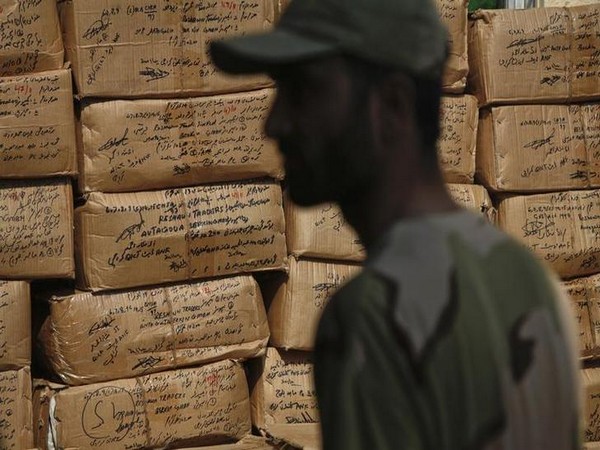
Drug trafficking main source of income for terrorists in Pakistan
| Updated: Jul 20, 2017 12:55 IST

Islamabad (Pakistan) July 20 (ANI): The international community has long regarded Pakistan as a transit point for narcotics trafficking, and this was confirmed on July 13, when the nation's Anti-Narcotics Force (ANF) announced the seizure of 365 kilograms of drugs worth 430 million Pakistani rupees in international market. Addressing the media after the seizure, the ANF said the drugs were seized during 12 counter-narcotics operations conducted across the country. News of this huge drug haul has once again confirmed that they are being sold illegally and the revenue acquired from it is used to finance terror activities emanating from its soil. Various reports have suggested that Pakistan's drug syndicate runs a parallel economy in connivance with select elements of the political and military establishments, and the July 13 seizure is being touted as just being the tip of the lethal drugs iceberg whose tentacles are spreading across international markets. In February, the ANF seized narcotics weighing 19.6 tonnes and valued at 34 billion Pakistani rupees. Then, 20 counter-narcotics operations were initiated. A March 2017 confidential report compiled by the Financial Monitoring Unit (FMU), an intelligence service department, active within the Ministry of Finance, said that "Main sources of income of terrorists in Pakistan include foreign funding, drug trafficking, kidnapping for ransom, extortion from business, etcetera." Pakistan is geographically vulnerable to drug trafficking, sharing a 2,430-km-long porous border with Afghanistan, the world's largest producer of illicit opium. Cannabis is also produced in large quantities in the sub-region, most of the cannabis trafficked in the region also originates from Afghanistan, and is processed in the inaccessible areas of Pakistan's FATA region. According to the United Nations Office on Drugs and Crime (UNODC) estimates, approximately 43 per cent of the Afghan opiates are trafficked through Pakistan. The UNODC estimates that Pakistan is now the destination and transit country for approximately 40 percent of the opiates produced in Afghanistan. Most processing takes place in small, mobile laboratories in the Afghan-Pakistan border areas. The sub region itself has become a major consumer market for opiates. Opiate processing on both sides of the Afghan-Pakistan border have created a trafficking and, importantly in the case of Pakistan, a drug abuse problem since the early 1980s. The Khunjerab Pass in Northwest China's Xinjiang Uyghur Autonomous Region overlooks Pakistan, but the border inspection station here, according to the state mouth piece Global Times, suspiciously sees every traveler coming through as a criminal trying to smuggle drugs or guns into the country. Besides Pakistan, the Khunjerab Pass is also near Afghanistan and Tajikistan. So concerned are the authorities here about the potential spread of narco-terrorism, that the Human Resources and Social Security Bureau of Kashgar recently recruited 3,000 more policemen aged between 18 and 35 as a counter-measure. Ever since the Khunjerab Pass crossing opened in 1982, drug dealers have been trying to flood the Chinese market with their lucrative products. Usually, according to the Global Times, the drugs are grown and manufactured in Afghanistan and are then transported to northern Pakistan, where the bulk product is packaged into smaller bags before being smuggled into China. Over the years, inspectors have seen countless concealment methods. Some put the drugs into condoms and hide the packages inside their body, some dissolve narcotics into cola, while others put them into handicrafts, cosmetic packages and other everyday goods. People who take the drugs along each step of the chain do not know much about the other links. Around the border, drugs are just one part of an intertwined illegal trade. People living on the frontier are familiar with the phrase "using drugs to foster terrorism." Guns and drugs are always near each other. The free-flow of the narcotics has abetted terrorism in Pakistan. There are reports that suggest Pakistan's political class and the powerful military are in cahoots with the drug mafia. Recently, U.S. Army Reserve Col. (Retired) Lawrence Sellin, in an article, said that Pakistan is using the narco-terror network of the Lashkar-e-Khorasan for ethnic cleansing in Balochistan. He said that the Pakistan government has nurtured and deployed home grown terrorists to quell all forms of nationalist and ethnic unrest at home and also incorporated them as an element of its foreign policy to carry out attacks in India and Afghanistan. Col. (Retired) Sellin further added that the designated role of the Lashkar-e-Khorasan in southwest Balochistan has been to kill members of the secular independence movement and cleanse Balochistan of Sufi Zikris, Shia Hazaras, Hindus, Christians, Ahahmadis, Sikhs or anyone else who refuses to convert to the extreme form of Sunni Islam. He said that the leader of Lashkar-e-Khorasan is Mullah Shahmir Bizenjo, resident of Turbat and the son of Aziz Bizenjo, whose cousin is National Party President and Senator Hasil Bizenjo, currently Pakistan's Minister for Ports and Shipping. The role of Pakistan's politicians and military in narcotics trade was accepted by none other than the Prime Minister Nawaz Sharif. According to a 1994 report in Washington Post; then Opposition leader Sharif claimed that three months after his election as prime minister in November 1990, Gen. Aslam Beg, then army chief of staff, and Gen. Asad Durrani, then head of the military's Inter-Services Intelligence (ISI), told him the armed forces needed more money for covert foreign operations and wanted to raise it through large-scale drug deals. Though the army mandarins named by Sharif denied allegations, the fact of the matter is that Pakistani army and its intelligence wing- Inter-Services Intelligence- are believed to be still engaged in narco-terrorism with the active support of the government. In the nineties, a consultant hired by the CIA reported that drug kingpins were closely connected to the country's key institutions of power, including the president and military intelligence agencies. Narcotics gives a major fillip to terrorism, which is an expensive affair. The narcotic drugs are the most lucrative commodity that generates quick money without paper work. The business transaction is done in hard cash and no document is left as evidence for legal action. The drug proceeds are laundered through numerous legal and illegal financial institutions and petty business enterprises. For instance, heroin from the Golden Crescent (the clandestine land routes of Iran, Afghanistan and Pakistan collectively constitute the Golden Crescent) costs approximately one lakh rupees in South Asia and fetches nearly one crore in the U.S. market. The volume of money these drugs generate in the West is out of proportion, since enormous money has been involved in illegal drug trade, terrorists has successfully established links with drug traffickers to meet expenses for operation terrorism. The ill effects of narcotics have also started showing in Pakistan. According to a 2013 Survey Report, a collaborative research set up by the Narcotics Control Division of Pakistan Bureau of Statistics and the UN, states that there are 7.6 million drug addicts in the country, out of which 78 percent are men and 22 percent are women. A recent report in Dawn said that about eight million people in Pakistan are drug addicts and the number is increasing with every passing day. (ANI)




