Xi Jinping wishes to defeat "Colour Revolutions" by defeating Western ideas
Washington [US], August 31 (ANI): China's leader Xi Jinping has been trying to defeat the "Colour Revolutions" by defeating the Western constitutional democracy promoted by the US.
ANI
Aug 31, 2022 20:03 IST

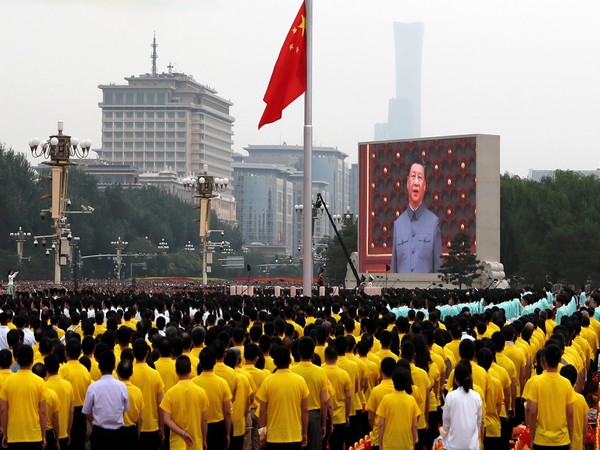
Washington [US], August 31 (ANI): China's leader Xi Jinping has been trying to defeat the "Colour Revolutions" by defeating the Western constitutional democracy promoted by the US.
Thwarting the infiltration of Western ideas, and information and defeating the US in a global struggle between the superpowers are two sides of the same coin in Xi's US-China relationship strategy.
According to Jianli Yang, a former political prisoner of China and a Tiananmen Massacre survivor and Xueli Wan, an independent scholar, Managing Director of CSI Research writing in US-based publication Providence said that Xi plans to secure the former by ensuring the latter through a "People's War."
Two major insecurities have pervaded Xi Jinping's reign and defined his two recurring political themes. The first is apprehension about his personal power; the second is apprehension about the CCP's power.
Thus, his ongoing struggle to consolidate power and defend against colour revolutions are inextricably intertwined. Repression at home and aggressiveness in overseas affairs are two sides of the same coin, said Jianli and Xueli.
As per Xi, the West is attempting to export colour revolutions to China. In a conversation with then US President Barack Obama over a decade ago, he spoke of China being the target of "colour revolutions" (New York Times, Aug. 7, 2022).
This wasn't Xi Jinping's first complaint. During a visit to Mexico three years earlier, he bitterly vented his rage, "A few foreigners, with full bellies, have nothing better to do but point fingers at us. China does not export revolution, hunger, or poverty; nor does China mess around. What else do you require from us?"
The Arab Spring uprisings raging throughout the Middle East at the time sparked a modest "Jasmine Revolution" in the "Middle Kingdom" -- China. Meanwhile, Xi regards himself as a "real man" who will save the CCP from collapse, reported Providence.
In late April of 2013, Document No 9, officially titled "Communique on the Current State of the Ideological Sphere," was printed and widely circulated within the CCP. The document warned of seven "dangerous" Western values, and banned them from publication and teaching in China.
These values include western constitutional democracy, "universal values" (of human rights), civil society, neoliberalism, media independence, "historical nihilism" that criticizes the CCP's past, and questioning the socialist nature of the People's Republic of China.
Xi Jinping believes that eliminating the infiltration of "western influences" in Chinese society is the first step to safeguarding the CCP regime, said Jianli and Xueli.
In late 2013, one year after assuming power, Xi announced the formation of the Central National Security Commission (CNSC), which aims to strengthen "centralized, unified leadership on national security matters."
How the CNSC is staffed and operated remains top secret. However, it appears that the Commission played a role in many of Xi's subsequent security "achievements," including those in Hong Kong and Xinjiang.
In the meantime, Xi decided to tighten controls on non-governmental organizations (NGOs), which had flourished in China over the past two decades.
Following a decision in 2015 that all social, cultural and economic organizations (including all domestic NGOs) should set up (CCP) party groups, new legislation was introduced to put foreign NGOs on China's "national security" radar, said Jianli and Xueli.
China's Law on the Activities of Foreign NGOs ("Foreign NGO Law") was passed in 2016 and went into force on January 1, 2017. As a result, many foreign NGOs have been forced to curtail politically sensitive programs or to leave China permanently, which is exactly what Beijing anticipated, wary of foreign NGOs gathering intelligence or inciting social unrest.
The above initiatives were not random. Rather, they were well-designed measures aimed at countering "tactics of colour revolutions" that CCP officials summarized from "history." They have proven successful in intercepting most "foreign infiltration."
Among the most remarkable developments are the national Social Credit System, which rates, punishes, and rewards all businesses and individuals in China, as well as mass surveillance technologies such as facial recognition, mobile location tracking, and the "digital passport" devised during the COVID pandemic, reported Providence.
Moreover, an internal document published by the CNSC in 2022 states that "hostile forces at home and abroad have never let up for one moment in their strategy to Westernize and split apart (China)," once again reflecting Xi's obsession with colour revolutions. (ANI)
Tags:
Get the App