 हिंदी खबर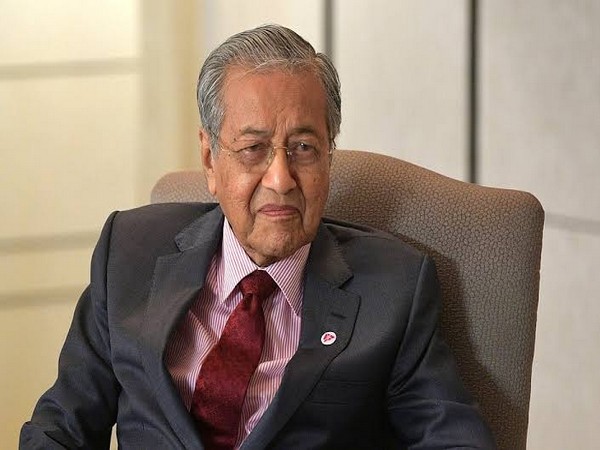

By Lee Kah Whye
Singapore, Feb 3 (ANI): Malaysian Prime Minister Mahathir Mohamad is one of the more colour political personalities in Southeast Asia.
Mahathir, a medical doctor, was active in politics since his university days but first entered parliament at the age of 39 in 1964 with the United Malays National Organisation (UMNO). He lost his seat in the next elections but regained his place in parliament in 1974. He rose quickly through the ranks becoming deputy Prime Minister in 1976 and then Prime Minister in 1981.
In the early days, he was a fierce critic of Singapore's leader Lee Kuan Yew calling him "arrogant" and Lee's party "anti-Malay".
Lee was far from the only foreign leader he annoyed. He also gained a reputation for being an outspoken critic of the West and had his run-ins with various countries including Australia, the United Kingdom and the United States.
He led a boycott of British goods which became known as the known as the "Buy British Last" campaign and was critical of the foreign policy of the United States particularly during the presidency of George W. Bush. Despite this, the US continued to be Malaysia's largest foreign investor at that time.
In the Middle East, he was supportive of the Palestinians and critical of Israel. Some people even accused him of being antisemitic
However, Malaysians love his directness and willingness to take on the "big boys".
He retired from politics after 22 years as Prime Minister in 2003 at the age of 78. He was however not one to ride quietly into the sunset. He was constantly courting controversy by commenting about government policies and decisions. Most just dismissed them as mutterings of an old man who had nothing better to do, assuming that his political days were over.
However, as the public uproar over perceived mismanagement by the government of Prime Minister Razak Najib came to a head, Malaysians sought a leader and saviour who could unite the divided opposition. If the opposition remained split, they would not stand a chance against the well-oiled machinery of the ruling coalition, the Barisan Nasional (BN) who had at that point been in power for 61 years. The rest, they say is history.
When he won the 2018 general elections as head of Pakatan Harapan, the opposition alliance, he became the oldest Prime Minister and head of government in the world. He turns 95 in July this year.
Although, a little more mellow than the fiery politician of the 70s and 80s, he certainly has not shied away speaking his mind and stroking controversy.
Knowing Mahathir, no one in Southeast Asia was surprised that he came out strongly against Prime Minister Modi's decision to scrap the special status for Indian-controlled Kashmir and Jammu, and also against New Delhi's new citizenship law which he perceived as anti-Muslim.
Naturally, the Indian government didn't take kindly to such statements.
Not long after, just about two weeks ago, Reuters reported that India, the largest purchaser of edible oils in the world, has restricted the imports of refined palm oil. Reuters sources added that traders were asked informally to stop importing all kinds of palm oil from Malaysia, saying that this was in retaliation of Mahathir's criticisms of India. Some call it a "trade war".
New Delhi, however, denies targeting Malaysia with any palm oil restrictions. Commerce Minister Piyush Goyal was quoted as saying that if any curbs were to be imposed, it would apply to all countries uniformly.
India has been Malaysia's largest buyer of its palm oil for the past five years and bought 4.4 million tonnes in 2019. Malaysia is the world's second-largest producer and exporter of palm oil after Indonesia. Any curbs by India will impact Malaysia severely.
Palm oil which contributed USD11 billion or 3.8 per cent to Malaysia's GDP, is its most important agricultural product.
Bilateral trade between the countries was worth USD17.2 billion in the last fiscal year with India exporting USD6.4 billion and importing USD10.8 billion.
India is the seventh biggest market for all Malaysian exports, and Malaysia's tenth largest trading partner.
The main imports from Malaysia are petroleum and petroleum products, palm oil, wood and wood products, and television and computer monitors. The main Indian exports to Malaysia are light and medium oils and preparations, frozen, boneless bovine meat, aluminium products and copper cathodes.
Malaysian Primary Industries Minister Teresa Kok, in charge of palm oil, has indicated that the Malaysian government is looking for dialogue and "engagement" to resolve their differences with India. She also inferred that Malaysia sees this as a trade issue and not a political one.
With New Delhi keen to reduce the trade deficit with Malaysia, Reuters reported that the negotiated solution appears to involve MSM Malaysia, a subsidiary of government-linked palm oil plantation firm FGV Holdings Berhardbuying 130,000 tonnes of raw sugar from India worth almost USD50 million in the current quarter. It had bought 88,000 tonnes for the whole of 2019.
Malaysia with an economy of USD 358.6 billion, is 13 per cent the size of India's. They are still struggling from the financial troubles caused by the previous administration. The budget deficit was raised to 3.8 per cent in 2018 and set to remain relatively high at 3.4 per cent in 2019 in order to service various commitments. Government debt is over USD 1 trillion. Public sector projects have been scaled back or delayed.
Relations between Malaysia and India have been friendly in the past. PM Modi was one of the first foreign leaders to congratulate PM Mahathir when he ascended to power for the second time. Malaysia is seen as an important country in India's "Look East" policy and seven per cent of the Malaysian population or 2.2 million people are indigenous Indians.
It is unlikely Malaysia was seeking to upset the Indian intentionally. It has more to lose than gain.
(Disclaimer: The views expressed in this column are strictly those of the author) (ANI)
Will palm oil spate start a trade war between India and Malaysia?
Lee Kah Whye | Updated: Feb 03, 2020 11:55 IST




