 हिंदी खबर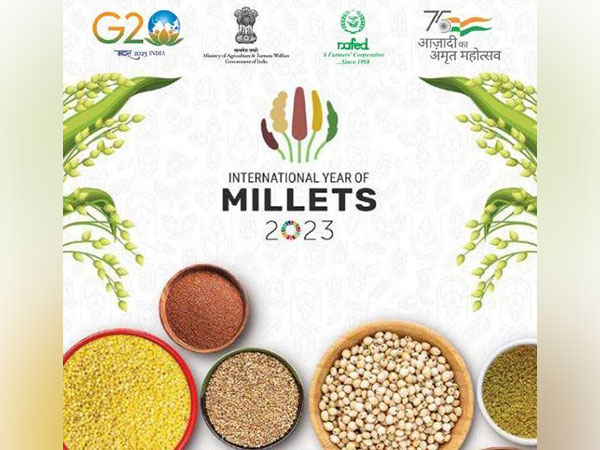

New Delhi [India], April 14 (ANI): At a time when the two extremes of malnourishment and obesity plague large portions of the world, India, has taken it upon herself to educate the masses about these small-seeded grasses that are highly beneficial to human health.
Millet and grain cereals, despite being rich sources of protein and antioxidants with high nutritional value have never been considered fashionable foods, however, India has done remarkably well when it has come to meeting the caloric needs and demands of her people.
India, the world's largest producer, and the world's second-largest exporter of millet are hoping to change the humble millet's reputation worldwide.
Unlike a large part of the rest of the world, almost every Indian household is acquainted with the taste and the benefits of millet.
Millets have been a staple of the Indian diet, especially in rural India, for years and remain prevalent even today. They have been a large contributor to Indians' balanced diets.
The Government of India has identified millet as a safe bet to enhance farmers' income and as a reliable grain to ensure India's nutritional and food security.
"We are the largest producer and the second largest exporter of Shri Anna (Millets) in the world. We grow several types of Shri Anna (Millets), such as Shri Anna Jowar, Shri Anna Ragi, Shri Anna Bajra, Shri Anna Kuttu, Ram dana, Kangni, Kutni, Kutki, Kodu, Cheena and Samaa," said Finance Minister Nirmala Sitharaman.
Millets went out of favour and down the order in the common man's kitchen when many food conglomerates, driven by profits and not by the desire to help improve the health standards of people, prioritised other grains over millets.
India, like many other countries, witnessed a major decline in both production and consumption of millet. Public perception of millets also changed due to the market being increasingly dominated by wheat.
"Pearl millet is a crop which has a high content of protein, it is good in fat content, it has good fibre content, and carbohydrate content besides this there are a lot of micronutrients especially iron and zinc," said Dr Suneha Goswami, Scientist, IARI New Delhi.
However, now realising the nutritious value and climatic reliance of millet production, the Indian government took it upon itself to revive the practice of adding millet to the country's food basket once again.
The Government of India, to encourage millets' cultivation and consumption, declared 2018 as the national year of millets. The government also began referring to millets as nutri-cereals, giving them an image makeover.
It is because of such efforts that India exported USD 64 million of millet in 2021. It was a remarkable achievement considering India had not even touched the export mark of USD 30 million worth of millets in 2019 and 2020.
India, home to 20 per cent of the global millet production with a staggering 80 per cent contribution to Asia's millet production, also proposed that the United Nations declare an international year of millet, according to APEDA.
Cognizant of India's success in feeding her vast population and working for global welfare, the global body declared 2023 as the international year of millets.
The primary aim of the international year of Millets is to raise awareness about millets' nutritional value and promote understanding of how millets can prove instrumental in eradicating food inequity and deficiency.
Recently, New Delhi hosted the Global Millets Conference, wherein as many as 100 Indian millet exhibitors and around 100 international buyers from countries around the world participated.
The event was aimed at further promoting and developing the global millet market.
According to the International Crop Research Institute for the Semi-Arid Tropics, more than 90 million people depend on millet in their diet. While this is already a vast number of people, proponents of millet production are of the opinion that a greater number of people should include millet in their diet.
Millets are versatile grains that grow in half the time as wheat and use 70 per cent less water than rice, providing a multi-fold benefit.
A concentrated campaign to enhance the production and consumption of millets, which are rich in carbs, proteins and vitamins, can change the entire paradigm of the food and health industry globally.
Several experts have agreed that a sincere effort towards millet production can help countries effectively overcome micronutrient deficiencies.
India, already a self-sufficient country when it comes to ensuring food for its people, is on a mission to capitalize on its millet market and deliver its people the benefits that go beyond just one aspect of human welfare. (ANI)




