WHO's Poonam Khetrapal Singh calls for collective action towards 'integration of traditional medicine'
Singh, while speaking to ANI, said, "WHO Traditional Medicine Global Summit will look new at the vast potential and applications of traditional medicine amidst important challenges and opportunities to achieve universal health coverage and well-being for people and the planet."
ANI
Aug 17, 2023 17:16 IST

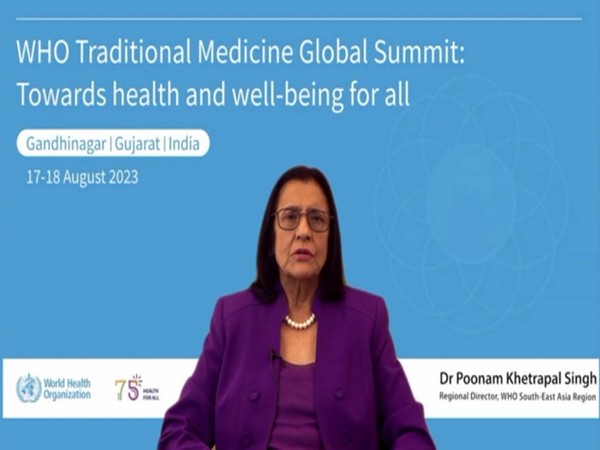
Gandhinagar (Gujarat) [India], August 17 (ANI): Reiterating the vast potential and application of traditional medicine in improving health and well-being, the Regional Director of World Health Organisation (WHO)'s South-East Asia, Dr Poonam Khetrapal Singh said the WHO Traditional Medicine Global Summit will catalyse political commitment and collective action towards the evidence-based integration of traditional medicine into the health systems.
Singh, while speaking to ANI, said, "WHO Traditional Medicine Global Summit will look new at the vast potential and applications of traditional medicine amidst important challenges and opportunities to achieve universal health coverage and well-being for people and the planet."
She also claimed that the insufficient scientific knowledge on the safety and efficacy of traditional and complementary medicine (T&CM) products and practices is the main barrier in the way to accessing safe and quality T&CM services.
"A key barrier to enabling access to safe and quality traditional and complementary medicine (T&CM) services, including through integration into national health systems, is insufficient scientific knowledge on the safety and efficacy of T&CM products and practices," she said.
She endorsed that the stronger evidence base will enable countries to develop appropriate mechanisms and policy guidance for regulation, quality control and monitoring of T&CM practices and said that Artificial intelligence (AI) has emerged as a game-changer, revolutionizing the study and practice of traditional healing systems.
She also said, "There has been remarkable and rapid modernization of the ways traditional medicine is being studied. Artificial intelligence (AI) has emerged as a game-changer, revolutionizing the study and practice of traditional healing systems. AI’s advanced algorithms and machine learning capabilities have allowed researchers to explore extensive traditional medical knowledge, mapping evidence and identifying once elusive trends."
"Amid this wave of progress, it is vital to ensure responsible and equitable use of these technologies, including by strengthening digital infrastructure, and addressing ethical considerations, such as data privacy, consent, bias, and fair access," she said while stressing on the rising concerns of using the new technology.
When asked about the challenges in the integration of traditional medicines in the medical system, the WHO director emphasised that the major challenges include a lack of policies, regulations, finance and information on the resources, and utility.
"Barriers to integration of T&CM into health systems in accordance with national contexts and priorities include lack of policies, regulation, finance, and information on the resources, utility, and safety of T&CM. Education and regulation, including the assessment of T&CM educational programmes across the globe, current efforts to create training benchmarks and training modalities for T&CM practitioners in countries," she said.
WHO regional director also put light on the status of the traditional medicines systems in the WHO South-East Asia Region and informed that almost all countries in WHO South-East Asia Region have national policies on traditional medicine. They are Bangladesh, Bhutan, DPR Korea, India, Indonesia, Maldives, Myanmar, Nepal, Sri Lanka, and Thailand.
She added, "Countries in the Region are at the forefront of the global momentum on traditional and complementary medicine, reflecting their commitment to leveraging the potential of traditional and complementary medicines to achieve national, regional, and global goals."
She further added, "Nine of the 11 countries have formal training and education systems for traditional medicine practitioners, ten countries have regulating registered traditional and complementary medicine products and national traditional and complementary medicine institutes".
Earlier Today, addressing the World Health Organisation Traditional Medicine Global Summit, which was inaugurated in Gandhinagar, WHO Chief Tedros Adhanom Ghebreyesus said India has a rich history of traditional medicine."India has a rich history of traditional medicine through Ayurveda, including Yoga which has been shown to be effective in alleviating pain," Tedros said.
Tedros, who arrived in India on Wednesday, added that traditional medicines are being sought by countries to deal with non-communicable diseases, mental health and treatment of many other ailments. (ANI)
Tags:
Get the App