 हिंदी खबर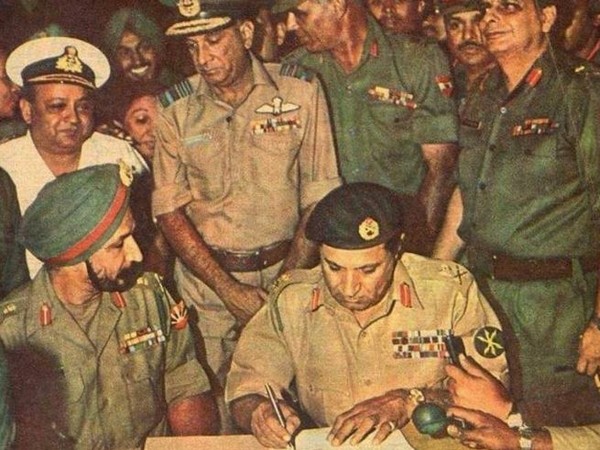

New Delhi [India], December 16 (ANI): Under President Ayub Khan, a military decision was taken that 'the defence of the East lies in the West' based on the principle that if the military was split between the two wings, neither of them would have been able to resist the Indian army. Thus, a bigger portion of the Pakistan army was deployed in West Pakistan and a much smaller force was kept in East Pakistan to defend the border.
Sahibzada Yakub Khan who was posted as commander, Eastern Command, in 1969 had conceived a security plan titled 'Op Blitz', meant to counter any unrest in East Pakistan. This was formulated much before the 1970 elections and on 11 December 1970, within days of the general elections in Pakistan the plan was operationalized. It authorized the commander, Eastern Command, to take control of the entire civil administration and restore law and order with complete freedom in the exercise of his powers.
The Hamoodur Rehman Commission (HRC) set up to enquire into the surrender in Dacca, in its report confirmed that 'The decision not to hand over power, and the use of a military crackdown codenamed "Operation Blitz" had been prepared well ahead'; and 'the negotiations which were carried on from the middle of March up to this date were no more than a camouflage, it being all along the intention of Gen. Yahya Khan and his military advisers to cow down the Awami League with a heavy hand.'
The excesses carried out by the Pakistan army in East Pakistan have been very well documented. According to Lt Gen A A K Niazi, Commander Eastern Command and Chief Martial Law Administrator, his predecessor Lt Gen Tikka Khan's policy was brutal--killing of civilians and scorched the earth. His order to the troops was: 'I want the land and not the people.' Major General Farman Ali and Brig. (later Lieutenant General) Jahanzeb Arbab carried out these orders faithfully. Farman had written in his table diary, 'Green land of East Pakistan will be painted red.' Niazi goes on to say: 'The military action was a display of stark cruelty, more merciless than the massacres at Bukhara and Baghdad by Changez Khan and Halaku Khan, or at Jallianwala Bagh by the British General Dyer.'
During his interrogation in India after the war, General Niazi said that Pakistan's strategy was centred on the premise that India had 'planned only a limited action' for establishing Bangladesh Government in East Pakistan. On the basis of this assessment, Pakistan deployed her forces thinly all along the border spread out over twenty-five hundred miles and ordered them to hold on at any cost. As a result, Pakistani troops were pinned down at the periphery. This enabled the Mukti Bahini to expand their sway inside East Pakistan. In reality, the Indian objective was not capturing a chunk of territory but by the time this was realized, it was much too late for Pakistan to rectify its strategic mistake.
On 9 July 1971, Henry Kissinger arrived in Islamabad enroute to his secret trip to Beijing. During the discussions with Yahya, he realized that 'Yahya... fundamentally was oblivious to his perils and unprepared to face realities.' On his return to the US, Kissinger briefed the National Security Council that India was determined on a war with Pakistan and that Yahya 'lacked the imagination to solve the political problem in time to prevent an Indian assault.' He thus recommended that the US should prepare for an 'evolution that would lead to eventual independence for East Pakistan.'
The Pakistani attack on 3 December 1971 pivoted around pre-emptive air strikes against Indian airfields. In all, thirty-two aircraft out of an inventory of 278 fighter planes took part in the initial strike that started between 5:09 pm and 5:23 pm but was not successful. The limited Pakistani attack surprised even the US. As Henry Kissinger put it, 'That's [a] helluva way to start a war.'
The confused state of higher-level decision-making in Pakistan was revealed by the fact even the defence secretary and the head of the ISPR, the official mouthpiece of the regime, were unaware of the war on 3 December. The defence secretary heard over Radio Pakistan that India had invaded West Pakistan. The naval chief and Pak Navy ships at sea too found out from the Pakistani radio broadcast. On the eastern front, Lt Gen. Niazi learnt of the air strikes while listening to the BBC world service.
Though Niazi waxed eloquent about his prowess and about not surrendering, the reality was just the opposite. One of his colleagues, Gen. Rao Farman Ali, told the Hamoodur Rehman Commission that Niazi's morale had collapsed as early as 7 December when he broke down in a meeting with the governor, Abdul Motaleb Malik.
Dacca fell without a fight even though barely twenty-four hours earlier Niazi had defiantly told BBC that the army would fight to the last man. However, instead of any heroics, Niazi surrendered to the Indian army on 16 December and tamely signed the instrument of surrender in a formal public ceremony. The main thrust of Niazi's defence of his actions as detailed in his book was that he was forced to surrender by the Pakistan high command in West Pakistan. With the war in the West not going well, Yahya Khan was unwilling to risk losing the West in order to save the East. Pakistan's strategy that the defence of the East lay in the West had boomeranged.
Just as Ayub Khan told a cabinet meeting after the 1965 war that never again would Pakistan 'risk 100 million Pakistanis for 5 million Kashmiris,' Yahya Khan announced that he was not going to endanger West Pakistan 'for the sake of Bengalis.'
The people of Pakistan heard the news of the surrender on 16 December through the Indian prime minister's broadcast over All India Radio. The announcement of surrender was soft-pedaled by Radio Pakistan in its 5 p.m. news bulletin in these memorable words: 'Following an arrangement between the commanders of India and Pakistan, fighting has ceased in the Eastern theatre and the Indian troops have entered Dacca.'
The surrender in East Pakistan and the creation of Bangladesh was a devastating event for West Pakistan, the aftershocks of which continue to this day. Along with the physical fall of Dacca, Pakistan was also defeated psychologically. The two-nation theory, that Muslims of the subcontinent formed a nation, was demolished. Pakistan is still searching for a rationale for the dismemberment. (ANI)
When Pakistan's Operation Blitz failed and opened the gates for Bangladesh's birth
By Tilak Devasher | Updated: Dec 16, 2022 09:37 IST




