 हिंदी खबर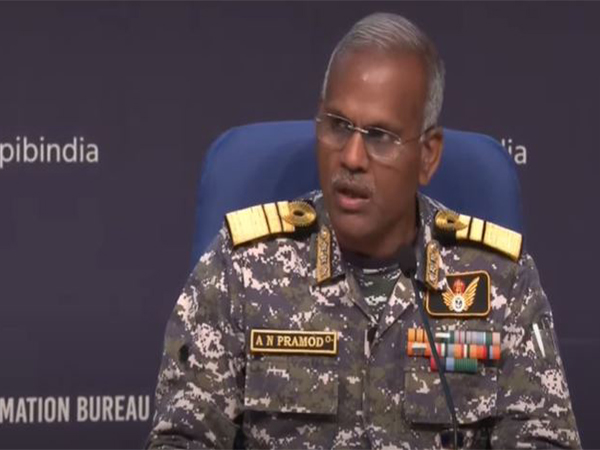

New Delhi [India], May 12 (ANI): With the air defence systems deployed by India standing the test of time in the face of aggression launched by Pakistan, Director General Naval Operations, Vice Admiral AN Pramod, said on Monday that the Indian Navy is maintaining continuous surveillance to degrade or neutralise threats as they emerge.
Addressing a joint press conference on Operation Sindoor, Vice Admiral Pramod said that India has an effective, layered fleet air defence mechanism that caters to all threats.
"Effectively using multiple sensors and inputs, we are maintaining continuous surveillance to degrade or neutralise threats as they emerge or manifest to ensure targeting at extended ranges. All these are conducted under the umbrella of a comprehensive and effective layered fleet air defence mechanism that caters for all threats, be it drones, high-speed missiles or aircraft, both fighters as well as surveillance aircraft," he said.
The joint briefing was also addressed by the Indian Army's DGMO Lt Gen Rajiv Ghai and Air Marshal AK Bharti.
Vice Admiral Pramod said that the Indian Navy was at an advantage during Operation Sindoor and the presence of the carrier battle group ensured that the adversory did not get any chance to come close.
He said the Indian Navy operates as a composite naval force that can address air, surface, and subsurface threats.
Vice Admiral Pramod said Indian Navy's presence compelled the Pakistani air operations to remain bottled up "denying any opportunity to be a threat in the maritime space".
"The Indian Navy maintains credible capability to detect, identify and neutralize any aerial platforms that threaten our units at sea...To sum up, the Indian Navy's dominance ensured that, should we choose to, we can strike at will," he said.
In his remarks, Director General Air Operations Air Marshal AK Bharti detailed the success of the Indian Armed Forces' Operation Sindoor, launched on May 7, targeting nine terrorist infrastructure sites in Pakistan and Pakistan-occupied Jammu and Kashmir (PoK).
The operation, a response to the April 22, Pahalgam, terror attack, was executed with precision to minimize damage to civilian and military infrastructure despite intervention by the Pakistani military.
Air Marshal Bharti emphasised that the Indian Armed Forces' fight was solely against terrorists and their support networks, not the Pakistani military. The Armed forces also displayed a video that showed the destruction to Pakistani ordinance in the strikes.
He noted that the Pakistan military chose to intervene, and thus any loss from their side was their sole responsibility.
"We had a detailed brief on the successful joint operations to destroy the terror operation in Pakistan-occupied Kashmir and Pakistan itself... We reiterated that our fight was with terrorists and their support infrastructure and not with the Pakistani military. However, it is a pity that the Pakistani military chose to intervene and back the terrorists, which compelled us to respond, and whatever loss they suffered, it was their own responsibility," he stated.
The Air Marshal highlighted the effectiveness of India's layered and intricate air defence (AD) system, which played a pivotal role in thwarting multiple waves of Pakistani drones and unmanned aerial vehicles (UAVs). The robust AD environment, comprising assets from the Indian Army, Navy, and Air Force, included multilayered sensors and weapon systems, indigenously developed soft and hard-kill counter-UAV systems, and highly trained personnel. The Integrated Air Command and Control System (IACCS) of the Indian Air Force (IAF) was instrumental in coordinating this defence network.
"This brings me to the point of how the Indian Forces brought minimum damage to both civilian and military infrastructures in spite of Pakistan's unrelenting forces... The majority populace has a lot to say about the layered and intricate air defence system put in place by the Indian Armed Forces, which includes assets of the Indian Army, Navy and Air Force... This robust AD system comprises a large variety of multilayer AD sensors and weapon systems... Numerous waves of drones and UAVS deployed by Pakistan were also thwarted by the indigenously developed soft and hard kill counter-UAV systems and the well-trained Indian personnel," Air Marshal Bharti noted.
Air Marshal Bharti attributed the success of India's air defence capabilities to a decade of unwavering budgetary support from the Government of India, which enabled the development and deployment of advanced systems.
"All these were brought together as an effective AD environment by the IACCS of the IAF. The performance demonstrated by the older battle system also took them (drones) head-on... Another highlight was the stellar indigenous AD, like the Akash System... This AD environment was possible over the last decade because of the unwavering budget allocated by the Government of India," he stated.
"Numerous waves of drones and unmanned combat aerial vehicles employed by Pakistan were also thwarted by the indigenously developed soft and hard kill counter-UAS systems and the well-trained Indian Air Defence personnel," he added. (ANI)


