 हिंदी खबर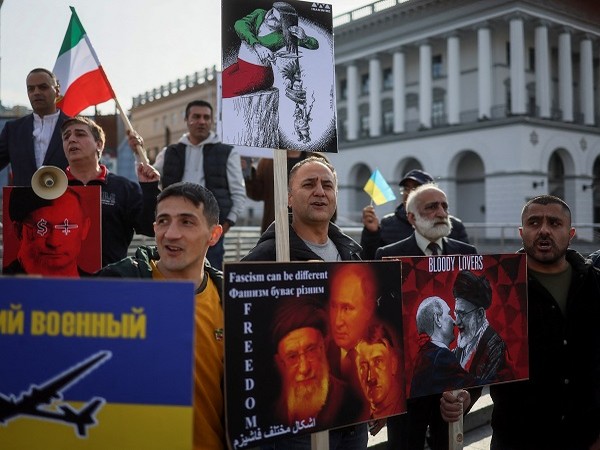

By John Solomou
Nicosia [Cyprus], December 5 (ANI): While since last February the world's attention has been mainly focussed on the war in Ukraine, the confrontation between Iran with the United States and Israel is escalating dangerously and could take the form of unconventional war.
This dangerous situation is basically due to three reasons:
First, the failure of the parties involved to reach an agreement on a nuclear deal that would significantly reduce economic sanctions on Iran and in exchange Tehran would reduce its nuclear program -which is seen by the West as aiming at building a nuclear bomb- and would allow international monitoring.
Second, the supply of hundreds of cheap Iranian drones to the Russian Army which it uses to destroy Ukraine's electricity and water supply infrastructure. The use of Iranian drones is causing severe hardship to millions of Ukrainian civilians, leaving them without heating, lighting and running water.
Third, the brutal repression of Iranian protesters demonstrating against the government, using live ammunition and killing hundreds of them and arresting and sending to jail more than 1000 people. Now let's see in more detail the reasons why the confrontation between Tehran and the West has greatly escalated in recent months and can take the form of an unconventional war.
Hopes for the revival of the Joint Comprehensive Plan of Action (JCPOA) that would have prevented the development of an Iranian nuclear bomb in exchange for the lifting of Western sanctions were dashed a few months ago.
Last month Iran announced that it would start enriching uranium at 60% purity at its Fordow plant - a plant buried inside a mountain- which could be protected from missile attacks or air strikes.
This decision, taken in retaliation for a resolution of the International Atomic Energy Agency ordering Iran to cooperate in an investigation concerning the finding of uranium particles in undeclared sites, was seen by the West as a serious provocation.
Israeli Prime Minister-designate Benjamin Netanyahu as well as many Israeli leaders belonging to different parties have repeatedly warned that Israel was prepared to use its right to self-defense and do whatever it takes to stop Iran from obtaining a nuclear bomb.
Another issue that raises concerns among NATO allies and the West, in general, is that Russia, which is facing a serious depletion of its drones, has bought a few thousand inexpensive Iranian Shahed drones and uses them as suicide drones to strike against a wide range of military targets in Ukraine and mainly the electricity infrastructure of the country, turning the conflict into a war of attrition.
Such drones are known to cost about USD dollars 20,000, whereas surface-to-air missiles or ground-based interceptors cost between USD 400,000 and USD 1.2 million each. So far, Russia has been sending swarms of drones against Ukraine, forcing it to use all its means to intercept or destroy them and at the same time making them unavailable for attacks against the Russian forces.
However, this situation may change soon as Ukroboronexport, a Ukrainian arms producer, claims that it is developing better and equally inexpensive drones as the Iranian Shahed. So, Ukraine too could soon use drones to give Moscow tit for tat.
Presumably, Ukraine too could target Russia's infrastructure with drones or carry out acts of sabotage. Furthermore, countries hostile to Tehran, which in the past had been attacked by Iranian drones, like Saudi Arabia and the United Arab Emirates, can use such drones to avenge Tehran for the attacks they had suffered.
Another point of friction is the Western condemnation of the harsh methods used by the Iranian regime to suppress the wave of protests sparked by the death of Mahsa Amini, a Kurdish woman, who last September was arrested by the morality police for an alleged breach of the strict Islamic dress code and subsequently died in police custody.
The Islamic regime accuses the West of exploiting the unrest and demonstrations in the country as Iranians from all walks of life continue to take part in massive protests. Many incidents have been reported in which protesters showed their outrage by torching police stations and vehicles, while the police on several occasions used deadly force to dispel them.
According to the Iranian Interior Ministry, the death toll due to the continuing unrest was 200, but foreign human rights organisations estimate that the death toll is more than 300 people, including 41 children.
In a tweet, Iranian Foreign Minister Hossein Amir-Abdollahian claimed that various security services, Israel and some western politicians "who have made plans for civil war, destruction and disintegration of Iran should know that Iran is not Libya or Sudan."
Tehran has accused the United States, Israel, the United Kingdom and Saudi Arabia of being behind the protests and claimed that the country was facing a "hybrid war" by hostile countries and "terrorist media groups."
The U.S. government insists that Iran is spending more than one billion dollars a year for terrorist financing and considers Tehran as the foremost state sponsor of terrorism. For this reason, it has imposed sanctions on numerous Iranian officials and military officers.
Middle East analysts believe that any of these three issues, or a combination of them, could lead to unconventional warfare between the US and Iran or between Israel and Iran.
According to Wikipedia, unconventional warfare is broadly defined as "military and quasi-military operations other than conventional warfare" and may use covert forces, subversion, or guerrilla warfare. This is typically done to avoid escalation into conventional warfare as well as international conventions."
Michael Knights and Alex Almeida in an analysis published by the Washington Institute for Near East Policy on the use of Iranian drones by Russia warn: "If the adversaries of Russia and Iran are prepared to go beyond sanctioning, naming and shaming, the costs of undertaking strategic attacks could become unbearably high for the rogue states of the world." (ANI)


