 हिंदी खबर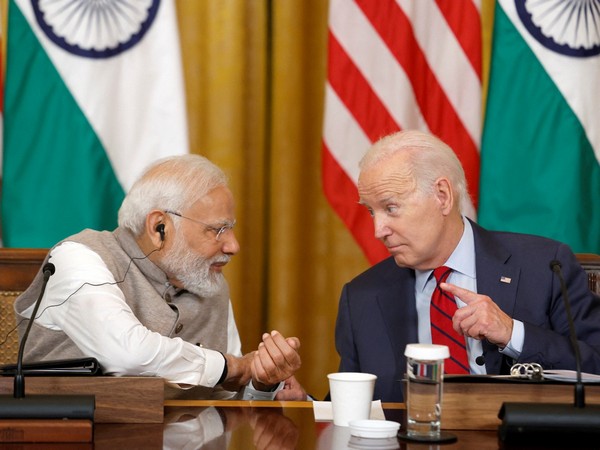

New Delhi [India], June 28 (ANI): Prime Minister Narendra Modi's first State visit to the United States has been an instant hit.
Note that this is not a Bollywood movie that we are talking about, but a journey that resounds with a new mantra for India-US ties.
The India-US joint statement sums up the sentiments and intent of both nations by stating that "Our cooperation will serve the global good as we work through a range of multilateral and regional groupings - particularly the Quad- to contribute toward a free, open, inclusive, and resilient Indo- Pacific. No corner of human enterprise is untouched by the partnership between our two great countries, which spans the seas to the stars".
The grand rhetoric will be translated into action as India will soon join the Artemis Accords, a US-led effort to send humans to the moon again by 2025, with the ultimate goal of expanding space exploration to Mars and beyond. The range of bilateral agreements signed and the likely spin-offs that it will bring to the Indian industry by itself indicates the depth of mutual understanding and strategic salience attached to India by the US.
The perspective from Beijing and Islamabad gives us a bird's eye view of the State Visit of Prime Minister Modi. Both China and Pakistan have long opposed an assertive India on the world stage and especially one that is in sync with the United States. For China, the State Visit of Prime Minister Modi to the US was a cruel reminder that it is not only Beijing which can pursue "win-win" cooperation with America.
The Prime Minister indirectly hit out at China when he told Congress, "The dark clouds of coercion and confrontation are casting their shadow in the Indo-Pacific."
He added, "The stability of the region has become one of the central concerns of our partnership."
The joint statement included a warning of rising tensions and destabilizing actions in the East and South China Sea and stressed the importance of international law and freedom of navigation. The US may have well sent a gentle reminder to China when they played Lata Mangeshkar's "Ae mere wattan ke logon", at the State dinner.
This is a song that commemorates the Indian Army soldiers who lost their lives during the 1962 India-China border war. Symbolism plays an important part of the new normal in India-US relations! Chinese state media said the US was displaying "wishful thinking" regarding India's potential. They regarded Modi's visit as part of Washington's strategy to prop up India to contain China - exuding a mild 'cautious optimism' - as Beijing believes that the two sides aren't entirely aligned.
The winds of change in Indo-US relations are best seen in the Joint Statement wherein both leaders "....strongly condemned cross-border terrorism, the use of terrorist proxies and called on Pakistan to take immediate action to ensure that no territory under its control is used for launching terrorist attacks." This was certainly not liked by Pakistan. Pakistan's Foreign Ministry said the US-Indian Joint Statement was "unwarranted, one-sided, and misleading".
The reference to Islamabad in it was "contrary to diplomatic norms," it said. The Dawn (June 24), as did other major English dailies tried to cloak Pakistan's role in fostering militancy and terrorism in India by arguing that, "While Pakistan has had a problem with militancy, the critique would have carried more weight had the Biden administration also brought up India's deplorable treatment of its Muslims, and its long subjugation of Kashmir." The Express Tribune (June 24) alleged that the joint statement showed that "Washington was harping to the tune from India". Most importantly, speaking from the international relations perspective, "India's inking of big-ticket projects... has cemented a decade of neo- World Order in Asia."
Foreign Secretary Vinay Mohan Kwatra aptly summed up the outcomes of the visit when he said the area of technology cooperation across the entire ecosystem, tech transfer, tech trade in products and services, tech capacity building, tech co-production and research, constituted a major takeaway from the visit, alluding to the cooperation within the framework of the initiative on critical and emerging technologies (iCET) and beyond. Special mention could be made of advancements in defence partnership, space cooperation, and commitment of both nations to harnessing advanced technologies for mutual benefit. The very fact that President Biden accorded a state honour to the Prime Minister indicated the importance the US attaches to the visit. Geo-politically both nations have shown the will and the way to move closer. This bilateral bonhomie is reflected in the manifold sectors in which the US has agreed to link up with India. Defence, semi-conductors and space cooperation are at the forefront of this new cooperative spirit.
The agreement to jointly produce jet engines, procurement of High Altitude Long Endurance (HALE) drones, and establishment of semi-conductor facilities in India demonstrates a substantial leap in technology defence partnerships. Of note is the MoU signed between General Electric and Hindustan Aeronautics Limited to jointly produce GE 414 fighter jet engines, with technology transfer and indigenous manufacturing capabilities. The Tejas Mark II will certainly get a boost. The potential for using the GE 414 for the AMCA also opens up in the future. Additionally, the Indian Navy, Army, and Air Force will procure 31 MQ-9B HALE US drones, to strengthen India's Intelligence, Surveillance, and Reconnaissance capabilities. To support long- term goals in boosting India's indigenous defence capabilities, the US-based General Atomics will set up a Comprehensive Global MRO facility in India. While US defence industry has shown the way, US political leadership will have to ensure continuity in this sector.
The fact is that both India and the US need each other in the new world order. With Russia fighting a lone war in Ukraine, China on its mission to become a world power and others clamouring for a place on the world stage, the US realizes it needs a partner in the Indo-Pacific to whom it can entrust the responsibility of acting as a countervailing force against China. India hesitates to be that force openly. It is therefore important for India to take action in that direction without necessarily bragging about it.
India and more importantly, Prime Minister Modi realizes that closer interaction with the US is essential if it is to move away from its dependence on Russia for its weapons and other equipment. There is another facet to the current visit which is geo-politically important for both the US and India, though for different reasons. The US expectation is that India will sooner than later overtly support Ukraine in the conflict. Till this happens, the need to use bilateral leverages with India will continue.
At the end of the day, the India-US relationship has benefitted. Both sides are now able to bring together their requirements on a single platform and the multi-layered mechanisms put in place to achieve the goals set by the Joint Statement will probably outlast the elections next year, both in India and the US. If this indeed happens, then President Biden and Prime Minister Modi would have helped to unequivocally shape the future of India-US ties! (ANI)




