 हिंदी खबर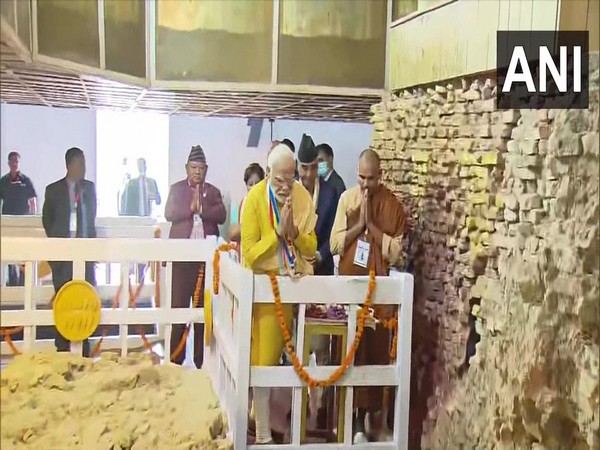

New Delhi [India], May 25 (ANI): India and Nepal have a profound and enduring bond rooted in deep socio-political, economic, cultural and religious ties that have spanned across centuries.
These two sovereign nations not only possess open borders, but they have also fostered an environment of unrestricted movement, allowing the people from both countries to establish intense connections through marriage, kinship and familial relationships.
The intermingling of their societies has led to a strong interdependence and shared experiences, solidifying the historical and social fabric that binds Nepal and India together.
This unique relationship showcases the strength and resilience of their interconnectedness, illustrating a remarkable synergy that transcends geographical proximity.
India's involvement in Nepal has been informed by its principle of 'Vasudhaiva Kutumbakam' and the policy of 'Neighbourhood First'.
In this regard, India's main focus has been to boost Nepal's development through aid and infrastructure development grants, foster ethnic linkages and improvement of human development indicators, and support Nepal during adversities such as the 2015 earthquake.
The Nepal-India Chamber of Commerce and Industry (NICCI) recently hosted the India-Nepal Economic Partnership Summit 2023, a momentous event to bolster business and trade ties between the neighbouring nations.
Held in Birgunj, in collaboration with the Nepal SBI Bank, Birgunj Chamber of Commerce and Industry, and the Start-up Network, the summit had the overarching objective of forging new avenues for business collaborations and investments in crucial sectors of the economy. Moreover, it sought to invigorate trade along the vital India-Nepal border located in Birgunj.
The summit's key highlights encompassed the establishment of a platform for comprehensive economic engagement between India and Nepal, facilitating reciprocal investment flows, reaffirming the bilateral relations as the cornerstone of sub-regional cooperation in South Asia, and shedding light on the untapped potential of the Border Area Development Programme.
The programme will pave the way for significant Indian involvement in the infrastructural revitalization of Nepal's bordering districts in Bihar, transforming them into gateways for the India-Nepal Trade Connection. In a statement, the chamber emphasized the imperative to streamline business procedures between the two nations, an essential step toward fostering greater ease.
Despite a few hiccups in the bilateral relationship, the ties between the two countries have grown from strength to strength. It is a relationship that is characterised by multidimensional partnership covering all the domains be it trade and commerce, defence and security or people-to-people socio-cultural ties.
In spite of an overarching relationship, there are few aspects that can further boost the relationship between the two countries and therefore need urgent attention by the decision-makers, policy mandarins, business community and civil society of both countries.
One of these dimensions is the mutual benefit that can accrue to both nations by furthering India's Buddhist cultural policy initiatives. Buddhism is a potent factor that binds both India and Nepal together. Buddha was born in Lumbini in Nepal and he attained enlightenment, disseminated Buddhism through his sermons and attained Mahaparinirvana (Moksha) in India.
Buddhism has become one of the key instruments of India's soft power outreach to enhance the bilateral relationship with Nepal owing to the common Buddhist heritage linkages. India's policy doctrine informed by the principle of "mutual respect for each other's territorial integrity and sovereignty" is rooted in the ideals of Buddhism itself.
In 2014, during the visit of Prime Minister Narendra Modi to Nepal, both countries signed an agreement to boost spiritual tourism including connectivity of the Buddhist holy sites in both countries.
In this regard, Buddhist Circuit under India's Swadesh Darshan scheme is now to extend to Lumbini in Nepal, connecting it with important Buddhist sites like Bodh Gaya, Sarnath and Kushinara in India.
India has also provided financial assistance to renovate and reconstruct a number of Buddhist sites in Nepal including The Tashop (Tare) Gompa Monastery in Kathmandu, The Ganga Pokhari and Shree Mahanyan Boudha Samaj Gumba in Lalitpur district, among others.
The visit of PM Modi to Lumbini, the birthplace of Gautama Buddha, on Buddha Purnima this year marked a watershed moment in fostering ties between the two countries based on the Buddhist linkage.
The laying of the foundation stone for an Indian monastery along with the inception of construction of the India International Centre for Buddhist Culture and Heritage in the Lumbini Monastic Zone of Nepal by the Indian PM helped further bolster the relations.
Another aspect that can further advance the relationship between the two countries is boosting the open border movement of trade and people. This has enabled the development of a "roti-beti" relationship between the citizens of the two countries. This open border access is based on the Treaty of Peace and Friendship, 1950 which provides for equal rights in matters of residence, acquisition of property, and employment and movement in each other's territory.
With remittances being one of the mainstays of the Nepalese economy and a dominant part of that coming from Nepalese working in India, this open border has benefitted Nepal and its citizens tide over poverty, unemployment, and undernutrition, amongst other challenges.
Also, with Nepal being a landlocked country, the open border provision has provided Nepal access to seas through India for its exports and imports. It has thus helped in its trade and commerce immensely. This arrangement has also enabled Indian businesses to open their ventures in Nepal and contribute to its growth and development.
The hydropower sector is another pillar that can be a stimulant for boosting bilateral ties. Over the past few years, India has begun to prioritise development in this field.
The 900 MW Arun III project, being developed by a subsidiary of Satluj Jal Vidyut Nigam (SJVN), is moving ahead at a faster pace. India has also come to Nepal's aid by signing an agreement between Nepal and India's NHPC Ltd. to develop both the 750 MW West Seti project, a project that was stranded by a Chinese company citing financial unviability.
The 900 MW Upper Karnali Project has also been taken up by GMR, an Indian company, for construction. Notably, between June and December 2022 alone, Nepal earned NPR 11 billion by exporting hydropower to India.
Nepal has also proposed a 25-year bilateral agreement for power trade that will replace the current annual renewal system bringing inefficiency and uncertainty in trade prospects.
In taking the Indo-Nepal cooperation to a new height, India's flourishing start-up system too can play a crucial role.
Nepal has a large, young population. It lacks sufficient employment avenues which can absorb its young demography. Creating new businesses and ventures, therefore, becomes essential for Nepal to reap its demographic dividend and step up the growth ladder.
India's booming startup ecosystem has been facilitated by the Indian government through its Start-up India scheme, supporting more than 4200 startups in India through its Fund of Funds and Seed Fund.
Incubation centres, accelerators and technology hubs have been created which facilitate budding entrepreneurs innovate and create new products and services.
Through JAM trinity (JanDhan, Aadhar and Mobile), Indian startups in the fintech, logistics and e-commerce sectors have scaled up immensely.
In the recently organized India-Nepal Startup Connect, an event to bring together the start-up ecosystems of the two countries, the Nepalese entrepreneurs, businesses and officials expressed their desire for greater collaboration of the startup ecosystem of the two countries as Nepal can benefit enormously from leveraging Indian expertise.
By harnessing the full potential of the various dimensions and sectors discussed, India and Nepal can embark on a journey of enhanced cooperation and collaboration, reaping mutual benefits along the way.
The remarkable socio-economic, cultural and political ties shared between the two nations provide a strong foundation for further advancement. By prioritizing and capitalizing on these aspects, a new chapter can be written in the Indo-Nepal relations, propelling them to even greater heights.
This requires a concerted effort from both countries, recognizing the immense value of fostering deeper engagement and leveraging each other's strengths. As India and Nepal continue to navigate their shared destiny, embracing these key dimensions will unlock a world of opportunities and solidify their enduring partnership for generations to come. (ANI)


