Strengthening Indo-Japan partnership: A shared vision for free, prosperous Indo-Pacific
The cooperation between India and Japan continues to deepen over time as the two nations share historical linkages with exchanges between the two countries being traced to the 6th century when Buddhism was introduced in Japan.
ANI
Jul 31, 2023 02:15 IST

By Divya Rani
New Delhi [India], July 31 (ANI): The cooperation between India and Japan continues to deepen over time as the two nations share historical linkages with exchanges between the two countries being traced to the 6th century when Buddhism was introduced in Japan.
As both nations deal with the challenges provided by an aggressive China in the Asian region, India's political ties to Japan have grown significantly over the past few decades.
The commitment of India and Japan to a free and open Indo-Pacific, boosting economic cooperation, and encouraging people-to-people interactions is highlighted by their most recent strategic discussion.
Their reinforced partnership, which marks a key turning point in their ever-expanding relationship, holds great potential for helping to shape a thriving Indo-Pacific region governed by inclusion and rules-based principles in the face of shifting geopolitical circumstances.
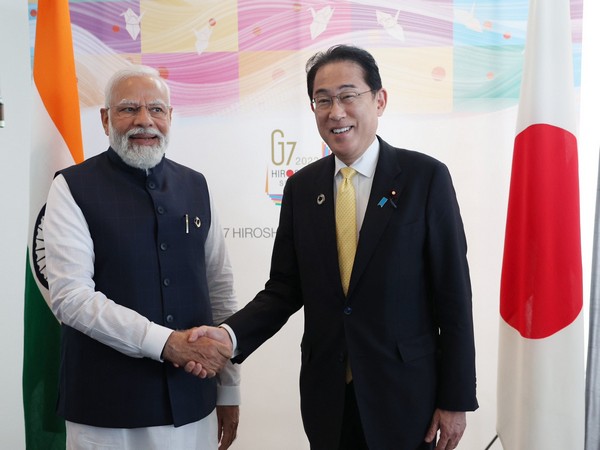
In 2006, the bilateral partnership between the two countries was elevated to the status of ‘Global and Strategic Partnership’, which was further upgraded to ‘Special Strategic and Global Partnership’ in 2014 after the summit meeting between the then leaders of the two countries – Prime Minister Narendra Modi and then PM Shinzo Abe. Such an agreement was the testimony to a deepening, broad-based and action-oriented partnership between India and Japan and a reflection of a broad convergence of their long-term political, economic and strategic goals.
In the lead-up to both the G20 and G7 summits, the visit of Japanese PM Kishida to India bolstered further commitment between the two countries to work together for the realisation of a ‘Free and Open Indo-Pacific”.
India and Japan have already developed various frameworks of security partnership including a ‘2+2’ Dialogue involving Foreign and Defence ministers. The two countries regularly participate in joint military exercises such as the Malabar Exercise and have various partnership agreements ranging from defence equipment trade to military logistics.
Moreover, the connections have continuously grown closer and wider in the area of commercial partnerships. The amount of trade between the two nations has amplified over the years.
Japan is India's 13th-largest trading partner, whereas India is Japan's 18th-largest. With Japan's private sector investment in India steadily increasing, it is among the top five foreign investors in India. India also receives the most official development assistance (ODA) funding from Japan. A noteworthy illustration of Japan's ODA's achievement in India is the Delhi Metro.
The cooperation between the two countries is getting ever stronger with an increasingly assertive China posing a challenge to both countries.
The strategic doctrines of Japan – both the National Security Strategy 2022 and the National Defence Strategy 2022 – clearly expresses Japan’s intention to deepen bilateral and multilateral defence exchanges with India, with an emphasis on securing a free, open, peaceful, stable, and rules-based Indo-Pacific.
Japan has also been allowed by India to carry out projects in the Andaman and Nicobar Islands, which are in close proximity to the strategic chokepoint Strait of Malacca.
A reflection of true Global Strategic Partners, India and Japan have been jointly developing infrastructure projects across Sri Lanka, Bangladesh and Africa with a view not only to counter China’s Belt and Road Initiative (BRI) but also to invest in the development of these regions and support the local community.
The recently concluded 15th India-Japan Strategic Dialogue, led by Japanese counterpart Yoshimasa Hayashi and Indian Minister of External Affairs S. Jaishankar, added another feather to this steadily growing partnership.
It demonstrated both countries' unwavering commitment to strengthening their bilateral partnership on important regional and international issues. Given the current global climate, this dialogue is very noteworthy.
The ministers emphasised the importance of creating an Indo-Pacific region that is free and open and is founded on common values and principles. Speaking warmly of India, Japanese Foreign Minister Hiyashi highlighted how crucial India is to achieving this kind of global vision.
Moreover, during the 15th India-Japan Strategic Dialogue, the foreign ministers agreed to achieve the target of Japanese investments in India to the tune of 5 trillion Yen (about USD 35.9 billion) over the period of 2022-27. Several potential areas for collaboration in the field of critical and emerging technologies were explored including semiconductors, resilient supply chains, and digital public infrastructure. The way forward to further deepen the Defence Equipment and Technology Cooperation was also taken up by the foreign ministers. Earlier, Japan and India agreed to start a policy dialogue to promote cooperation in the development of semiconductors, hydrogen fuel and other advanced fields. The two countries aim to strengthen partnerships between Indian and Japanese private sectors in advanced industries.
As India and Japan face geopolitical challenges and an assertive China, their strengthened alliance holds immense potential in ensuring a free, open, and prosperous Indo-Pacific region, guided by inclusivity and rules-based principles.
Japan and other East Asian countries are increasingly worried about China's assertive actions in the Indo-Pacific, territorial disputes, and border clashes.
India has shifted its approach towards China following PLA's incursions in Ladakh and Doklam. The Quad's formation and Japan's inclusion in the Malabar exercises, alongside India and the US, were responses to China's aggressiveness.
India and Japan are making strides in their bilateral defence and security cooperation, bolstered by Japan's evolving military policies and capabilities. Regular exchanges among their army, navy, and air force chiefs further reinforce this partnership. Efforts to deepen defence equipment and technology collaboration are also underway. Both nations share a similar outlook on major international issues, except for the Ukrainian conflict.
The strategic dialogue between the two concurred on the necessity of early reforms in the United Nations Security Council (UNSC). Japan is a major contributor to the United Nations, and India, with its substantial size and population, assert their rightful place in the UNSC. However, despite prolonged discussions, the current Permanent Five (P5) members—USA, China, France, Russia, and the UK—show a cautious approach towards expanding the composition of the esteemed council.
Relationships between India and Japan have greatly improved, overcoming historical obstacles to create a strong and complex cooperation. With an emphasis on regional and global concerns, economic cooperation, and cross-cultural interactions, their most recent strategic dialogue was another significant turning point in their relationship.
As geopolitical dynamics continue to evolve, India and Japan's joint efforts to foster a free, open, and prosperous Indo-Pacific region demonstrate the strength and potential of their ever-strengthening relationship.
*Dr Divya Rani is an Assistant Professor in the Department of Political Science, BHU (Varanasi). She has been in teaching and research of International Relations for more than a decade.* (ANI)
Get the App