South Korean exports expected to continue to decrease in fourth quarter
Although the South Korean economy continued to grow for nine consecutive quarters since March 2020 (2.3 per cent), the growth rate has decreased to a half of the second quarter (0.7 per cent). In particular, trade balance has significantly decreased. Exports increased 1.1 per cent due to decrease in chip exports, while imports such as crude oil and natural gas increased by 6 per cent.
ANI
Dec 02, 2022 10:43 IST

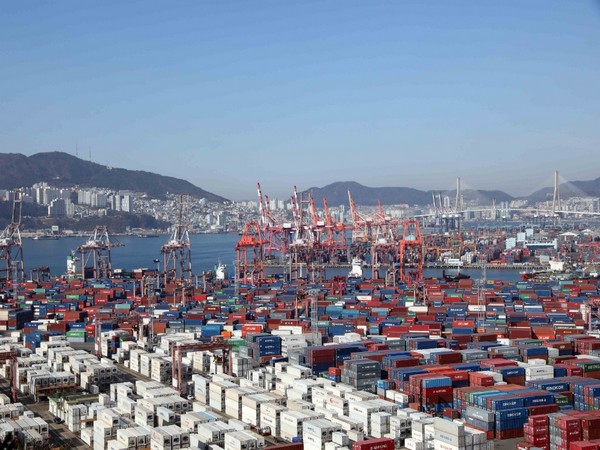
Seoul [South Korea], December 2 (ANI/Global Economic): Export, which led the Korean economy for about 2 years after the COVID-19 pandemic, has decreased rapidly due to the global economic slowdown.
In addition, if consumption and domestic demand also decrease due to inflation and interest hikes, economic growth is expected to be negative in the fourth quarter.
Although the South Korean economy continued to grow for nine consecutive quarters since March 2020 (2.3 per cent), the growth rate has decreased to half of the second quarter (0.7 per cent). In particular, the trade balance has significantly decreased. Exports increased 1.1 per cent due to decrease in chip exports, while imports such as crude oil and natural gas increased by 6 per cent.
As a result, the contribution of net exports to the growth rate in the third quarter fell to -1.8 per centp. It means that net exports cut the growth rate by 1.8 per centp, and recorded a negative contribution for two consecutive quarters following the second quarter.
Fortunately, private consumption and facility investment raised the growth rate by 2.0 per cent. Regarding the contribution of net exports to negative growth, Choi Jung-tae, head of the Bank of Korea's National Account Department, said, "This is because semiconductor exports declined and crude oil imports increased in the third quarter."
In the fourth quarter, exports turned to decline. According to the Ministry of Trade, exports (USD51.91 billion) in November plunged 14 per cent from USD60.33 billion last year. It decreased for 2 consecutive months since October (-5.7 per cent).
In particular, exports of semiconductors (-29.8 per cent) and petrochemicals (-26.5 per cent) which are Korea's main export items decreased significantly due to falling demand and global economic slowdown.
An official from the Ministry of Trade said, "Various reasons such as the prolonged war between Russia and Ukraine, the global economic slowdown caused by tightening policies in major countries, and the truckers union's strike affected a decrease in exports."
Due to a deficit in the balance of goods, the overall current account balance in October is also expected to post a deficit. Exports continue to decline, but consumption and investment are unlikely to continue to increase.
According to the Bank of Korea's consumer trend report, the overall CCSI (Composite Consumer Sentiment Index) in November was 86.5 points, down 2.3 points from October (88.8 points). It has decreased for 2 consecutive months since October, which means that consumption has begun to decrease due to high prices and interest hikes.
Hwang Hee-jin, head of the Bank of Korea's statistical research team, said, "Consumer sentiment has continued to decrease due to concerns over economic slowdown amid high inflation."
Investment is also declining. According to the Bank of Korea's November BSI (Business Survey Index) survey, overall BSI was 75 points, hitting the lowest in a year and 11 months since December 2020 (75 points). The expected BSI (74 points) in December also fell 2 points from November (76), the lowest since January 2021 (70 points).
In this situation, it is not expected that companies will make investments at risk. South Korean economy is expected to rapidly slow down as exports, consumption and investment decrease. As the government stresses fiscal soundness, it is difficult to expect the government's expansionary fiscal policy.
Many domestic and foreign institutions, including the Bank of Korea (1.7 per cent), recently cut Korea's growth forecast for next year to 1 per cent.
In addition, some experts predicted that the Korean economy growth rate will decrease in the fourth quarter for the first time in 2 years and 6 months since the second quarter of 2020 (-3.0 per cent). (ANI/Global Economic)
Tags:
Get the App