 हिंदी खबर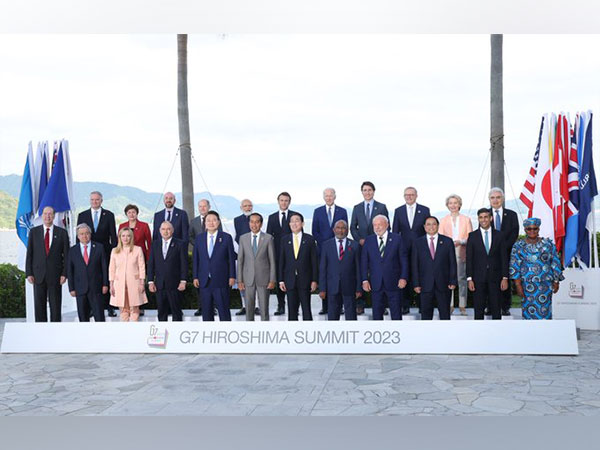

New Delhi [India], May 26 (ANI): In the recent Group of Seven or G7 Summit, Prime Minister Narendra Modi's interactions with several countries' leaders shows a shift in India's international diplomacy and also its proactive approach towards its relations with foreign nations, foreign affairs expert Maheep wrote.
Maheep is a leading expert of India's Foreign Affairs and He is the Principal Investigator of a National Project on India's Soft Power Diplomacy.
In the three-day Summit, PM Modi's journey witnesses his active participation in the meetings held in Hiroshima, Japan.
Notably, the Prime Minister's visit to Hiroshima, Japan for the G7 summit, from May 19 to 21, stands as a testament to India's growing global influence.
During this summit, Prime Minister Modi's interventions addressed a broad horizon of themes including the pursuit of peace, stability, and prosperity for a sustainable planet, as well as addressing critical concerns of food, fertilizer, and energy security.
India was among the invitees to the G-7 summit, along with Australia, the Cook Islands, Brazil, Vietnam, Indonesia and others.
The invitation was extended during the visit of the Japanese Prime Minister to India in March 2023. Earlier in 2019, India was invited by France, which hosted the G-7 summit that year. USA had invited India in 2020 but the summit meeting that year was cancelled on account of the COVID-19 pandemic. It seems that India has become a permanent guest for the G-7 summits.
On May 19, PM Modi landed in Hiroshima to join the G7 proceedings and hold bilateral meetings on the sidelines with several world leaders, according to Maheep.
During his visit, he unveiled a bust of Mahatma Gandhi in Hiroshima which was crafted and sculpted by Padma Bhushan awardee Ram Vanji Sutar. The 42-inch-tall bronze bust was gifted as a symbol of friendship and goodwill between India and Japan. It has been installed close to the iconic Atomic Bomb Dome in a befitting tribute to a city that symbolizes humanity's yearning for peace. Speaking to reporters after the event, the Prime Minister emphasized the global appeal of Gandhian ideals of peace and non-violence, observing that it gave strength to millions.
At the G7 working session on food, health, development and gender, Prime Minister Modi called for building an inclusive food system focusing on the world's most vulnerable people, especially marginal farmers, and strengthening of global fertilizer supply chains on a priority basis.
He also called for greater health security in future, through hard-wearing healthcare systems and greater attention to holistic healthcare. Speaking on the development, he stressed on the democratization of technology as a bridge between democracy and development. Finally, on the gender question, the Prime Minister observed that it has been made an integral part of the decision and policy-making process in India.
Prime Minister held a meeting with Volodymyr Zelenskyy, President of Ukraine on the sidelines of the G-7 Summit. He observed that for him the conflict in Ukraine was not merely a political or economic issue but an issue of humanity, of human values. Appreciating Ukraine's cooperation in the safe evacuation of Indian students, Prime Minister Modi conveyed India's unwavering support for dialogue and diplomacy as a way forward, promising that India and Prime Minister personally would do everything within their means to find a solution to the problem.
Modi later held a warm productive conversation with Japanese premier Fumio Kishida on Saturday, May 19. The two leaders explored various ways to coordinate various efforts of respective G-7 and G-20 Presidencies, with the objective to highlight the voice of the Global South. They also exchanged views on contemporary regional developments and on deepening cooperation in the Indo-Pacific.
Modi later met South Korean President Yoon Suk Yeol. The two premiers discussed the progress of the India-Republic of Korea Special Strategic Partnership, exploring strategies to strengthen bilateral cooperation across sectors, including high technology, IT hardware manufacturing, trade and investment, defence, semiconductors, and culture.
Prime Minister Modi also met Pham Minh Chinh, the Prime Minister of Vietnam. They were happy with the steady progress of the bilateral Comprehensive Strategic Partnership, ageing to increase high-level exchanges and deepen bilateral trade and investment ties. They also explored prospects in the sectors of defence, energy, science and technology, building resilient supply chains, culture, human resource development, and people-to-people ties. They had a positive exchange of views on regional developments, such as the ASEAN and cooperation in the Indo-Pacific.
On May 21, PM Modi met Luiz Inacio Lula da Silva, President of Brazil in what was the first meeting between the two leaders. Noting that this year marked the 75th anniversary year of the establishment of diplomatic relations, they reviewed their Strategic Partnership and discussed ways to further strengthen it, especially in sectors of defence production, trade, agriculture, pharmaceuticals, dairy and animal husbandry and bio-fuels and clean energy. Both leaders called for more high-level meetings among captains of industry from both countries.
Prime Minister Narendra Modi also met German Chancellor Olaf Scholz. He welcomed Germany's support for the India-EU trade and investment agreements and for India's G20 Presidency. The two premiers reviewed the progress in bilateral relations and exchanged views on regional developments and global challenges.
On the same day, PM Modi met Rishi Sunak, the UK Prime Minister. They reviewed their Comprehensive Strategic Partnership, including the progress in India-UK FTA negotiations. They resolved to deepen mutual cooperation in trade and investment, science and technology, higher education, and people-to-people contacts. Updating Sunak about various developments about India's ongoing G20 Presidency.
Prime Minister Modi looked forward to welcoming UK PM in New Delhi for the G-20 Summit.
The recent events surrounding Prime Minister Narendra Modi's engagements at the G7 summit have showcased the depth and significance of India's global relations. Notably, the warmth and camaraderie between Prime Minister Modi and US President Joe Biden exemplify the strength of the India-US relationship. Their warm greeting and shared hug signify a strong bond and set the tone for the Prime Minister's upcoming visit to the United States from June 21 to 24, where he will be hosted by President Biden at the esteemed White House. The viral response to President Biden's light-hearted remark in social media about accommodating numerous requests from a large number of potential attendees to meet the Indian Prime Minister reflects the immense anticipation and enthusiasm surrounding this significant diplomatic encounter.
Furthermore, Prime Minister Modi's active involvement in bilateral discussions with Indonesian President Joko Widodo and UN Chief Antonio Guterres reinforces India's commitment to constructive dialogue and collaboration on the global stage. Amidst the hectic schedule and multitude of engagements during the G7 summit in Japan, Prime Minister Modi displayed remarkable diplomatic prowess and a firm dedication to advancing India's interests and fostering international cooperation.
The culmination of these events has catapulted India into the spotlight, underscoring its growing influence and prominence in global affairs. Prime Minister Modi has concluded his three-nation visit with meaningful connections, setting the stage for future collaborations and endeavours.
With every encounter, India's global standing is further solidified, showcasing the nation's commitment to forging mutually beneficial partnerships, addressing pressing global challenges, and championing the principles of peace, stability, and prosperity.
The Group of Seven (G7) is an informal group of seven developed countries -- the United States, Canada, France, Germany, Italy, the United Kingdom and Japan, the heads of which attend an annual summit with the European Union and other invitees. It came into being in the 1970s, in response to huge economic problems such as the first oil shock and the collapse of the Bretton Woods fixed exchange rate system. The heads of state and government required an international platform to explore how to calibrate international economic policies and institutions to cope with their effects.
The members represent 40 per cent of the global GDP and 10 per cent of the world's population. However, the G7 has no legal existence, permanent secretariat or official members. Its resolutions have no binding impact on policy and commitments made at G7 must be ratified independently by the member states. (ANI)
PM Modi's interactions at G7 Summit depict India's proactive approach to international relations
By Maheep | Updated: May 26, 2023 10:47 IST


