 हिंदी खबर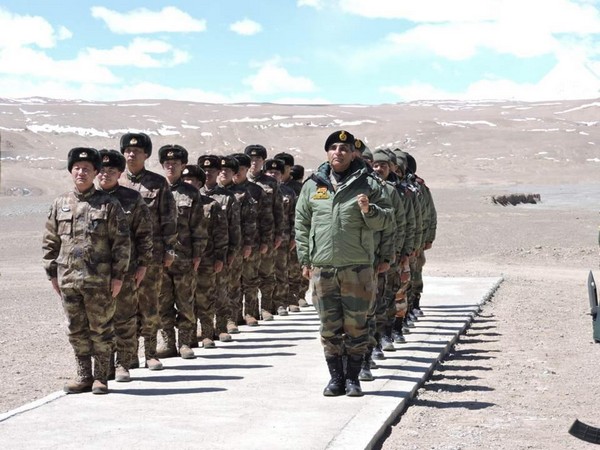

Hong Kong, December 15 (ANI): Chinese troops of the People's Liberation Army (PLA) clashed with the Indian Army in the eastern area of the two countries' disputed border on December 9.
This is simply the latest in a series of provocations that reflect China's love of "salami slicing" in order to gain greater swathes of territory.
The clash occurred in the Yangtse sector north of Tawang, located in Arunachal Pradesh. In Chinese, the area is known as Dongzhang. It was the most serious clash to erupt since the deadly confrontation at Galwan Valley in Ladakh in June 2020.
Of course, it is difficult to ascertain the exact truth about what transpired at Yangtse, since both sides have given completely contrasting accounts.
India reported that 300-400 Chinese troops initiated a confrontation. Injuries were reported on both sides in the ensuing scuffle that involved handheld weapons such as spiked clubs, tasers and monkey fists (knotted ropes swung as weapons).
Chinese media agencies such as Phoenix reported that "about 8-9 people were injured in the Indian Army, and several people in the Chinese People's Liberation Army were also injured".
Yet, as one suspicious Chinese netizen noted on the social media website Sina Weibo, "The opponent's number of injuries is clear, but our side's number of injuries is unknown."
Clarity was not helped by kneejerk reactions on social media, nor the circulation of video clips that clearly did not emanate from the aforementioned incident. Indeed, a viral video clip most likely came from a 2021 clash in the area.
However, what the video did underscore was that this has been an area of tension for some time and that Chinese provocations are not new there.
Understanding the PLA's actions is much more difficult, because of a paucity of official comments from the Chinese side. One Chinese poster on Weibo bemoaned, "I have never understood it. Every time I encounter such news, the Chinese side hardly reports it or explains the situation. Not even the most concise introduction; I don't know why."
This is typical of China since it attempts to keep a tight wrap on controversial news. If indeed, PLA troops were trounced by India in this confrontation, it is not news that it would wish to disseminate on the Chinese internet.
Furthermore, the Chinese leadership and Chairman Xi Jinping are already reeling from a brief but spirited outburst of protests over the country's Draconian zero-COVID measures. Does it wish further embarrassment from news of a poor showing on the border with India?
In a rare departure from official silence, a spokesperson for the PLA's Western Theater Command issued a brief statement on 13 December. This particular command is responsible for the border area that adjoins India.
Senior Colonel Long Shaohua described a "routine patrol" that occurred "on the Chinese side of the Line of Actual Control (LAC)" on 9 December. Long said these troops "encountered obstruction from the Indian troops who illegally crossed the LAC".
If Indian reports of 300+ troops are correct, then this was clearly not a routine patrol; the latter would more likely comprise just 8-10 soldiers. Of course, any explanation from either the Chinese government or the PLA cannot be taken at face value anyway.
The deceit and prevarication of state-controlled media and government statements are illustrated by China's dramatic and recent U-turn on anti-COVID measures. Within mere days, the party line changed from one of the enormous dangers posed by COVID and its infectiousness to one of how benign it is and that restrictions can afford to be loosened.
Returning to the PLA's statement, Long continued: "The Chinese troops made [a] professional, normative and resolute response, bringing the on-site situation under control. Up to now, the Chinese and Indian troops have disengaged."
The PLA spokesperson further added that "the Chinese side demands that the Indian side should strictly discipline and control its frontline troops and work with the Chinese side to maintain peace and tranquillity in the border areas". In other words, the PLA was an innocent victim and India was the provocateur. This is nothing strange from the Chinese side.
However, the PLA will surely be disappointed with its efforts. Some Chinese civilians certainly were! After watching the earlier viral Indian video where PLA members were being trounced, one netizen complained, "Hey, these kids don't exercise enough and can't compete with the tallness of the Indian Army." Another said, "Expert in internal fighting, beaten in external fighting, hahahaha."
Another, apparently a Chinese person safely residing in New York, chided: "Hey, what about the CCP's tanks? What about machine guns? Isn't it awesome at 64 [a reference to the date of the Tiananmen Square massacre]? Oh, it turns out that they only target their own people."
On 13 December, Indian Defence Minister Rajnath Singh told his parliament that Chinese soldiers had "encroached upon and attempted to change the status quo" of the disputed frontier. "The Chinese attempt was contested by our troops in a firm and resolute manner." Local commanders from both sides met on December 11 to resolve the issue.
Such efforts to overturn the status quo are often described as "salami slicing", or "gray zone" tactics. It is China's modus operandi, with such efforts used repeatedly in the South China Sea, against Taiwan, in the East China Sea and also along the LAC with India.
At every opportunity, the PLA attempts to gain advantages on the ground in the Himalayas, and it is unafraid to provoke. The disputed border is a critical component of Beijing's relationship with India, and it will continue to be a stress point in their bilateral relationship. One thing that has become clear in Xi's decade-long tenure is that he does not like to sit idle and is never content with the status quo.
The entire LAC is thus an active fault line, and China can probe at any point along that 3,400km border. By regularly shifting foci and fronts, the PLA can keep India unsettled throughout the LAC.
China has also turned territorial disputes into "sovereignty" issues, with attendant claims that disputed territory is "sacred and inviolable". Taking such a stance, discussions will not make any difference to China, especially as Xi cannot look weak in front of either domestic or international audiences. China's goal is to absorb more territory on the ground, rather than resolve disagreements about the actual position of the border.
It is no surprise, then, that China shows contempt for past agreements such as the Border Peace and Tranquility Agreement of 1993 and other confidence-building measures since then. As recently as September, China and India pledged to de-escalate border tensions.
That Chinese commitment has been shown for what it was - worthless words. There is a noticeable hardening on Beijing's part, and no amount of Indian diplomatic activity will prevent the PLA from ramping up the pressure and future provocation. India thus faces the dilemma of being firm but not escalating with its northern neighbour.
Since the bloody clash at Galwan Valley in mid-2020, the PLA intensified patrols elsewhere, including doubling their frequency at Tawang and elsewhere in Arunachal.
Indeed, the Indian military had already registered the importance of the Tawang area to the PLA. For example, visits by senior PLA officials jumped from ten over a two-year period prior to the Galwan crisis, to more than 40 in 2020-21. The Indian Army assessed this was "due to the importance of the sector, current operational situation and familiarization visits".
A Pentagon spokesperson said the US Department of Defense "is closely watching the developments along the LAC at the border. We've seen the PRC continues to amass forces and build territory infrastructure."
Indeed, border infrastructure is critical. The PLA seems to have been surprised by the readiness of the Indian Army, and its ability to rapidly reinforce units on the border. It is probably expected to overwhelm 50 Indian troops with 300+ of its own. This illustrates the importance of developing requisite border infrastructure.
In the Yangtse sector, China has developed a new road leading up to the disputed border from a village. The creation of such infrastructure is an indicator of preparations for new territorial probes, and this seems the case here. Yangtse, at an altitude of 15,000-15,500 feet, offers views of Chinese outposts, so the PLA would obviously like to take this advantage away from India.
In the area, a mountain peak that rises 17,000 feet would be a fine prize for the PLA, since it would give commanding views of the sector, as well as views of the road connecting Tawang with Sela Pass, a main supply line from the plains to Tawang.
Furthermore, the new 2.5km Sela Tunnel will open next year, providing all-weather access to Tawang, which is the gateway to India from southern Tibet.
A Chinese troop build-up seems to have commenced in late November when the frequency of face-offs with India started to spike. Before the Tawang clash on 9 December, the Indian Air Force had scrambled Su-30MKI fighters several times in response to aggressive Chinese unmanned aerial vehicle (UAV) activity.
Opposite the sector, ANI is aware of a PLA camp at Thagla Ridge, and more expansive facilities at Cona. There is a PLA camp at Cona, for instance, as well as a nearby helipad. Also, farther north, is a radar electronic intelligence site.
The closest major PLA Air Force (PLAAF) airbase to the Tawang sector is Lhasa Gonggar Airport since the nearer Shannan Longzi Airport is currently still under construction. However, it appears that Shigatse Airport in Tibet may be the main forward airbase as the PLAAF supports troops on the ground.
Following the clash at Tawang, satellite imagery revealed an uptick in activity by Chinese aircraft and UAVs at Shigatse Airport. On December 11, imagery showed ten fighters and two airborne early warning (AEW) aircraft lined up at Shigatse. The spike in AEW aircraft is important, as these platforms help coordinate PLA air operations and monitor Indian movements.
Significantly, a mixed detachment of at least a dozen UAVs of different types was evident at Shigatse, with such aircraft important for intelligence, surveillance and reconnaissance. The UAVs included an identifiable WZ-7 Soaring Dragon high-altitude unmanned aircraft.
Just as Indian social media exploded with outraged emotion, so news of the confrontation at Tawang brought emotions to the surface on Chinese social media. On Sina Weibo, for example, nationalist hubris was evident in comments such as: "Asking the truth to be released to the public. Ah San's [a reference to India] hatred will be avenged sooner or later."
Another urged, "South Tibet, take it back as soon as possible!" There were similar calls too for Chinese residents: "The Indian Ah San really deserves a beating. India will be dismembered next time." Another warned, "After Taiwan is settled, the next step is to dismember India."
Such comments merely underline how Xi and his leadership have created within China a fever-pitch wave of nationalism and territorial covetousness. The event at Tawang is just one symptom of that. (ANI)


