 हिंदी खबर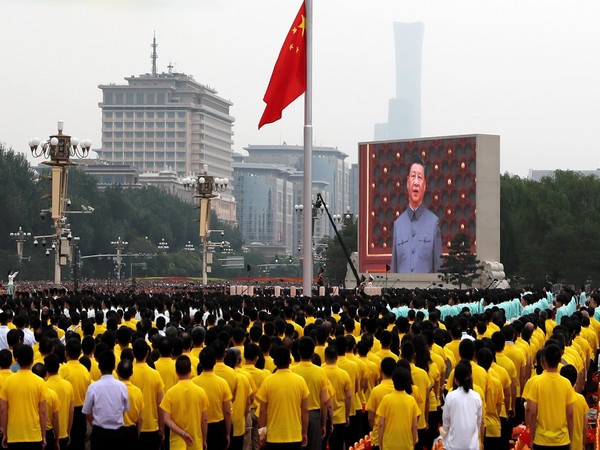

Hong Kong, August 23 (ANI): China's tight government control over the media and internet, and its ability to muzzle free speech, is legendary. One problem is that Beijing is not content silencing all voices bar its own at home, but it wants to spread the same distorted message all across the world.
The organization Reporters without Borders gives China a ranking of 175th out of 180 in its World Press Freedom Index 2022. Only Myanmar, Turkmenistan, Iran, Eritrea and North Korea rank lower.
In a visit to three state-run media outlets in 2016, Chairman Xi Jinping famously demanded that editors and reporters show loyalty to the Chinese Communist Party (CCP). "The media run by the party and the government are the propaganda fronts and must have the party as their family name ... All the work by the party's media must reflect the party's will, safeguard the party's authority and safeguard the party's unity. They must love the party, protect the party and closely align themselves with the party leadership in thought, politics and action."
In other words, the media's role is not, to tell the truth, or expose errors, but merely to parrot whatever will keep the CCP in power. This is why Chinese state media cannot ever be trusted, for their fealty is sole to the CCP.
China's paranoia over information is reflected in the CCP's Propaganda Department. Indeed, Sun Yeli, Vice Minister of this department, had some advice for Hollywood this month. He declared, "We hope the quality of American films can continue to be improved on the basis of respecting our culture, customs and audience behaviours."
Sun added, "We will import from whichever countries that make better films, and films that are more suitable for the taste of the Chinese audience." The last clause is better translated as "more suitable for the taste of the CCP".
Sun's message was clear - Hollywood can either submit to CCP propaganda sensibilities or wave goodbye to the Chinese market. In 2021, Hollywood's share of the Chinese film market slumped to a record low, with just 28 American films released. This compared with 50 in 2019, as Xi reduces Western influence over his shackled China. CCP control over Chinese media is absolute, and woe betides anybody who fails to toe the party line. Presently, 108 journalists are imprisoned there, the greatest number of any country. Reporters without Borders also noted that Hong Kong dropped a stunning 68 places in 2022 to have the 148th worst press freedom in the world.
The organization stated: "In the eyes of the regime, the media's function is to be the party's mouthpiece and to impart state propaganda. Independent journalists and bloggers who dare to report 'sensitive' information are often placed under surveillance, harassed, detained and in some cases tortured. To receive and renew their press cards, journalists must download the Study Xi, Strengthen the Country propaganda application that can collect their personal data."
China's constitution guarantees "freedom of speech [and] of the press", but such promises are laughable. Acting with impunity, China accuses journalists of espionage, subversion or picking quarrels and provoking trouble to silence them.
Furthermore, Reporters without Borders noted: "Independent journalists can be legally placed in solitary confinement for six months under Residential Surveillance at a Designated Location in China's 'black prisons', where they are deprived of legal representation and may be subjected to torture."
It concluded: "President Xi Jinping, in power since 2013, has restored a media culture worthy of the Maoist era, in which freely accessing information has become a crime, and to provide information about an even greater crime. China's state and privately owned media are under the communist party's ever-tighter control, while the administration creates more and more obstacles for foreign reporters."
This type of control allows the CCP to direct public opinion and glorify the state. During the recent spat with Taiwan over US House Speaker Nancy Pelosi's visit, for example, China manipulated the People's Liberation Army's (PLA) unprecedented joint exercises as part of a mass disinformation campaign.
One example was the imagery of a fake PLA Air Force mission, concocted by the PLA's "media fusion centre" on 15 August and distributed by Xinhua. The faked image showed an aircraft supposedly near the Taiwanese island of Penghu in the middle of the Taiwan Strait. Similarly, another image supposedly shows a PLA warship sailing close to Taiwan was clearly photoshopped. Such signalling, called "cognitive warfare", is designed to encourage an opponent to give up rather than fight.
Or what about China's internet, hemmed in by the Great Firewall?
Since the beginning of his reign, Xi has promoted propaganda and doubled down on censorship. At his very first Propaganda and Ideological Work Conference in 2013, Xi stressed the critical nature of the "public opinion struggle" and "telling Chinese stories well". Xi enunciated "seven baselines", the foundation of Chinese censorship, at that time.
The next important move came in 2015 when Xi cancelled foreign VPNs, and universities were required to recruit "network civilization volunteers". Their numbers exploded by hundreds of thousands, creating a paid part-time internet army estimated today at 20 million strong, plus two million professional internet commentators employed directly by the Cyberspace Administration of China (CAC). Many "volunteers" are university students or members of the Communist Youth League.
Prior to 2018, a variety of government and CCP offices were responsible for patrolling the internet. This was inefficient, so a reorganization occurred and the CAC and Network Security Bureaus (departments within the Public Security Bureau) took up the mantle. The former "organizes the ecological governance of online public opinion" and "coordinates the disposal of harmful online information". It manages local branches and state-owned media to monitor the spread of information, plus it employs the so-called "50 Cent Party" of internet trolls to "guide the trend of public opinion" both inside and outside China.
Network Security Bureaus dish out punishments for breaches by netizens, and its officers can issue warnings via direct messages. The Orwellian CAC warns: "The cyber police are right by your side. The eyes of the supervisor are watching you. You will tighten a string, and you will have the necessary scruples. You will exercise restraint and rationality when you post and write messages."
Lu Wei, the CAC chief from 2013-16, was imprisoned for corruption in 2019. The state described him as "tyrannical" and "shameless", and Xi placed his own close associate Zhuang Rongwen over the CAC in 2018. In November that year, Zhuang invited WeChat and Sina Weibo executives to discuss how social media giants were undermining censorship in China. He scathingly accused them of "breeding chaos in the media" and "endangering social stability and the interests of the masses".
This marked a significant milestone in censorship in China. It was already tight, but from that point on, it became even worse for China's 900 million netizens. Interestingly, Chinese party offices spent more than USD6.6 billion to monitor and guide public opinion online in 2020 alone. However, Ryan Fedasiuk, a research analyst at Georgetown University's Center for Security and Emerging Technology believes the number is closer to USD13 billion when purchasing power parity is taken into account.
Fedasiuk, in an article for The Jamestown Foundation think-tank in the USA, noted: "Broadly speaking, the party's censorship activities fall into one of two categories: first, silencing netizens that stand against its interests - including 'democracy activists', 'rights lawyers' and 'dissidents' at home and abroad - and second, generating noise to crowd out online discussions of sensitive topics."
The CAC pays money to social media sentiment analysis companies, trains internet trolls and pays the salaries of system administrators and web content moderators. Remembering that China has 1.4 billion citizens, wiping the internet clean every day is an exacting task. In 2020, CAC accepted 138 million plus reports of "illegal and bad information," mostly on Sina Weibo and Baidu. A large part of this is spam, but there is considerable political censorship too.
China's Public Security Bureau created the "Golden Shield" in the 2000s, which permits the authorities to police the internet to the hilt. It was largely completed by 2008, but upgrades still continue.
Something of a global internet organization arms race is now occurring too. Just last month, Beijing attempted to alter global internet rules by announcing it would transform its annual World Internet Conference into a permanent organization for "global internet development and governance". This organization is part of Beijing's long-term strategic playbook and Xi faithful Zhuang of the CAC will be its first director.
Beijing claims 18 nations/regions are on board with Xi's proposal, including human rights luminaries like Afghanistan, Cambodia, North Korea and Syria. Xi is agitating for cyber sovereignty, giving governments unfettered control over all online activity (e.g. censorship and surveillance), with privacy and freedom of expression thrown out the door.
This "dictators 'r us" grouping will have limited appeal, but China has been fighting for years to wrest control of the International Telecommunications Union, the United Nations agency for information and communications technology. Its Chinese-born Secretary-General Zhao Houlin is championing Huawei technology, which would help China manipulate the internet and 5G.
Of concern are foreign "helpful idiots" who subscribe to China's view of the internet. Incidentally, billionaire Elon Musk had an opinion piece published in July's issue of China Cyberspace, the CAC's official magazine. In the first such piece ever penned by a foreigner, Musk called on "like-minded Chinese partners" to help him build a "future worth waiting for".
Musk must remember what the CAC is - primarily a censorship body designed to keep out foreign or non-CCP ideas, and to promote the party's narrative. There is absolutely no chance that this administration is going to change direction at Musk's or anyone else's request, so willing participants like Musk should be seen as consorting with the enemy. Furthermore, Musk claims to value freedom of speech and has criticized American policy on COVID. Yet in China, there is absolutely no freedom of speech, plus the government is positively Machiavellian when it comes to COVID restrictions. Musk, who argued that fighting against censorship was in his plans for Twitter, is here cooperating with one of the world's worst perpetrators of censorship.
The average Chinese person dares not say what they think, and they certainly cannot use
overseas forums like Twitter. Musk's actions, therefore, reek of hypocrisy.
China sees the internet as a battlefield that must be dominated if it is to win the global struggle for "image sovereignty". It is importing its chilling notions of censorship and propaganda. For instance, Prime Minister Manasseh Sogavare in the Solomon Islands is seeking to put restrictions on overseas journalists and to set up a state-run newspaper. He has also just signed a telecommunications deal with Huawei, is trying to delay national elections and is training police with Chinese instructors.
Nonetheless, China's propaganda messages in the West are often bumbling and misguided, even as it seeks to scrub indelible stains from its record - including its handling of COVID-19, its 2020 border confrontation with India, its aggressive bullying of Taiwan, and its incarceration of a million Uyghurs.
What might work well at home does not usually come across well to a global audience. Fedasiuk commented: "On the few occasions that the party has mobilized trolls to meddle non-foreign platforms, they have been thwarted - with disastrous consequences for its broader propaganda apparatus. Simply put, by starting to swing around its bully pulpit, the CCP has spurred foreign social media platforms - already on guard against domestic and foreign disinformation campaigns - to respond forcefully, hurting the Chinese state's global reputation and its ability to 'tell Chinese stories well'."
However, China's ham-fisted propaganda efforts abroad are improving and evolving. This can be seen in overt propaganda tones being replaced with storytelling, in attempts to subtly change foreigners' perceptions of China.
Unfortunately, successful CCP propaganda at home means that narrow-minded nationalism is rampant in China, plus it exhibits disdain and superciliousness towards smaller countries. Some have described it as having "an immature sense of national greatness", thanks in large part to its own propaganda. (ANI)


