Pakistan govt pressurising Hindus to convert for jobs
Islamabad [Pakistan], August 5 (ANI): Hindus in Pakistan, who are being treated as second-class citizens in the country since 1947, are now forced by the Imran Khan government to convert for employment.
ANI
Aug 05, 2020 19:48 IST

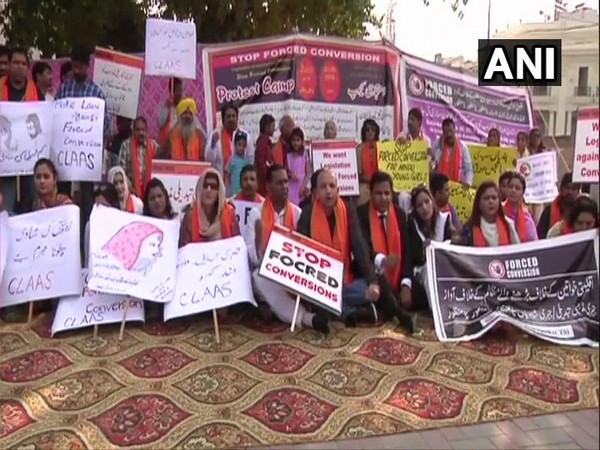
Islamabad [Pakistan], August 5 (ANI): Hindus in Pakistan, who are being treated as second-class citizens in the country since 1947, are now forced by the Imran Khan government to convert for employment.
This reflects the grim scenario of the minorities including Hindus in Pakistan as they continue to face systematic discrimination for years. Several incidents of forced conversions and marriages of minors and women and vandalisation of places of worships of minority communities have come to light in the country. Earlier in June, a large number of Hindu families were converted in Badin district of Sindh province.
"What we are seeking is social status, nothing else," Muhammad Aslam Sheikh was quoted by The New York Times as saying. Sheikh's real name was Sawan Bheel till June, when he was converted along with his family in Badin.
Notably, over 100 people were converted in a ceremony in Badin. "These conversions are becoming very common in poor Hindu communities," Sheikh said.
Even as Pakistan's teetering economy is on the verge of collapse in the wake of the COVID-19 pandemic, the pressures on the country's minority communities, especially those from the economically weaker backgrounds, have increased.
According to the World Bank, the economy will contract by 1.3 per cent in 2020 fiscal year due to the pandemic and 18 million of Pakistan's 74 million jobs could be lost.
When Pakistan achieved independence, Hindus comprised 20.5 per cent of the population. In the next few decades, the percentage dipped alarmingly and rapidly. In 1998, the last Pakistani government census to categorise people based on religion, Hindus accounted for just 1.6 of the country's population.
Sindh province was known to be the place where minority communities used to coexist but people have fled to other countries due to discrimination, sectarian violence and the risk of being accused of blasphemy -- a capital crime -- if they speak out against the Islam.
"The dehumanisation of minorities coupled with these very scary times we are living in -- a weak economy and now the pandemic -- we may see a raft of people converting to Islam to stave off violence or hunger or just to live to see another day," said Farahnaz Ispahani, a former Pakistani lawmaker who is now a senior fellow at the Religious Freedom Institute, a research group based in Washington.
Recalling the 2010 floods in Sindh province that left thousands homeless, Ispahani said that Hindus were not allowed to sit with Muslims at soup kitchens. Even the Hindu community members received less government aid compared to their Muslim counterparts.
"Will they be converting with their hearts and souls? I don't think so," she was quoted as saying.
According to Ispahani and others, the further economic disturbance caused by the COVID-19 pandemic could lead to more sectarian violence, pressurising the minorities to convert.
"Overall, religious minorities do not feel safe in Pakistan. But poor Hindus are the most vulnerable among them. They are extremely poor and illiterate, and Muslim mosques, charities and traders exploit them easily and lure them to convert to Islam. A lot of money is involved in it," said Lal Chand Mahli, a Pakistani Hindu lawmaker of the ruling Pakistan Tehreek-e-Insaf (PTI), and is also a member of a parliamentary committee to protect minorities from forced conversions.
Last year, Muhammad Ali -- who was earlier known by his Hindu name Rajesh, and his family decided to convert to Islam when a cleric named Muhammad Naeem offered to free them from the clutches of bonded labour which they were trapped and were living and working as servants due to unpaid debt, according to The New York Times.
Ali is originally from the Bheel caste, one of the lowest in Hinduism.
Bonded labour was banned in Pakistan in 1992, but the practice is still rampant. Lower-caste Pakistani Hindus are often victims of bonded labour. According to the Global Slavery Index, more than three million Pakistanis live in debt servitude.
Pakistan has been repeatedly slammed by the international community for not taking stringent measures to protect its minority communities, despite the country's Prime Minister Imran Khan vowing to protect them on numerous occasions.
In the pretext of providing minority families with a well-off and dignified life, landlords trap them into such bondage by providing loans that they know cannot be repaid. Hindus and their families are often forced to work off the debt and women are sexually abused, as per rights groups. (ANI)
Get the App