 हिंदी खबर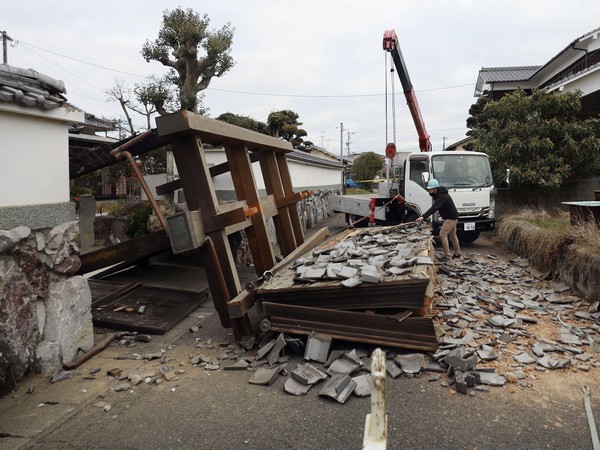

Tokyo [Japan], April 1 (ANI): The earthquake that struck the Noto Peninsula in Japan on New Year's Day is still affecting thousands of individuals, as over 8,000 individuals continue to live in evacuation centres, according to The Japan Times.
The thousands of individuals living in evacuation centres have prompted experts to question why lessons from past disasters haven't been learned.
Despite the introduction of cardboard beds, the initial scene of individuals sleeping huddled on gymnasium floors has persisted.
Kazuhiko Hanzawa, a specially appointed professor of cardiovascular surgery at Niigata University and executive director of the Association for Evacuation Shelters and Evacuation Living, expressed distress at encountering clusters of evacuees sleeping on the floor.
"Nothing has changed from 20 years ago," said Hanzawa, who visited evacuation sites across Ishikawa Prefecture, including those in Wajima, in January.
While some areas swiftly adopted cardboard bedding within two weeks of the quake, others lagged behind, leaving shelters deprived of adequate provisions well into March, The Japan Times reported.
Hanzawa further stressed the urgency for local authorities to swiftly establish essential amenities such as toilets, kitchens and bedding within 48 hours of a disaster.
"The earthquake has exposed the problem of not stockpiling supplies, as deliveries of supplies stagnated due to roads being cut off," he said.
Hanzawa said that since evacuation shelters are operated by municipalities, the quality of disaster relief varies depending on the strength of each local government.
Moreover, he underscored the need for Japan to overhaul its disaster-response framework, advocating for a centralised ministry dedicated to disaster management to preemptively address seismic risks lurking beneath Tokyo or the Nankai Trough, reported The Japan Times.
Meanwhile, only about 21,000 of the 34,000 people who evacuated after the earthquake have been identified.
According to an official in charge, processing handwritten documents submitted by each evacuee, is the only way to collect information from them, which is a challenge in itself.
Shigeki Yamanaka, an adviser at Kwansei Gakuin University's Institute of Disaster Area Revitalization, Regrowth and Governance who is well-versed in disaster recovery, said the biggest failure was that secondary evacuation had not been made by each community, according to The Japan Times.
He said temporary housing should have been built for each district, as in the case when the 2004 Chuetsu earthquake struck. The entire community of the village of Yamakoshi was evacuated to the city of Nagaoka.
"There is a danger that fewer people will return (to their original places of residence), and depopulation will quickly accelerate," he said.
He also said that it would be difficult to identify disaster-related deaths if evacuees are not identified and support for them is cut off.
"We need to ask for the cooperation of nonprofit organisations and other groups this time too," he said.
"As we navigate this crisis, it's imperative to heed the lessons of history," he added.
On January 1, the earthquake that struck Japan was centred around 30 kilometres east-northeast of Wajima with a provisional depth of 16 km and registered the highest level of 7 on Japan's seismic intensity scale, according to the agency.
A level-7 quake is described as making it impossible for people to stand. (ANI)




