Nobody was expected to blink when US State Secy Blinken met Chinese President Xi
The meeting itself lasted 35 minutes, enough time for the shutterbugs to record the handshake and both leaders to articulate diplomatic inanities.
ANI
Jun 19, 2023 23:57 IST

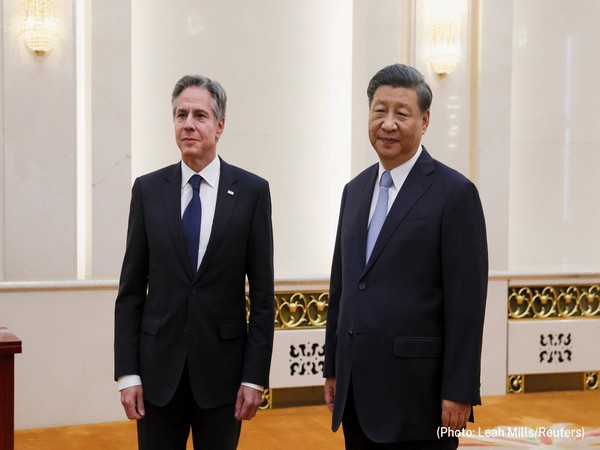
Beijing [China], June 19 (ANI): Summits happen between equals. Only summits succeed or fail. Antony Blinken is only US Secretary of State. Nothing much was expected out of his meeting with Chinese President Xi Jinping in Beijing. That the meeting came about at all is news.
Such is the antagonism between the two countries that till the last minute neither side confirmed the meeting would happen. The US State Department made it official with just an hour to go.
The meeting itself lasted 35 minutes, enough time for the shutterbugs to record the handshake and both leaders to articulate diplomatic inanities.
Xi was heard saying, "The two sides have agreed to follow through on the common understandings President Biden and I have reached in Bali."
If Antony Blinken said anything, it was not available in the Chinese recording. But he was seen saying something to the Chinese President.
Diplomatic logic says there cannot be a higher-level meeting after this. Only the Summit remains. Is this a step-by-step close-in to a possible meeting between Xi and US President Joe Biden? Speculative.
The fact is, the meeting will at best ensure that either side commits no irreversible mistake for some time in the future and keeps channels of communication open despite open hostility.
Officially, they claim to be in the process of reducing the risk of misperception and miscalculation, but there is no indication that things are starting to turn around.
Blinken met other Chinese leaders as well in Beijing, but no side showed any inclination to loosen their hardened positions on disagreements over a range of issues. The issues are many.
To recall the major ones, the issues include the tariff and trade war, Taiwan, human rights conditions in China and Hong Kong, Chinese military assertiveness in the South China Sea, and Russia's war in Ukraine.
In the opening round of talks, Blinken met for nearly six hours with Chinese Foreign Minister Qin Gang after which both countries said they had agreed to continue high-level discussions. However, there was no sign that any of the most fractious issues between them were closer to resolution.
The Chinese state media said Qin Gang pointed out that the Taiwan question is at the core of China's core interests, it is the most significant issue in China-US relations, and it is also the most prominent risk. China has been urging the US side to adhere to the one-China principle and the three China-US Joint Communiques, and truly implement its commitment not to support "Taiwan independence".
Blinken then met China's top diplomat Wang Yi for about three hours. The US State Department said Blinken "underscored the importance of responsibly managing the competition between the United States and the PRC through open channels of communication to ensure competition does not veer into conflict."
China's Ministry of Foreign Affairs in a statement wrote that Blinken's visit "coincides with a critical juncture in China-US relations and it is necessary to make a choice between dialogue or confrontation, cooperation or conflict," and blamed the "US side's erroneous perception of China, leading to incorrect policies towards China" for the current "low point" in relations.
Blinken's exchanges with the two Chinese officials makes it clear that achieving something tangible was not on the agenda. It was an effort by both sides to keep stirring the pot and not allow anything to spill out.
For instance, the American side reportedly invited Qin to the US which the latter accepted but not before Beijing made it clear - and the Americans echoed the sentiment - that "the China-US relationship is at the lowest point since its establishment".
The Blinken visit comes after so much preparation. The initial schedule in February was deferred after the Americans shot down a Chinese "surveillance balloon" over US territory. Had the meeting still taken place and Xi snubbed the American, the freeze in ties would have been complete. Both sides did not want that.
So, efforts were made to keep the channels of communication open. CIA chief William Burns visited China in May. China sent its Commerce Minister to the US. Biden's national security adviser Jake Sullivan called on Chinese foreign policy adviser Wang Yi in Vienna in May.
Even as the meetings took place, neither side stopped the exchange of angry rhetoric from both countries over the Taiwan Strait, their broader intentions in the Indo-Pacific, China's refusal to condemn Russia for its war against Ukraine, and US allegations from Washington that Beijing is attempting to boost its worldwide surveillance capabilities, including in Cuba.
Earlier this month, the Chinese Defence Minister rebuffed a request from US Defense Secretary Lloyd Austin for a meeting on the sidelines of a security symposium in Singapore, a sign of continuing discontent.
Just before Blinken travelled to Beijing, US President Joe Biden said he hoped to be able to meet President Xi in the coming months to take up the plethora of differences that divide them.
Judging by the reactions of both sides after the Blinken-Xi meeting, the agenda for a possible Summit is being set and the issues and stands are being outlined already.
The Chinese hope that the US will have an objective and rational understanding of China, walk towards China, maintain the political foundation of China-US relations, and "calmly, professionally, and rationally handle unexpected incidents".
As Wang stated, they expect the US not to assume China was seeking dominance, and not to "misjudge" Beijing based on the trajectories of traditional Western powers. "This is key as to whether the US policy towards China can truly return to objectivity and rationality," Wang said.
On Taiwan, Wang stressed that safeguarding its national unity would always be at the core of China's core interests, and that there was "no room for compromise". Qin also warned that Taiwan was "the core of China's core interests", and that it presented the "most prominent risk" for ties between the two countries.
The American side has a single-point agenda that it openly declared, the Secretary made clear that the United States will always stand up for the interests and values of the American people and work with its allies and partners to advance our vision for a world that is free, open, and upholds the international rules-based order. (ANI)
Tags:
Get the App